
AI Humanoids: The Industrial Revolution of 2027 Underway
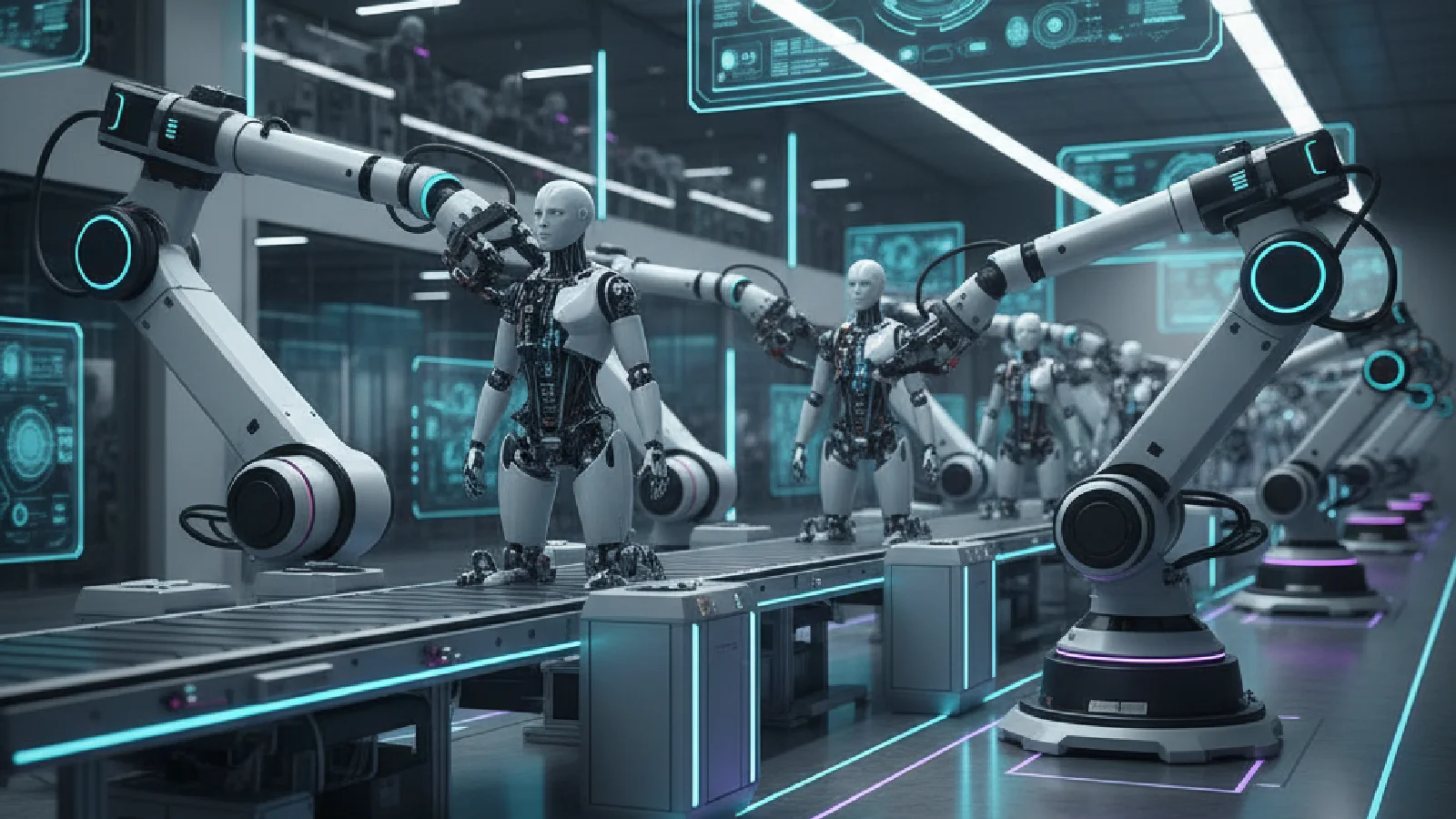
The global industry is witnessing a silent but decisive transformation: the arrival of AI-powered humanoid robots on production lines. Far from science fiction fantasies, these machines are adopting a pragmatic approach by targeting specific tasks where their versatility can compensate for the limitations of traditional industrial robots.
Early pilot deployments reveal a clear industrial strategy: leveraging humanoid flexibility for complex operations while benefiting from robotic precision and resilience. This discreet revolution could redefine production standards by 2027.
Promising Pilot Deployments
Pilot projects for humanoid robots are multiplying across various industries, marking a transition towards broader adoption. Innovative startups like Mimic Robotics, a spin-off from ETH Zurich, are developing robotic hands with 21 joints and 0.5-millimeter precision. These systems are already being tested on consumer goods manufacturing lines and at Fortune 500 automotive manufacturers. Notably, 2023 saw a spectacular leap, with the experimentation of technologies like those developed by IBM in robotics.
Meanwhile, Agility Robotics and other suppliers are deploying their humanoid platforms for parts assembly, including wheel mounting in Chinese factories. These concrete applications demonstrate that the technology has now moved beyond the experimental stage and that humanoid robots are the next AI revolution.
Targeted Industrial Applications
Initial use cases focus on tasks where human dexterity is essential but where traditional automation fails:
- Precision assembly: handling fragile or complex-shaped objects
- Internal logistics: transport and sorting in variable environments
- Visual inspection: quality control requiring three-dimensional mobility
- Preventive maintenance: interventions in confined spaces
These applications particularly target repetitive, arduous, or dangerous tasks where human flexibility is required but where robotic strength and precision offer a tangible competitive advantage.
The Challenge of the AI "Brain"
Despite impressive hardware advancements, the main obstacle remains the artificial intelligence that powers these robots. The AI "brain" still needs to make significant progress in logical reasoning, real-time decision-making, and safe interaction with human workers.
Current AI models, while effective for specific tasks, struggle to manage the unpredictability of the industrial environment. Contextual adaptability, essential for seamless integration into existing processes, requires further development.
"The manual dexterity of humanoids has made enormous progress this year. These developments reflect the convergence of advanced hardware designs and sophisticated AI learning techniques."
This limitation explains why current deployments remain confined to controlled environments and standardized tasks. The challenge for 2025-2027 will be to develop more robust AIs capable of handling real industrial variability.
| AI Characteristic | Overcoming Current Limitations |
|---|---|
| Logical Reasoning | Improved real-time decision-making |
| Decision-making | Managing industrial unpredictability |
| Interaction | Contextual interpretation and adaptation |
Obstacles to Mass Production
Technical and Economic Challenges
The transition to widespread adoption faces several major obstacles. The cost of these systems remains prohibitive for many companies, despite gradual price reductions due to economies of scale and optimization of basic components.
Mass production also poses significant logistical challenges. Manufacturers must balance growing demand with limited production capacities, particularly for critical components such as high-performance servomotors and precision sensors.
Certification and Safety
Safety certification is a crucial issue for the industry. Humanoid robots, designed to operate alongside workers, must meet strict safety standards that did not exist for traditional industrial robots isolated behind barriers. It is essential to establish strict standards for humanoid robots in Europe.
This regulatory issue slows down deployments and requires close collaboration between manufacturers, standardization bodies, and regulatory authorities to establish appropriate standards.
Adoption Outlook 2025-2027
Market forecasts reveal a spectacular growth trajectory. According to the latest analyses, over 10,000 humanoid robot units will be shipped by 2027, progressing to 38,000 units by 2030, marking a compound annual growth rate of 83% for the period 2024-2030.
This exponential growth is based on several converging factors:
- Technological maturation: improvement of AI algorithms and hardware components
- Cost reduction: economies of scale and optimization of manufacturing processes
- Competitive pressure: need for automation to maintain competitiveness
Return on Investment
Initial industrial use cases are beginning to demonstrate a sufficient return on investment to justify adoption. Automating labor-intensive tasks, combined with improved quality and productivity, generates measurable operational gains.
For a typical assembly deployment, companies observe a 15 to 25% reduction in direct labor costs, accompanied by a 10 to 15% improvement in finished product quality. These performances, while modest, are sufficient to initiate adoption in highly competitive sectors.
Social Acceptance Challenges
Social acceptance is a major challenge often underestimated by technology developers. The introduction of humanoid robots into the workplace raises legitimate concerns among employees regarding the evolution of their jobs and working conditions.
Pioneering companies are developing specific change management strategies, including team training, job redefinition, and valuing human skills that complement robotic capabilities.
This human dimension will be crucial for the success of large-scale deployments. Organizations that neglect social support risk seeing their technological investments compromised by internal resistance.
Continuous Innovation and Ecosystem
The humanoid robotics innovation ecosystem is experiencing remarkable effervescence. Specialized startups are on track to raise nearly $7.5 billion by the end of 2024, according to industry data. This massive capital injection accelerates the development of increasingly powerful solutions.
Tech giants like Google, Tesla, and Boston Dynamics continue their massive investments in fundamental research, contributing to the emergence of new generations of more autonomous and versatile robots. This technological emulation benefits the entire industrial sector.
Increasing integration with conversational AI solutions like Claude opens new perspectives for natural interaction between humans and robots, facilitating adoption and daily use, in addition to the issues raised by digital marketing 2026.
Conclusion
The AI humanoid revolution in industry is beginning quietly but surely. Current pilot deployments, though still limited, demonstrate the transformative potential of this technology to automate tasks previously reserved for humans.
Significant challenges remain, from perfecting AI to managing social acceptance, and industrializing production processes. Nevertheless, the convergence of technological advancements, massive investments, and growing industrial needs paints a promising horizon for 2025-2027.
This gradual transition towards the integration of advanced AIs like GPT-5 into humanoid robotic systems could catalyze faster-than-expected adoption, fundamentally transforming industrial production models.