CVC vs Traditional VC: Investment Strategies in 2026

When Maersk announced its complete withdrawal from Corporate Venture Capital to prioritize direct operational partnerships, this strategic shift revealed a tension running through the entire innovation ecosystem: how can large companies and investment funds truly stimulate value creation amidst current economic turmoil?
The landscape of innovation financing has been profoundly reshaped since 2020. On one side, Corporate Venture Capital (CVC) mobilizes industrial capital to capture disruptive technologies. On the other, traditional venture capital funds (VC) maintain their agility and their quest for maximum financial profitability. Each model presents its strengths, vulnerabilities, and its own response to the macroeconomic challenges that are redefining the rules of the game.
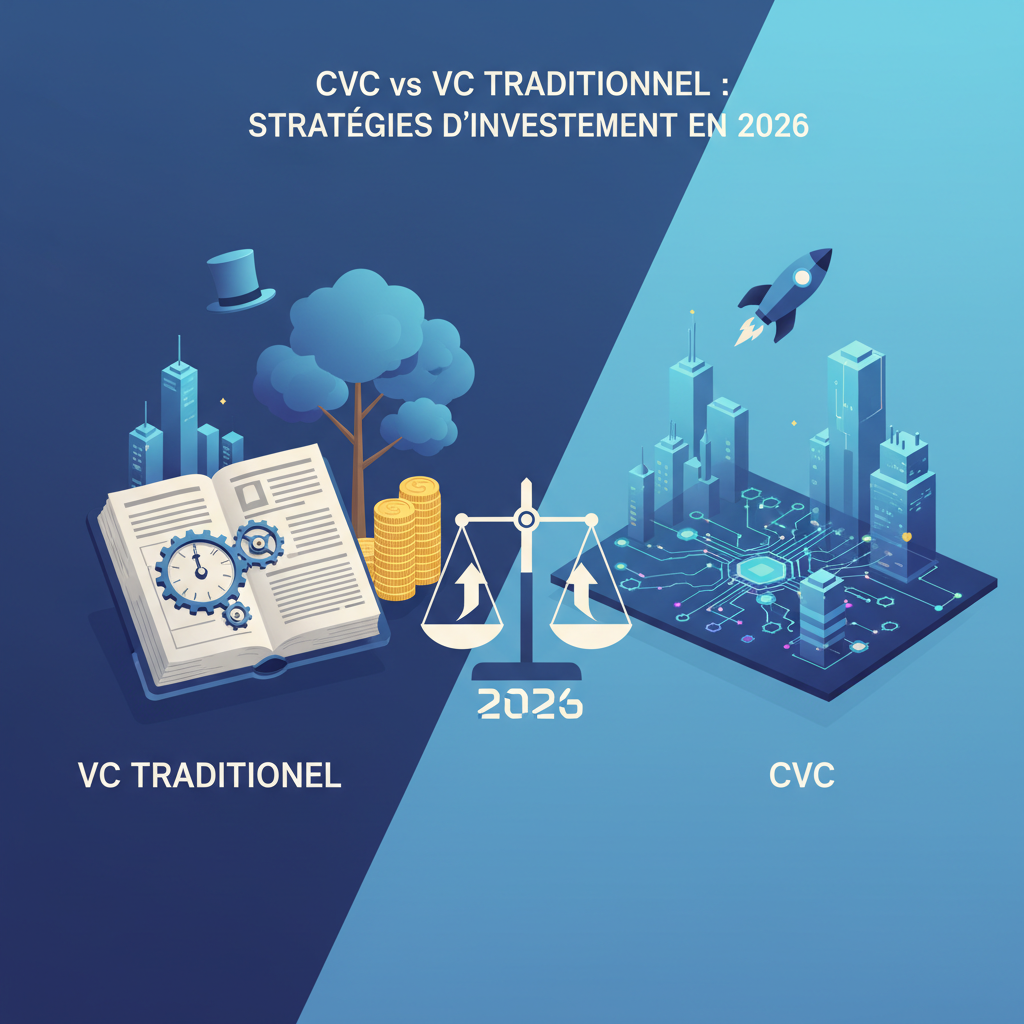
The Fundamentals: Two Logics, Two DNAs
CVCs and traditional VCs share common ground – capital investment in high-potential companies – but their motivations diverge radically.
Corporate Venture Capital operates on a dual objective logic: to achieve a financial return, certainly, but above all to secure privileged access to strategic innovations, ensure continuous technological watch, and develop operational synergies with their parent company. As explained in the white paper on corporate venture by France Invest, large groups mobilize their own resources to create dedicated investment envelopes – like Orange Digital Ventures and its 100 million euros focused on the strategic axes of the Essentiels2020 plan.
Conversely, traditional VCs adopt a purely financial approach: they raise funds from institutional or private limited partners, select early-stage or growth-phase startups, and then seek to maximize the internal rate of return (IRR) through lucrative exits (IPO, acquisition). This organizational autonomy allows them to make quick decisions, impose standardized terms, and co-invest with other market players without being constrained by corporate priorities.
“Is corporate venture an oxymoron, a 'contradiction in terms'? Can the risk-taking associated with early-stage investment be reconciled with the need for security that characterizes large groups?” – France Invest
Investment Strategies in the Face of Economic Challenges
The current macroeconomic context – marked by persistent inflation, normalized interest rates after a decade of ultra-accommodative monetary policy, and increased asset correlation – is reshuffling the investment deck. Traditional VCs are facing increasing pressure on their fundraising and must rationalize their portfolios, prioritizing financial discipline and immediate scalability.
CVCs, on the other hand, benefit from a certain resilience thanks to their internal resources. They can accept higher valuations to secure strategic advantages – a phenomenon that sometimes contributes to entry price inflation and alters negotiation dynamics. According to recent academic research, this ability to support multiple investment cycles and operationally integrate acquired technologies constitutes a differentiating asset in tight market phases.
But this flexibility has a downside: if the priority remains simple strategic visibility without true integration, the real impact on innovation can be limited. It is precisely this risk that pushes some corporates, like Maersk, to shift towards venture clienting – a model where the company becomes a client of the startup rather than an investor, thus prioritizing immediate return on investment and rapid production.

Impact on Innovation: Complementarity or Competition?
Does the entrepreneurial ecosystem benefit more from CVCs or traditional VCs? The answer is not binary.
CVCs amplify innovation by offering startups:
- Access to industrial synergies (distribution channels, customer bases, infrastructure)
- Business expertise and valuable field feedback
- Possibilities for multi-cycle follow-up, reducing the risk of financial discontinuity
This approach can accelerate the market launch of disruptive solutions, as demonstrated by Orange in supporting promising companies in telecoms, IoT, and digital services. Nevertheless, startups sometimes fear potential conflicts of interest – especially when the corporate investor becomes a competitor or imposes restrictive governance clauses.
For their part, traditional VCs stimulate value creation by promoting:
- Rapid scalability and international expansion
- Strict financial discipline, performance-oriented
- The dissemination of market practices (standardized terms, smart-money, co-investor network)
This model favors the emergence of unicorns and hypergrowth scale-ups, as highlighted in our analysis on the pitfalls of illusory valuation. But it can also generate excessive pressure on founding teams, prioritizing growth at all costs to the detriment of profitability or social impact.
In reality, the two models complement each other: CVCs provide strategic depth and operational resources, while traditional VCs ensure agility and financial efficiency. The most mature startups often articulate both approaches in their successive funding rounds.
| Characteristic | CVC (Corporate Venture Capital) | VC (Venture Capital) Traditional |
|---|---|---|
| Main Objective | Financial return + Strategic access / Synergies | Maximum financial return (IRR) |
| Source of Funds | Industrial capital (parent company) | Institutional/private Limited Partners |
| Main Motivation | Technology watch, access to innovations, operational synergies | Financial profitability, lucrative exit (IPO, acquisition) |
| Decision-making | Potentially influenced by corporate priorities | Purely financial, fast, and autonomous |
The Evolution of Practices: Hybridization and Convergence
In the face of economic uncertainties, the boundaries between CVC and VC are gradually blurring. Corporate venturers are increasingly adopting classic VC practices – rapid decisions, standardized terms, co-investments with pure-players – to remain attractive to entrepreneurs. Simultaneously, some traditional VCs are developing thematic sectoral funds that align with the strategic logic of CVCs.
This hybridization reflects a growing maturity of the ecosystem. As Mandalore Partners reveals in its analysis of venture clienting, corporates are no longer content with merely taking stakes: they are testing operational collaboration models (POCs, pilots, commercial contracts) to validate technological suitability before any massive investment. Further research on emerging approaches to innovation financing corroborates this transition towards more flexible and adapted models.
This cautious approach resonates with the strategic thinking we explored in our article on why not selling becomes strategic. In a volatile environment, long-term value creation sometimes takes precedence over quick exits.
Regulatory and Governance Issues
The fiscal and regulatory framework plays a decisive role in structuring venture capital funds. In France, the JEI (Young Innovative Company) scheme, tax exemption mechanisms for VC fund investors, and recent reforms on capital gains taxation have shaped the sector's attractiveness.
But CVCs operate within a more complex legal framework, subject to accounting consolidation rules, governance constraints, and sometimes specific sectoral regulations (finance, telecoms, health). This regulatory asymmetry can create competitive distortions and influence capital allocation choices.
Industry players advocate for European harmonization that would facilitate cross-border co-investments and strengthen the ecosystem's competitiveness against American and Asian giants. Ongoing discussions around the European innovation fund and pan-European venture capital initiatives demonstrate this ambition.
Perspectives: What Coexistence in 2026 and Beyond?
By 2026, three scenarios emerge for the innovation financing ecosystem:
- The convergence scenario: CVCs and traditional VCs continue their hybridization, creating mixed investment vehicles that combine smart-money, strategic access, and financial discipline. Startups thus benefit from the best of both worlds.
- The specialization scenario: each model refocuses on its strengths – CVCs on disruptive innovation and industrial integration, VCs on scalability and lucrative exits. Startup funding trajectories are clearly segmented according to their maturity stage and business model.
- The disruption scenario: the emergence of new models (venture clienting, revenue-based financing, decentralized funding platforms) challenges the relevance of traditional structures and redistributes power within the ecosystem.
Whatever the evolution, one certainty remains: the ability of venture capital players – whether corporate or independent – to adapt to macroeconomic, technological, and regulatory transformations will determine their real impact on innovation and the competitiveness of entrepreneurial ecosystems.
FAQ (JSON format - translate question and answer fields only):