
Bitcoin Halving 2028: Miner Strategies Amid Cost Pressures

March 2028 is approaching, and with it, an event programmed into Bitcoin's very code: the fifth halving in its history. This deflationary mechanism, which halves the reward granted to miners every 210,000 blocks, does far more than just reinforce the digital asset's scarcity. It represents a major resilience test for the global mining industry, which faces an increasingly tight economic equation.
When the block subsidy drops from 3.125 BTC to 1.5625 BTC, operators will have to navigate an environment where every satoshi counts. Between the technological race for ultra-efficient ASICs, the quest for cheap electricity, and revenue diversification, the mining ecosystem is poised to cross a new threshold. This transformation occurs in a context radically different from previous cycles: one of unprecedented institutional maturity, where ETFs and regulations are redrawing the rules of the game.
The Mechanics of the 2028 Halving: Beyond Simple Division
The fundamental principle has remained unchanged since 2009: approximately every four years, the reward paid to miners for validating a new block is halved. In 2028, this reward will drop to 1.5625 BTC, continuing the programmed trajectory until 2140, by which time all 21 million bitcoins will have been mined. For more details on the halving schedule, consult Swan Bitcoin.
But this time, the context is radically different. According to Yellow.com, over 10% of Bitcoin's total supply is now held by institutions and ETFs, compared to less than 1% during the 2020 halving. This institutionalization transforms the halving from a mere speculative catalyst into a structural supply shock amplifier.
| Halving | Approximate Date | Block Reward | Scarcity |
|---|---|---|---|
| 1st | 2012 | 25 BTC | High |
| 4th | 2024 | 3.125 BTC | Very High |
| 5th | March 2028 | 1.5625 BTC | Maximal |
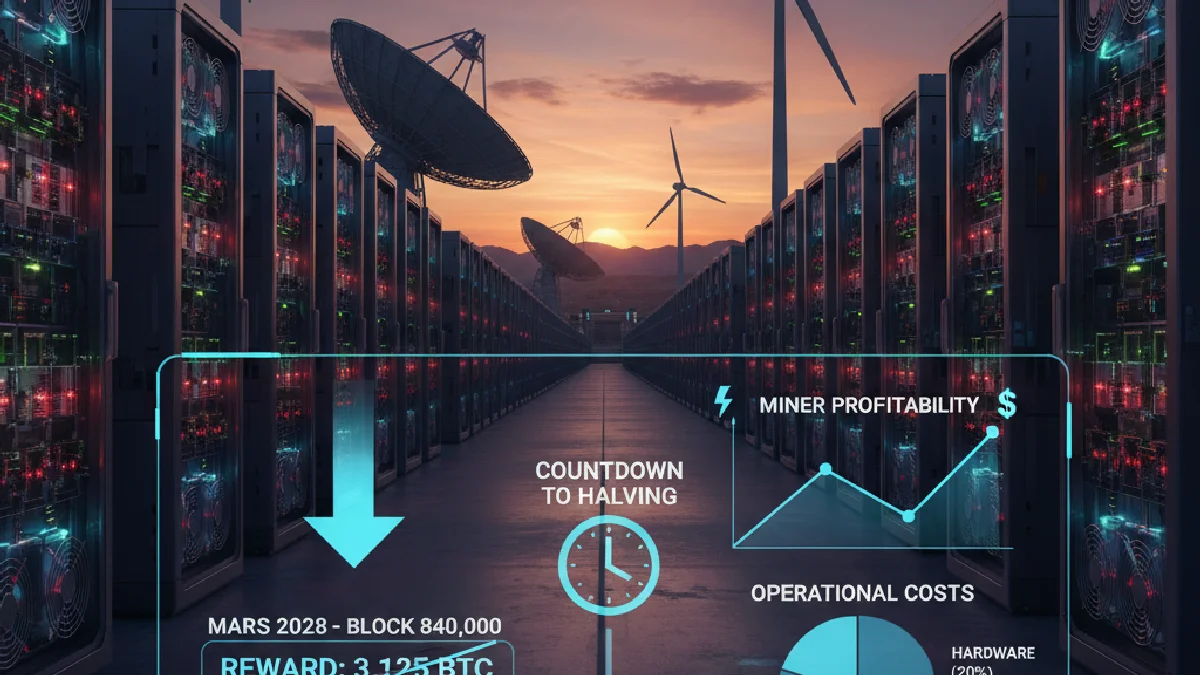
Pressure mechanically increases: with a halved reward, the cost of producing a bitcoin instantly doubles for operators. Only operations with state-of-the-art equipment and very competitively priced electricity will be able to maintain profitability. According to available analyses, the viability threshold could be around $0.06/kWh for farms equipped with recent hardware.
"The 2028 halving will occur in the most institutionally mature environment in cryptocurrency history, transforming this event into a supply shock amplifier rather than a mere speculative catalyst."
Technological Race: The New Generation of ASICs
Facing declining revenues, energy efficiency becomes the key to success. Miners must imperatively renew their equipment to survive beyond 2028. The next-generation ASICs, expected by 2027-2028, promise an efficiency of approximately 5 joules per terahash (J/TH), nearly a threefold improvement over the dominant models in 2025.
This race for technical performance accelerates a dynamic of industry consolidation. Small operators, unable to invest heavily in renewing their fleet, risk being forced out. Conversely, large publicly traded mining companies—who have access to capital markets—can raise funds to modernize their infrastructure and negotiate advantageous energy supply contracts.
Innovations are not limited to chips. Immersion cooling systems, modular architectures, and electrical load optimization software are proliferating. Some operators are even exploring hybrid models combining mining and participation in electricity grids via demand response mechanisms, transforming their farms into energy flexibility assets.
Energy Strategies: Renewables and Optimized Geography
The energy challenge extends far beyond the sole issue of costs. It is part of a global environmental debate where Bitcoin mining is regularly criticized. To remain competitive and socially acceptable, mining farms are massively turning to renewable energy sources: hydroelectric, solar, geothermal, and even associated natural gas (flaring).
This energy transition is accompanied by a geographical reconfiguration. Regions offering cheap and reliable electricity are becoming preferred destinations:
- Hydroelectric zones: Canada, Norway, certain regions of Latin America
- Solar projects: Texas, Middle East, Australia
- Geothermal: Iceland, El Salvador
The Fidelity Digital Assets report highlights that this geographical optimization is not just a matter of price: it integrates regulatory stability, grid reliability, and access to cooling infrastructure. Miners adopt a geographical portfolio management approach, diversifying their locations to mitigate risks.

Increasing integration with renewable energy producers creates new economic models. Some farms position themselves as "flexible loads," capable of reducing their consumption during periods of high demand and increasing it when production exceeds demand, thus contributing to grid balance.
Revenue Diversification: Transaction Fees Become Central
With the gradual reduction of the block subsidy, transaction fees are gaining importance in the miners' economic equation. Historically secondary, these fees could represent a growing share of total revenue after 2028.
Several factors fuel this trend. The rise of Ordinals—non-financial data inscriptions directly on the Bitcoin blockchain—has demonstrated that demand for block space exists beyond simple monetary transactions. Similarly, the development of second-layer solutions like the Lightning Network or emerging protocols generates anchoring transactions that pay fees.
According to Swan Bitcoin, miners are adapting their transaction selection strategies and optimizing block construction to maximize fee revenue. This optimization involves sophisticated algorithms that balance transaction size, proposed fees, and priority.
The question remains open: will fees be enough to offset the decline in rewards? Everything will depend on Bitcoin's adoption as a settlement network, the evolution of on-chain use cases, and developers' ability to create applications that generate demand for block space without compromising decentralization. For a broader macroeconomic analysis, you can consult our article on Bitcoin and global liquidity.
Industrial Consolidation and New Market Dynamics
The 2028 halving acts as a Darwinian filter for the mining industry. Inefficient operators, those who have not anticipated the technological transition or who depend on expensive electricity, risk bankruptcy or acquisition. This consolidation has been accelerating for several cycles, but 2028 could mark a decisive turning point.
Large publicly traded mining companies have structural advantages:
- Access to capital: ability to raise funds to invest in new equipment
- Negotiating power: bulk purchases of ASICs and preferential energy contracts
- Diversification: ability to explore ancillary revenues (HPC, AI, network services)
This concentration raises questions of centralization. If a few large operators control a significant portion of the hash rate, could Bitcoin's decentralized security be compromised? The debate remains lively within the community, with some seeing it as a natural evolution towards professionalization, others as a systemic risk. To delve deeper into Bitcoin's prospects, read our Bitcoin 2026 predictions.
In parallel, the emergence of new models like community mining or decentralized pools attempts to preserve a certain distribution of computing power. These initiatives, still marginal, could gain relevance if centralization concerns intensify.
Strategic Reserve Management and Selling Timing
Beyond operational efficiency, miners must intelligently manage their BTC reserves. Traditionally, many sold their bitcoins immediately to cover operating costs. But with market institutionalization and price volatility, more sophisticated management is required.
Some operators now adopt "HODL" strategies, retaining a portion of their production to benefit from potential price increases. Others use derivatives to hedge against volatility while maintaining BTC exposure. This approach transforms miners into asset managers as much as producers.
Post-halving financial pressure can also create market opportunities. Miners forced to liquidate their reserves to survive may temporarily depress prices, while those with cash can accumulate at a better cost. This dynamic between strong and weak players constantly reshapes the competitive landscape.
The timing of sales becomes a strategic art, influenced by macroeconomic expectations, regulatory cycles, and technological developments. The most sophisticated miners now integrate predictive models and on-chain analyses to optimize their decisions.
Prospects Beyond 2028: Towards a Post-Subsidy Model
The 2028 halving is just one step in the long transition towards an economic mining model entirely based on transaction fees. By 2140, when the last bitcoin is mined, miners will have to derive all their revenue from fees. This evolution raises fundamental questions about the network's long-term security. Galaxy provides insights into digital scarcity as a determining factor.
Academic research and community debates explore different scenarios. Some models suggest that a sufficiently high transaction volume will generate adequate fees to maintain an acceptable level of security. Others worry about a potential decrease in hash rate if revenues become insufficient, making the network more vulnerable to attacks.
Protocol improvement proposals regularly emerge. Some aim to optimize block space utilization, others to create new incentive mechanisms. However, any modification to the Bitcoin consensus requires broad agreement, which makes major evolutions complex and slow.
For miners, anticipating these transformations becomes crucial. Investing in research, participating in technical discussions, and developing a long-term strategic vision separate the survivors from the victims of future halvings. The ability to adapt and innovate will determine who prospers in tomorrow's Bitcoin economy.
Halving 2028: A Revealer of Maturity
The 2028 halving represents far more than a programmed technical event. It crystallizes the tensions between increasing scarcity and economic pressure on producers, between technological innovation and energy imperatives, between ideal decentralization and industrial realities.
Miners who successfully navigate this milestone will be those who have combined operational efficiency, sustainable energy strategy, and sophisticated financial management. This natural selection will shape a more mature mining ecosystem, capable of supporting the security of the Bitcoin network in a context of decreasing subsidies.
For crypto market observers, this halving offers a real-world laboratory where the economic mechanisms of a fully programmable monetary system are tested. The lessons learned from 2028 will illuminate not only the future of Bitcoin but also that of blockchain protocols seeking to balance security, decentralization, and economic viability.
FAQ (JSON format - translate question and answer fields only):