
Ethereum in 2026: Beyond Fusaka, What's Next?
The year 2026 is set to be a decisive one for Ethereum. Following the successful Fusaka update in December 2025, the network is preparing to reach new technological milestones. This major evolution, focused on improving data availability and reducing costs, paves the way for even deeper transformations.
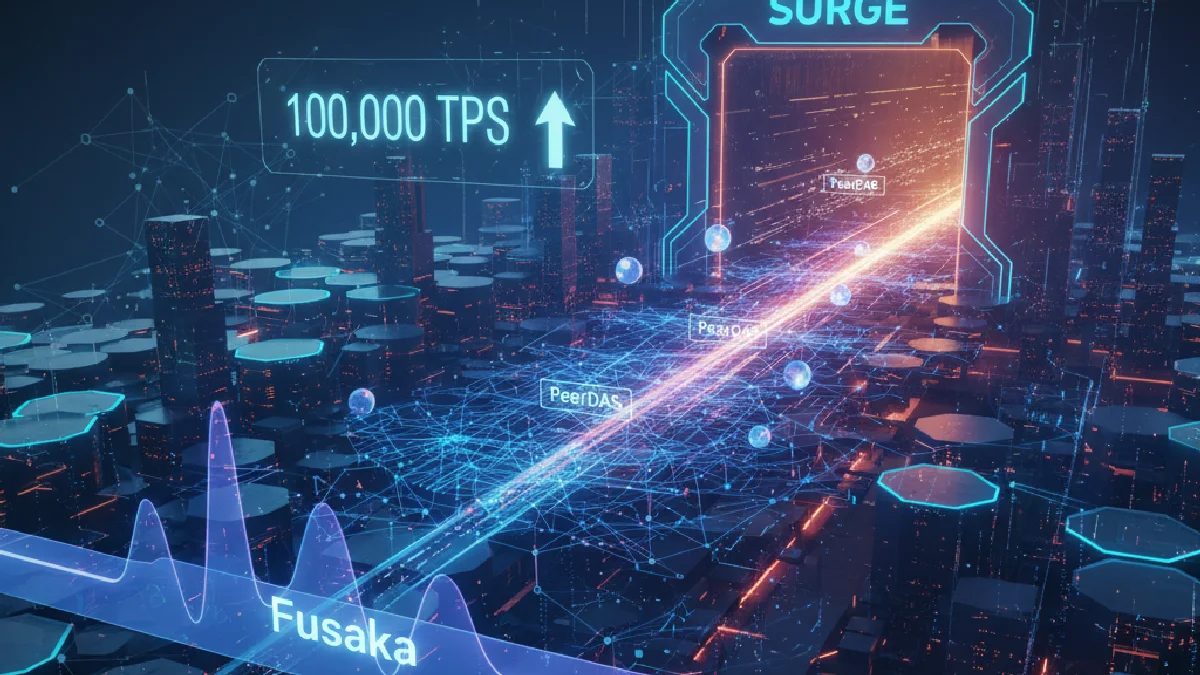
Fusaka marks the first milestone of the "Surge," an ambitious phase of Ethereum's roadmap aimed at multiplying processing capabilities. With the introduction of PeerDAS (Peer Data Availability Sampling) and a significant increase in the gas limit, the network can now envision a theoretical throughput exceeding 100,000 transactions per second at the ecosystem level.
Fusaka's Achievements: A Solid Foundation for the Future
The Fusaka update has profoundly transformed Ethereum's architecture. The increase in blob capacity represents one of the most significant advancements, offering 3.5 times more storage space for Layer 2 solution data. For a better understanding of this update, you can refer to this article on the Fusaka update.
This improvement translates into concrete benefits for users. Transaction fees on L2 roll-ups have dropped by 40 to 60%, making decentralized applications more accessible. The gas limit, raised to 60 million units per block, allows for smoother complex operations.
"Fusaka represents the first concrete step towards our goal of 100,000 TPS at the ecosystem level, without compromising decentralization." - Official Ethereum Documentation
The implementation of PeerDAS revolutionizes how validators manage data. Instead of downloading all information, they can now sample small fragments, significantly reducing computational load and infrastructure costs. For more details on the implications of this update, Stakely's article provides valuable information.
| Fusaka Feature | Key Impact |
|---|---|
| Blob Capacity | 3.5x more space for Layer 2 data |
| L2 Fees | 40-60% reduction on roll-ups |
| Gas Limit | Raised to 60 million units/block for smoother operations |
| PeerDAS | Reduced computational load for validators through sampling |
Glamsterdam: Optimization in Sight (Q1 2026)
The next major event is Glamsterdam, scheduled for the first quarter of 2026. This update aims for several crucial objectives for the network's evolution.
Optimizing the gas system is the primary priority. Developers are working on more sophisticated mechanisms to dynamically adjust fees based on network congestion. This approach should stabilize transaction costs even during peak activity.
Reducing block time is also on the agenda. Currently set at 12 seconds, this interval could be brought down to 8 seconds, significantly improving network responsiveness. This acceleration will particularly benefit applications requiring low latency.
Glamsterdam will also introduce reinforced measures against transaction censorship. Censorship resistance protocols will ensure that no entity can arbitrarily block certain operations, thus preserving Ethereum's permissionless nature.
Hegota: Towards Full Integration (H2 2026)
The second half of 2026 will be marked by Hegota, an even more ambitious update combining the "Verge" and "Purge" phases of the roadmap. This evolution touches upon the very foundations of Ethereum's architecture.
The integration of Verkle Trees is Hegota's flagship innovation. This technology allows for the creation of "stateless" clients, capable of validating transactions without storing the entire blockchain state. The benefits are manifold:
- Drastic reduction in necessary storage space
- Faster synchronization of new nodes
- Improved decentralization due to lower entry barriers
The implementation of EIP-4444 marks another revolution. This proposal allows for the "purging" of historical data, retaining only recent information necessary for network operation. Old data remains accessible via distributed networks but no longer clutters active nodes.
The 2027 Horizon: Danksharding and Quantum Resistance
Beyond 2026, the finalization of full Danksharding represents the ultimate goal of the Surge. This technology will enable Ethereum to process several hundreds of thousands of transactions per second while maintaining its security and decentralization.
Preparations for quantum resistance are also intensifying. The gradual integration of post-quantum cryptographic algorithms will ensure the long-term security of the network against future technological developments.
Research into zero-knowledge proofs (ZK-proofs) is accelerating. These technologies could revolutionize transaction privacy and efficiency, opening up new use cases for Ethereum.
Impact on the Layer 2 Ecosystem
Ethereum's evolution fundamentally transforms the ecosystem of second-layer solutions. Layer 2: The 2026 Challengers Against Arbitrum and Optimism directly benefit from the improvements brought by Fusaka and subsequent updates.
The reduction in data costs and the increase in blob capacity allow roll-ups to be more competitive. This dynamic fosters innovation and diversification of Layer 2 solutions, creating a richer and more resilient ecosystem.
Optimistic rollups and zk-rollups see their performance significantly improve. Finality times shorten, while transaction costs reach levels comparable to centralized blockchains, without sacrificing Ethereum's security.
Challenges and Risks to Anticipate
Despite these promising advancements, several challenges remain. The increasing technical complexity of the network could create entry barriers for new developers. The Ethereum team is actively working on more accessible development tools to counter this trend.
Decentralized governance represents another major challenge. Coordinating updates on such a vast network requires transparent communication and robust consensus mechanisms. Debates around technical priorities intensify as technological possibilities expand.
The impact of Spot Bitcoin and Ethereum ETFs on Altcoin Diversification also warrants attention. Ethereum's technical evolutions directly influence the institutional perception of the network and its relative valuation.
Conclusion
The year 2026 marks a pivotal stage in Ethereum's evolution. Fusaka has laid a solid foundation for a more scalable and economical network, while Glamsterdam and Hegota promise even deeper transformations.
The road to 100,000 TPS is no longer a utopia but a tangible goal, supported by concrete technical innovations. The gradual integration of Verkle Trees, continuous optimization of the gas system, and preparations for quantum resistance position Ethereum as the reference infrastructure for tomorrow's decentralized applications.
According to the latest market analyses, these technical evolutions strengthen Ethereum's position against the growing competition from alternative blockchains. The network's ability to innovate while preserving its security and decentralization constitutes its major competitive advantage. To understand the factors influencing Ether's price, you can consult this article: What Influences Ether Price?.
Ethereum's future will depend on its ability to manage this increasing complexity while maintaining the adherence of its diverse community. The coming months will be crucial for measuring the success of this ambitious transformation.