2026 Portfolios: Balancing Performance and Personal Goals

The economic landscape of 2026 is expected to be complex and dynamic, marked by transitioning monetary policies and persistent geopolitical tensions. Faced with this reality, investors are confronted with a significant challenge: how to capitalize on opportunities identified by analysts while respecting their personal constraints and financial goals?
This delicate equation requires a methodical approach that articulates macroeconomic forecasts with the specificities of each investor profile. The challenge is not just to follow market trends, but to build a personalized strategy capable of navigating uncertainty while preserving long-term growth potential.
Understanding the 2026 Economic Forecasts
Analysts agree on several major trends that will shape the investment environment in 2026. The Bank of Canada is nearing the end of its monetary easing cycle, while the U.S. Federal Reserve maintains a slightly accommodative policy. This configuration offers specific opportunities for astute investors.

Artificial intelligence and technological innovation continue to transform traditional sectors, creating significant pockets of growth. Meanwhile, bond markets are regaining their attractiveness after several difficult years, particularly for Canadian government bonds in the medium and long term, which now offer higher income than short-term investments.
"Coordinated procyclical policy supports U.S. equities, with positive effects expected to materialize in 2026/2027." - Morgan Stanley
Geopolitical tensions and trade issues remain factors of uncertainty. This potential volatility reinforces the importance of geographical and sectoral diversification to reduce concentration risks.
Here are the main outlooks for 2026:- End of the Bank of Canada's monetary easing cycle.
- Slightly accommodative policy from the U.S. Federal Reserve.
- Significant growth in artificial intelligence and technological innovation.
- Renewed attractiveness of medium and long-term Canadian government bonds.
Defining Personal Financial Goals
Before integrating economic forecasts into their strategy, each investor must conduct a precise assessment of their personal situation. This process involves three fundamental dimensions that will determine the optimal asset allocation.
| Analysis Criterion | Description |
|---|---|
| Risk Tolerance | Objective capacity to absorb losses and psychological comfort. |
| Investment Horizon | Expected duration of the investment (short or long term). |
| Liquidity Needs | Necessity of regular access to capital. |
Risk tolerance is the first pillar of this analysis. It depends as much on the objective capacity to absorb losses as on psychological comfort in the face of market fluctuations. An investor nearing retirement will not have the same approach as a 35-year-old professional with an investment horizon of several decades.
Investment horizon directly influences the choice of asset classes. Short-term goals (less than 3 years) prioritize capital preservation and liquidity, while long-term projects can tolerate greater volatility in exchange for higher return potential.
Liquidity needs complete this equation. Some investors require regular access to their capital to finance projects or cope with unforeseen events, while others can tie up their funds for extended periods.
Building an Adapted Strategic Allocation
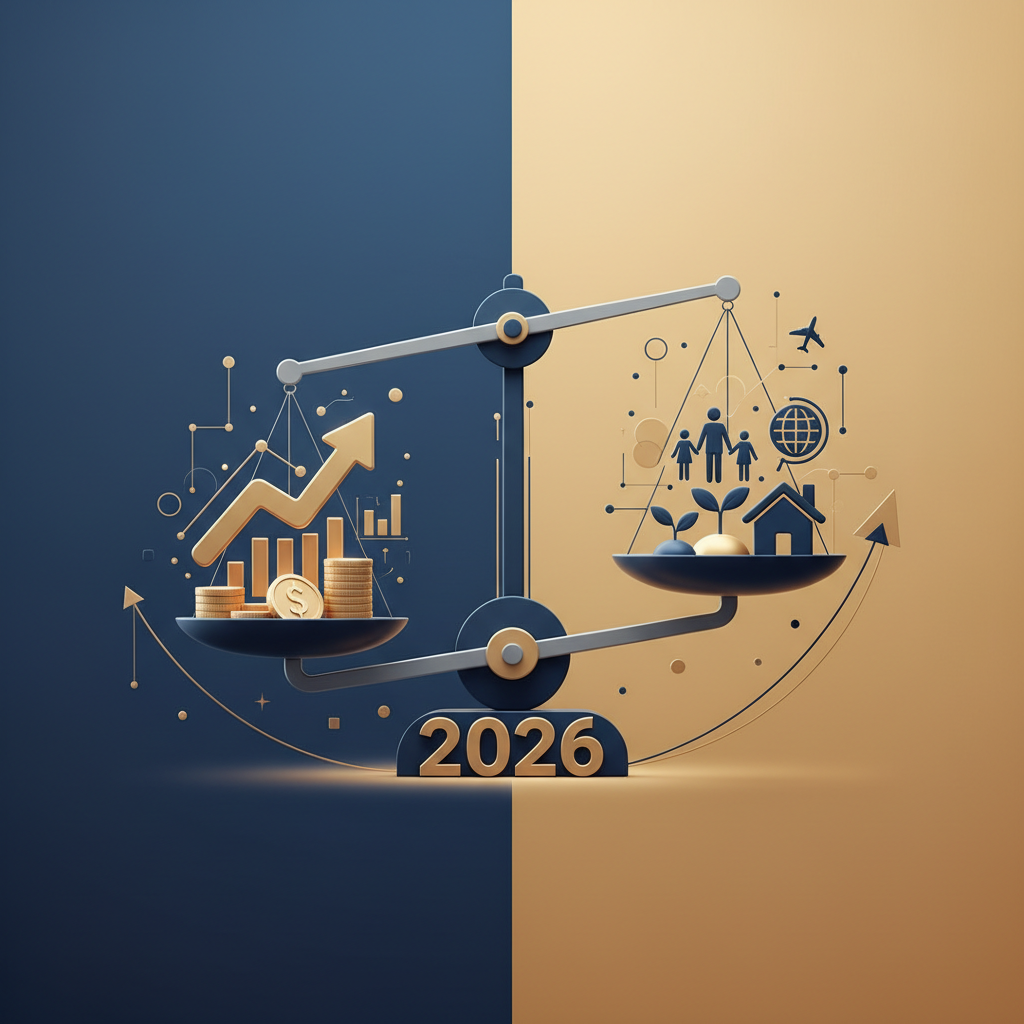
The art of portfolio construction lies in harmonizing market opportunities with individual constraints. The 2026 forecasts suggest a globally diversified approach that blends equities and bonds in proportions adjusted to each investor's profile.
For investors with moderate to high risk tolerance, dividend growth stocks present particular interest. These securities combine capital appreciation potential with regular income, offering relative protection against inflation while participating in economic growth.
The healthcare sector is among the defensive recommendations for 2026, benefiting from favorable demographic trends and lower sensitivity to economic cycles. This characteristic makes it an interesting complement to more cyclical positions in the portfolio.
Canadian investment-grade government bonds are regaining their appeal with falling interest rates. They allow for securing a portion of the portfolio while generating predictable income, particularly suitable for investors seeking stability.
The integration of real assets such as infrastructure and real estate deserves consideration for larger portfolios. These investments offer protection against inflation and additional diversification compared to traditional financial assets, as detailed in our analysis of real assets and inflation: the role of infrastructure in 2026.
Integrating ESG and Sustainable Considerations
Responsible investment is no longer an option but a strategic necessity for many investors. Environmental, Social, and Governance (ESG) criteria now influence the long-term performance of companies and represent risks that markets are gradually incorporating into their valuations.
ESG investment strategies help identify companies best positioned to face climate and societal challenges. This approach can improve the portfolio's risk-return profile while aligning investments with personal values.
Climate risks are particularly redefining investment in 2026, as explored in our dossier on ESG 2026: Climate Risks Redefine Investment. This dimension becomes essential in evaluating companies and sectors of activity.
Rebalancing and Adjustment Strategies
Portfolio construction is only the first step in a successful investment approach. Periodic rebalancing helps maintain the target allocation despite market developments and take advantage of temporary imbalances between asset classes.
This discipline involves selling positions that have gained too much relative importance and strengthening those that have been neglected by the market. Beyond the technical aspect, this approach forces investors to realize gains on outperforming assets and to take advantage of opportunities created by temporary corrections.
Adjustments must also take into account changing personal circumstances. A change in professional, family, or patrimonial situation may require a revision of the strategic allocation to maintain consistency between investments and life goals.
Continuous monitoring of relative performance helps identify discrepancies from expectations and adjust the strategy if necessary. This vigilance is particularly important in a changing economic environment like the one anticipated for 2026.
Managing Risks in an Uncertain Context
2026 promises to be rich in events likely to impact financial markets. Risk management therefore becomes a central element of any investment strategy, requiring a proactive and diversified approach.
Protection against dollar fluctuations is a legitimate concern for Canadian investors. A well-calibrated international exposure can mitigate the impact of exchange rate variations while providing access to diversified markets and growth opportunities.
Geopolitical uncertainties persist and can generate significant volatility episodes. A balanced allocation across different geographical regions and particular attention to defensive sectors help limit exposure to these external shocks.
The use of alternative funds with high risk-adjusted performance can complement traditional allocation for certain qualified investors. These strategies aim to increase returns without excessively increasing the overall portfolio's volatility.
The key to success lies in the balance between seeking performance and preserving capital. The 2026 forecasts offer a valuable reference framework, but their integration into a personalized strategy remains the determining factor for achieving long-term financial goals.
For more detailed information on the 2026 outlook, consult the comprehensive analyses from Edward Jones and PIMCO's investment outlook which provide expert insights into upcoming opportunities. You can also consult RBC's 2026 Outlook for global perspectives.