Thematic ETFs 2026: Navigating Future Sectors
The financial markets are undergoing a profound transformation. While traditional index funds continue to attract massive inflows, a new generation of instruments is gaining traction: thematic ETFs. Artificial intelligence, renewable energies, biotechnologies... These investment vehicles promise to expose savers to the technological and societal revolutions shaping our era.
But behind the appeal of these promising sectors lie contrasting realities. Increased volatility, geographical concentration, sometimes high fees: the pitfalls are numerous. For investors looking to position their capital intelligently in 2026, a thorough understanding of these instruments is essential.
The Rise of Thematic ETFs: A Response to Structural Transformations
Thematic ETFs differ from classic index funds in their targeted approach. Rather than replicating a broad index like the MSCI World or the S&P 500, they concentrate their investments on specific value chains linked to underlying trends.
This philosophy responds to a growing demand from savers: to align their investments with their convictions while capturing superior growth dynamics. The year 2026 marks a turning point in this adoption. According to analyses by BNP Paribas Asset Management, European investors are now prioritizing precise sectoral exposures to navigate an environment marked by geopolitical uncertainty and interest rate cycles.
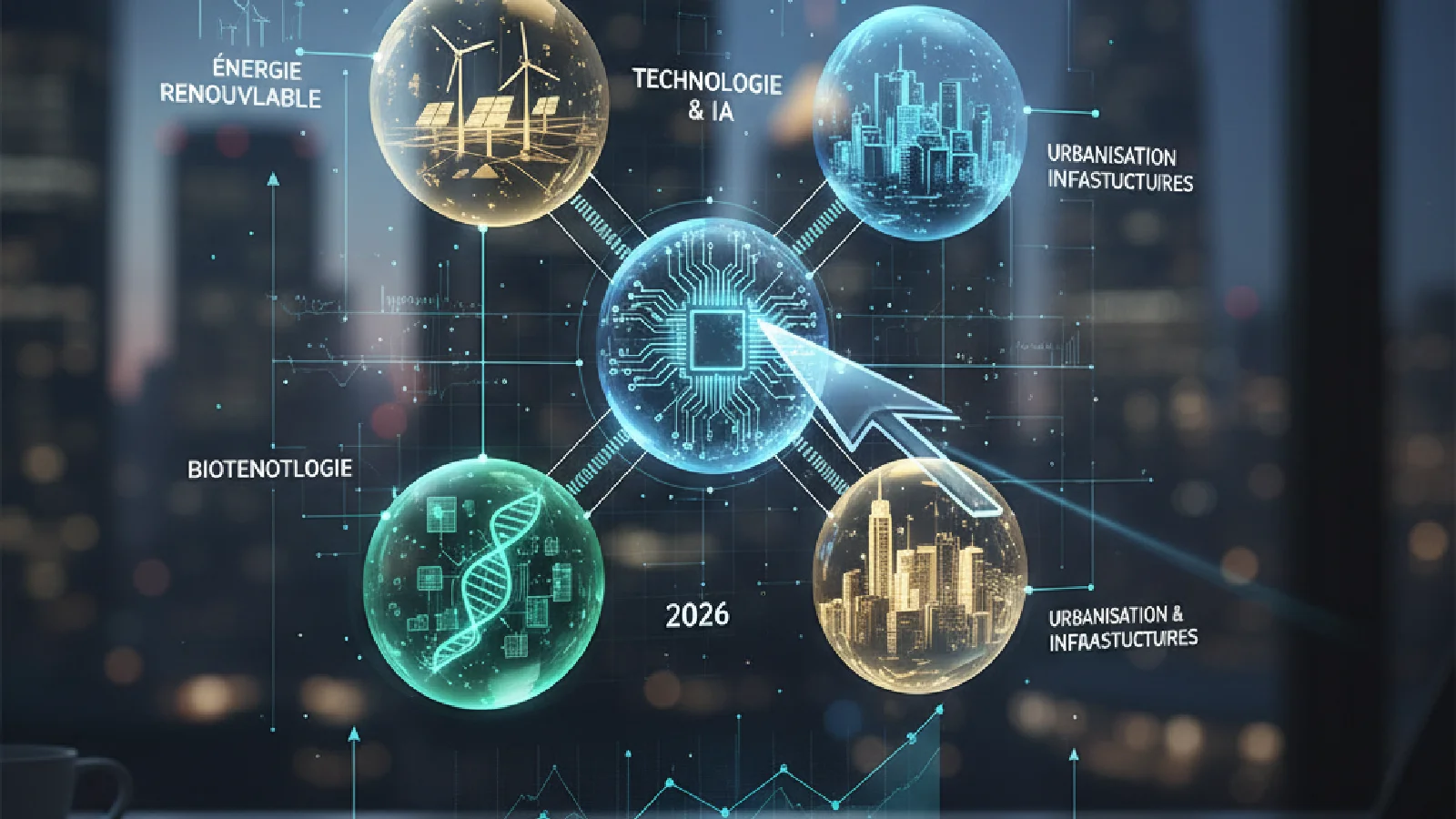
The three dominant themes for 2026 revolve around artificial intelligence, energy transition, and biotechnologies. These sectors benefit from a rare alignment of political support, technological innovation, and expanding structural demand.
Artificial Intelligence: The Engine of Technological Growth
Artificial intelligence is undoubtedly the most popular theme for investors in 2026. AI ETFs capture the entire value chain: from semiconductors to infrastructure software, cybersecurity, and cloud computing.
Issuers like WisdomTree, L&G, and Amundi offer dedicated UCITS that expose portfolios to global leaders in this sector. The performance of these funds reflects the accelerated adoption of generative AI in business, the rise of language models, and the explosion of computing power needs.
However, this concentration presents risks. The volatility of these ETFs remains significantly higher than that of broad indices. Geographical exposure, heavily biased towards the United States, accentuates dependence on American regulatory developments and the valuation cycles of technology stocks.
The question of the sustainability of current margins for tech giants is also a point of concern. In a context where interest rates remain high, economic models based on promises of future growth can suffer brutal corrections.
To delve deeper into allocation strategies in a volatile context, consult our analysis on 2026 stock market strategies facing post-Fed volatility.
Energy Transition: Between Political Ambition and Operational Reality
The energy transition represents the other major investment theme for 2026. Dedicated ETFs, such as ICLN, TAN, or QCLN, offer diversified exposure to electrical grid infrastructure, battery technologies, renewable energies, and transport electrification.
The political context plays a decisive role. The European Green Deal, massive investments in American infrastructure, and decarbonization programs in Asia create a favorable environment. Companies in the sector benefit from long-term contracts, public subsidies, and increased visibility on their future revenues.

Nevertheless, sensitivity to interest rate cycles constitutes a major impediment. Renewable energy projects require heavy initial investments, financed by debt. When rates rise, the profitability of these projects deteriorates, weighing on stock market valuations.
Furthermore, regulatory risks remain high. Changes in political majorities, revisions of subsidies, or tariff adjustments can abruptly impact the performance of these funds. As Amundi ETF highlights in its 2026 outlook, the growth of sustainable energies remains intimately linked to technological advancements and political decisions.
Major Investment Themes in 2026
| Theme | Description | Main Risks |
|---|---|---|
| Artificial Intelligence | Targets the entire AI value chain, including semiconductors, software, cybersecurity, and cloud computing. The sector is promising thanks to generative AI and computing power needs. | High volatility, geographical concentration (United States), dependence on high tech valuations, impact of interest rates. |
| Energy Transition | Encompasses electrical grid infrastructure, battery technologies, renewable energies, and transport electrification. Benefits from strong political support and subsidies. | Sensitivity to interest rate cycles (project financing), regulatory risks related to political changes and subsidies. |
| Biotechnologies | Focused on medical innovation such as gene therapies, immunotherapy, personalized medicine, and advanced diagnostics. Acceleration of medical research and development of treatments for incurable diseases. | Intrinsic volatility (clinical trial results), regulatory decisions (FDA, EMA), reimbursement issues, concentration on a few large-cap companies. |
Pitfalls to Avoid: Concentration, Fees, and Liquidity
Beyond specific sectoral risks, thematic ETFs share several common pitfalls that should be identified before any investment. According to Goliaths.io and Cabinet IGC, common errors include:
- Geographical and sectoral concentration: strong dependence on specific markets (mostly American) and a limited number of companies.
- Management fees: the TER (Total Expense Ratio) of thematic ETFs is generally higher (0.40% to 0.75%) compared to broad funds (0.10% to 0.30%), which can erode long-term performance. As Cabinet IGC reminds in its 2026 guide, cost control remains a key success factor.
- Liquidity: niche ETFs can have low trading volumes, leading to significant spreads during market stress.
- Tracking error risk: ETFs using synthetic replication via swaps can expose investors to counterparty risk and generate performance deviations from the benchmark index.
Building a Balanced Allocation: Diversification and Discipline
Given these opportunities and risks, what strategy should be adopted to intelligently integrate thematic ETFs into a 2026 portfolio?
The first rule is to maintain geographical and sectoral diversification. Thematic ETFs should only constitute a minority portion of the overall portfolio, typically between 15% and 30%. The core allocation should remain anchored in broad funds (MSCI World, MSCI ACWI) that offer stability and resilience.
Within the thematic portion itself, exposures should be distributed among several uncorrelated trends. Combining an AI ETF with a green energy fund and a biotech vehicle helps smooth out sectoral shocks. This multi-thematic approach reduces portfolio volatility without sacrificing exposure to growth trends. Investors can refer to the 4 major investment themes to follow in 2026 to refine their choices.
ETF selection should prioritize:
- A TER below 0.50% to limit erosion of returns
- Sufficient daily liquidity (trading volumes above 1 million euros)
- A transparent and replicable index methodology
- A significant fund size (assets under management over 100 million euros)
The dollar cost averaging (DCA) approach is particularly relevant for volatile themes. By smoothing entry points over several months, savers reduce timing risk and take advantage of market fluctuations to gradually build their position.
To optimize the income streams generated by these investments, our article on dividends and ETF distributions offers keys to tax and wealth optimization.
The Contribution of Artificial Intelligence in Portfolio Management
A notable development in 2026 is the increasing integration of AI into portfolio management itself. Next-generation robo-advisors use learning algorithms to optimize allocation between thematic ETFs and traditional funds based on each investor's risk profile.
These platforms analyze sectoral correlations, volatility signals, and macroeconomic indicators in real-time to dynamically adjust weightings. This approach helps limit concentration risks while maintaining exposure to structural trends.
Automated rebalancing is another advantage. Thematic ETFs, due to their high volatility, require regular adjustments to maintain the target allocation. Robo-advisors perform these arbitrations systematically and disciplinedly, eliminating emotional biases that can lead to timing errors.
To explore this evolution in depth, consult our dossier on 2026 robo-advisors and the hyper-personalization of passive management.
Vigilance on Warning Signs
Beyond selection criteria, investors must develop continuous vigilance for several warning signs that may indicate a trend reversal or a sectoral bubble.
Over-concentration in a few star stocks is a primary indicator. When a thematic ETF sees its top five positions represent more than 50% of assets, the fund loses its diversified character and becomes a bet on a few companies. This configuration amplifies idiosyncratic risk.
Massive capital flows over a short period should also raise an alarm. When an ETF attracts several billions in a few quarters, it can signal excessive enthusiasm fueled by the FOMO (Fear Of Missing Out) effect rather than solid fundamentals. Historically, these phases of euphoria often precede significant corrections.
Regulatory revisions represent an underestimated risk. A change in accounting doctrine, a tax modification, or a tightening of environmental standards can abruptly alter the economic equation of entire sectors. Investors must closely follow European and American regulatory news.
Finally, the divergence between valuations and fundamentals must be scrutinized. When the price/earnings or price/sales ratios of a thematic ETF's components reach historically high multiples without a proportional improvement in operational growth, the risk of correction becomes significant.
For those interested in sustainable investments, the list of 10 recommendations for Responsible ETFs in 2026 can offer additional avenues for analysis.
Prospects for Resilient Investment
Thematic ETFs are a powerful tool for capturing the structural transformations of the global economy. Artificial intelligence, energy transition, and biotechnologies represent sustainable trends that will redefine economic models and create major growth opportunities in the coming years.
However, these instruments require discernment and discipline. Inherent volatility, concentration risks, and higher fees necessitate a rigorous approach to selection and sizing within the overall portfolio.
In 2026, the savvy investor will combine targeted thematic exposure with a diversified core, while leveraging new-generation technological tools to optimize their allocation. This balanced approach allows participation in ongoing revolutions while preserving the resilience of wealth against inevitable market fluctuations.