
Multi-Touch Models: OOH, the Missing Link in Attribution
This gap in customer journey analysis creates a significant blind spot in understanding marketing ROI. How can the influence of a billboard on a Google search performed two hours later be measured? How can the effect of a subway campaign on e-commerce sales be quantified?

OOH, the Invisible Giant in Customer Journeys
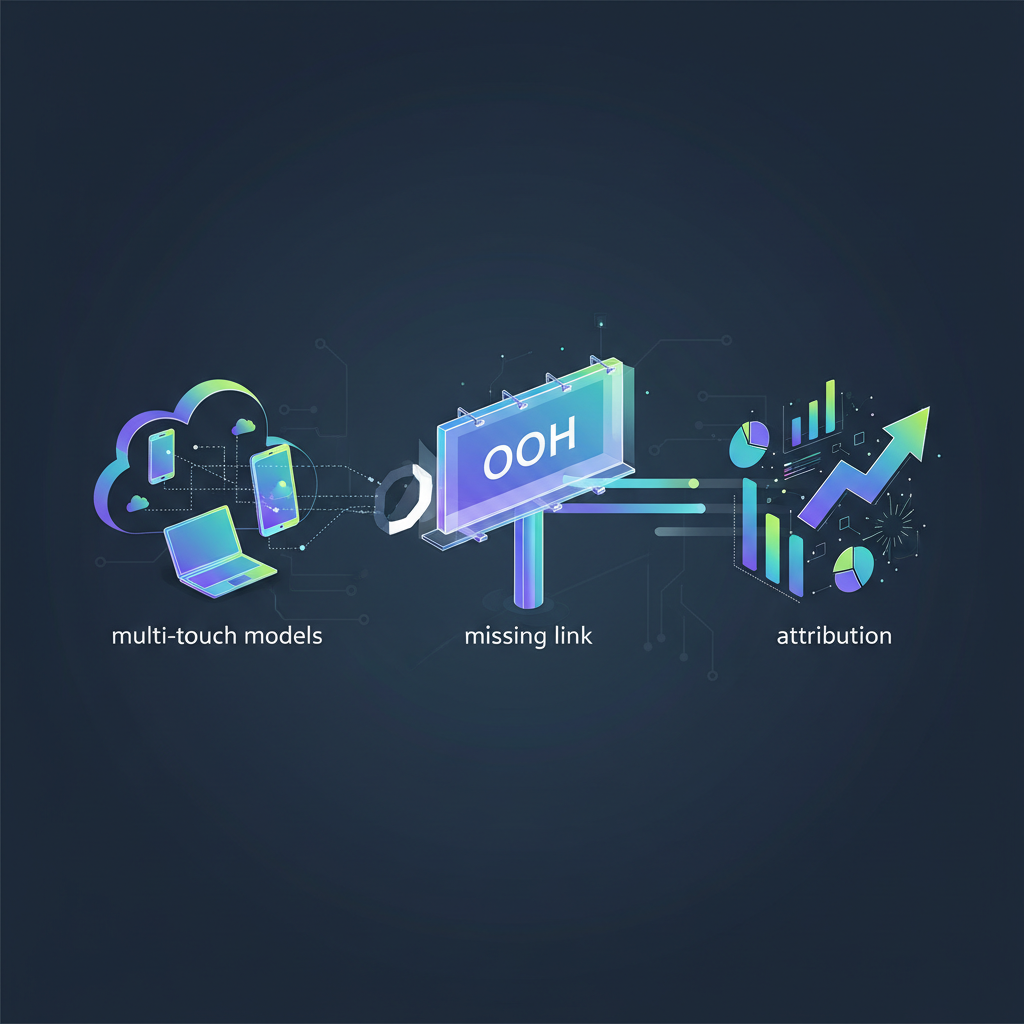
Traditional multi-touch attribution focuses on traceable digital touchpoints: clicks, impressions, visits. But this approach systematically ignores Out-of-Home media, which nonetheless generates massive awareness and crucial brand reinforcement.
Consumers do not live in an exclusively digital world. They evolve in a hybrid media ecosystem where a subway poster can trigger a mobile search, or an LED screen in a shopping mall can influence an online purchase the same evening.
Limitations of Current Models
Classic multi-touch attribution models have structural flaws:
- Digital bias: only traceable channels are valued
- Fragmented view: cross-media effects remain invisible
- Underestimation of awareness: brand awareness impact is not measured
This analytical myopia leads to biased budget allocation decisions, systematically favoring performance levers at the expense of brand investments.
| Characteristic | Classic Multi-Touch Attribution | OOH Integrated into Attribution |
|---|---|---|
| Touchpoints considered | Digital (clicks, impressions) | Digital and physical (OOH) |
| Awareness measurement | Limited | Awareness taken into account |
| Perspective | Fragmented (digital bias) | Holistic (cross-media) |
| Budget allocation | Biased towards digital | Optimized between digital and OOH |
How to Integrate OOH Data into Attribution?
Integrating OOH into multi-touch models requires a rigorous methodological approach combining several complementary data sources.
Exposure Data Collection
OOH data comes from multiple sources:
- Audience panels: measuring passages and attention paid to media
- Mobile tracking: geolocation of users exposed to campaigns
- Geo-targeted GRPs: estimating advertising pressure by zone
- Impact measurements: recognition and memorization surveys
This information allows for the creation of qualified exposure segments, an essential basis for reliable cross-media attribution.
Hybrid Attribution Algorithms
OOH integration transforms traditional attribution algorithms:
- Enriched linear model: equitable distribution including OOH exposures in the interaction sequence
- Extended U-shaped model: enhanced valuation of the first exposure (often OOH) and the final conversion
- AI-based model: machine learning considering complex correlations between online and offline
These sophisticated approaches finally allow OOH to be credited at its true value in the conversion funnel.
Marketing Mix Modeling: The Holistic View
Beyond tactical attribution, Marketing Mix Modeling (MMM) offers a complementary strategic perspective for measuring the impact of OOH on overall performance.
Long-Term Effects and Synergies
MMM reveals phenomena invisible in classic attribution:
"OOH exposure generates a halo effect across all digital channels, amplifying their effectiveness in a sustainable way." - Ekimetrics Study Source: Measuring media performance with and for business, Think with Google via Ekimetrics
Cross-media synergies manifest as:
- Improved click-through rates for search campaigns after OOH exposure
- Increased direct website traffic correlated with display investments
- Enhanced effectiveness of social networks in areas of high OOH pressure
Modeling Response Curves
MMM precisely models OOH response curves, revealing:
- Saturation thresholds by format and geographical area
- Carry-over effects over time
- Differential impact depending on broadcast times
These insights guide the fine-tuning of media plans and budget allocation between awareness and activation.
Cross-Media Attribution Technologies and Tools
Successful implementation of OOH attribution relies on an advanced technological ecosystem combining data management, predictive algorithms, and control interfaces.
Unified Measurement Platforms
Unified Marketing Measurement solutions like those mentioned in this attribution blog natively integrate OOH data:
- Real-time consolidation of multi-channel exposures
- Probabilistic attribution of offline and online conversions
- Integrated dashboards for operational management
These tools transform the complexity of cross-media attribution into actionable insights for marketing teams.
Artificial Intelligence and Machine Learning
AI revolutionizes the precision of OOH attribution through:
- Complex pattern recognition in customer journeys
- Impact prediction of campaigns before launch
- Automatic optimization of media mixes in real-time
Machine learning algorithms excel at detecting subtle correlations between physical exposures and digital behaviors, where traditional models fail.
Challenges and Future Prospects
Integrating OOH into multi-touch attribution still raises major methodological and organizational challenges.
Data Quality Issues
The reliability of cross-media attribution directly depends on:
- Geographical precision of geolocation data
- Representativeness of OOH audience panels
- Temporal consistency between exposures and conversions
These requirements necessitate significant technological investments and rigorous data governance.
Evolution Towards Real-Time Attribution
The future of OOH attribution is shaped by real-time capabilities allowing for:
- Dynamic adjustment of campaigns based on observed performance
- Contextual personalization of messages based on prior exposure
- Automatic optimization of creative rotations
This evolution will transform OOH from a mass medium into a personalized activation lever, maximizing the effectiveness of each impression.
While Query Fan-Out is already revolutionizing SEO with AI, marketing attribution is undergoing its own transformation with the integration of artificial intelligence into cross-media measurement.
OOH Attribution, a Performance Catalyst
Integrating Out-of-Home into multi-touch attribution models is not just a technical adjustment, but a fundamental transformation in understanding modern customer journeys.
By revealing the true impact of physical advertising on digital conversions, this holistic approach allows marketers to:
- Optimize their budget allocation between awareness and performance
- Maximize cross-media synergies
- Significantly improve their overall ROI
The future belongs to brands that can overcome analytical silos to embrace a unified vision of their media investments. In an ecosystem where TikTok Shop is revolutionizing social commerce and customer journeys are becoming more complex, OOH attribution becomes a decisive competitive advantage.
The question is no longer whether OOH influences conversions, but how to measure and maximize this impact to build tomorrow's marketing strategies.