
AI Copilots: Microsoft, Anthropic, and Cursor Battle for Developers

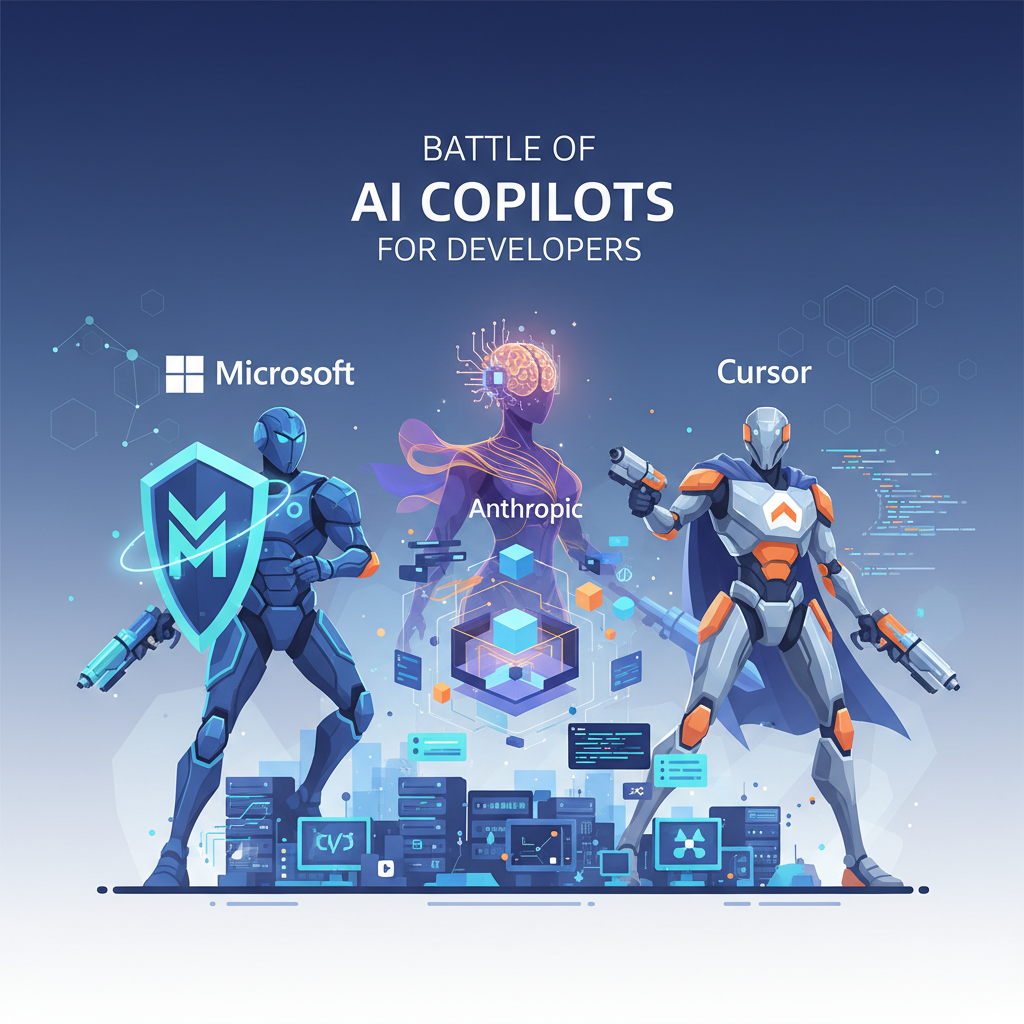
Software development is experiencing its fastest transformation since the advent of the cloud. In 2026, three major players are competing in the AI copilot market for developers: Microsoft with GitHub Copilot, Anthropic with Claude Code, and Cursor, the outsider that has become an essential platform. Each champions a radically different vision: the integrated ecosystem, compliance and ultra-long context, or multi-agent orchestration. For technical teams, the choice is no longer just about the tool, but about strategy.
This battle is no longer solely about the quality of the generated code. It has shifted to computing power, legal compliance, pricing, and the ability to orchestrate multiple artificial intelligences within the same workflow. The developer, once a coder, becomes an architect of AI agents.
Microsoft and GitHub Copilot: The Locked Ecosystem
Microsoft has built its lead on native integration within the GitHub ecosystem. Launched in 2021 with OpenAI, GitHub Copilot remains the default choice today for teams already entrenched in Visual Studio Code, Azure DevOps, and Microsoft 365.
The standard plan at $10/month is the entry-level offering, while the new “Copilot +” at $100/month, launched in May 2026, offers five times more computing power than the intermediate $20 plan. This temporary boost, active until May 31, targets scenarios of massive code generation and automation via Copilot Studio, GPT Store plugins, and Microsoft 365 integration.
Specifically, GitHub Copilot excels in three use cases:
- Real-time code completion: contextual suggestions directly in the editor
- Unit test generation: automation of test scenarios based on existing code
- Assisted refactoring: restructuring legacy code with architectural recommendations
Microsoft's strength lies in its closed but coherent ecosystem. Companies already using Azure, Teams, and GitHub find a natural continuity in Copilot. But this vertical integration comes at a price: dependence on a single vendor and limited flexibility in the face of competing models.
"Microsoft relies on the integrated ecosystem of GitHub Copilot, whose standard $10/month plan remains the benchmark choice for teams already anchored in GitHub." – 2026 Market Analysis
Anthropic and Claude Code: Long Context and Compliance
Facing Microsoft's integration strategy, Anthropic plays the card of ultra-long context and regulatory compliance. Claude Code, a CLI agent launched in 2025, leverages a context window of one million tokens, equivalent to several hundred thousand lines of code simultaneously. Details on Claude's benchmarks are available in this comparative article Claude vs ChatGPT 2026.
This capability radically changes the game for complex projects. Where GitHub Copilot analyzes a few files at a time, Claude Code can ingest an entire codebase, understand inter-module dependencies, and propose consistent modifications at the project level.
Advanced features include:
- `/ultraplan` command: detailed execution plan generation before any code modification
- Event monitor: token consumption reduction by filtering redundant events
- European data residency: GDPR-compliant offerings for regulated sectors (banking, healthcare, defense)
Cursor, the AI editor, which natively integrates Claude Code, has released a TypeScript SDK allowing developers to create custom coding agents with programmatic access to the same execution engine. Installation is a single command (`npm install @cursor/sdk`), and a few lines are enough to instantiate an agent, send it a task, and stream the response. Discussions on daily use of Claude Code or Cursor are available on Reddit.
Anthropic primarily targets regulated sectors where data confidentiality is critical. Unlike OpenAI, Anthropic guarantees that user inputs are never used to train its models. A decisive argument for financial institutions, public administrations, and healthcare companies.

Cursor: The Multi-Agent Orchestrator Disrupting the Market
Cursor has established itself as the third player by adopting a diametrically opposite strategy: interoperability. Where Microsoft and Anthropic rely on their own models, Cursor allows simultaneous orchestration of GPT-5.2, Claude Opus 4.6, Gemini 3 Pro, and Grok Code in the same environment.
The numbers speak for themselves: Cursor crossed $500 million in ARR (annual recurring revenue) in 2025 and approached $2 million in 2026. This rapid growth is explained by a unique value proposition: allowing developers to choose the best model for each task.
Specifically, a Cursor developer can:
1. Use Claude Opus 4.6 for complex code analysis and long context understanding 2. Switch to GPT-5.2 for rapid boilerplate and test generation 3. Invoke Gemini 3 Pro for multimodal feature integration (vision, audio) 4. Combine multiple agents in an orchestrated workflow
This flexibility is reflected in the pricing structure: Cursor Pro at $20/month for standard use, Cursor Ultra at $200/month for teams requiring massive computing resources and simultaneous access to all premium models.
Cursor's "agent-first" approach transforms the code editor into an orchestration platform. Developers no longer just receive suggestions: they pilot specialized agents, define complex workflows, and audit the outputs of each model. To learn more about integrating Cursor into operations, explore Cursor for AIOps.
Pricing and Computing Power: The Core of the Battle
The competition crystallizes around two variables: price and allocated computing power. The three players offer tiered pricing, but the gaps widen on premium plans.
| Player | Offering | Monthly Price | Specifics |
|---|---|---|---|
| Microsoft | GitHub Copilot Standard | $10 | GitHub ecosystem integration, Visual Studio Code |
| GitHub Copilot + | $100 | 5x more power, massive code generation | |
| Anthropic | Claude Code | (via Cursor/CLI) | Ultra-long context (1M tokens), GDPR compliance |
| Cursor | Cursor Pro | $20 | Standard use, multi-model orchestration |
| Cursor Ultra | $200 | Unlimited access to premium models, sandboxed cloud |
GitHub Copilot relies on an attractive entry price ($10/month) to capture the installed GitHub base, while offering an elite plan at $100/month for intensive use cases. Claude Code does not offer a standalone public offering: it is used via Cursor, via CLI integrations, or via cloud platforms like AWS Bedrock and Azure AI.
Cursor, for its part, plays transparency with two clear offers: Pro at $20/month and Ultra at $200/month. The Ultra plan includes unlimited access to premium models, sandboxed cloud virtual machines, and consumption-based token billing for exceptional workloads.
According to a benchmark conducted in January 2026, the vast majority of developers use their AI assistant at only 20% of its capacity. The choice of tool therefore depends less on raw power than on its suitability for real use cases: rapid completion, massive refactoring, security auditing, or documentation generation.
For businesses, the question of cost per developer becomes strategic. At $100/month per head, a premium plan can represent an annual investment of $1,200 per developer. For a team of 50 developers, this represents $60,000 per year – a budget that requires clear justification in terms of productivity gains.
Compliance, Security, and Data Sovereignty
Beyond technical performance, regulatory compliance is becoming a decisive selection criterion. European companies, subject to GDPR, scrutinize guarantees of data residency and non-use of inputs for model training.
Anthropic has built part of its positioning on this axis. Claude Code offers European data residency options, allowing financial institutions and public administrations to comply with digital sovereignty obligations.
Microsoft, for its part, relies on Azure to ensure compliance with major certifications (SOC 2, ISO 27001, HDS in France). But the use of OpenAI models, trained on American data, raises questions for the most sensitive sectors.
Cursor, as an aggregator, offers some flexibility: companies can choose to use only models hosted on Azure Europe or AWS Paris, excluding American endpoints. This granularity in vendor choice constitutes a competitive advantage for organizations subject to strict constraints.
The question of security of generated code remains central. All three platforms have implemented mechanisms for detecting secrets (API tokens, passwords) and compliance with open-source licenses. But the ultimate responsibility always lies with the developer: AI proposes, humans validate.
From Coder to Agent Architect: The Evolution of the Profession
The rise of AI copilots redefines the developer's role. Gone are the days when the core of the job consisted of writing code line by line. The developer of 2026 becomes an agent orchestrator, an AI output auditor, and a hybrid architecture designer.
Specifically, this means:
- Delegating repetitive tasks (boilerplate, tests, documentation) to AI agents
- Auditing the quality, security, and maintainability of generated code
- Designing workflows where multiple agents collaborate on complex tasks
- Training models on business context and company standards
This evolution creates a generational shift. Developers who master multi-agent orchestration gain a major competitive advantage. Those who continue to code manually gradually lose relative productivity.
Companies, meanwhile, must rethink their recruitment, training, and evaluation processes. The desired skills shift from syntactic mastery to the ability to prompt-engineer, to architect complex systems, and to audit code generated by models.
This transition will not be without tension. Some senior developers resist adopting copilots, citing risks of quality degradation or skill loss. Others, conversely, fully embrace automation and claim productivity gains of several hours per day.
As Maxime Thoonsen, co-founder of the AGO startup, explains, "a single developer can now pilot a constellation of code agents." This phrase summarizes the ongoing transformation: the developer no longer codes alone; they lead a virtual team of specialized artificial intelligences.
Towards Market Standardization or Increased Fragmentation?
The question for 2027 is that of market evolution. Three scenarios are emerging.
Scenario 1: Consolidation around two leaders. Microsoft and Anthropic strengthen their respective positions, with a clear division: GitHub Copilot for the Microsoft/Azure ecosystem, Claude Code for regulated sectors and projects requiring ultra-long context. Cursor, overtaken by the giants, gradually loses market share.
Scenario 2: Fragmentation and specialization. Each player positions itself in a specific segment: Microsoft on enterprise integration, Anthropic on compliance, Cursor on interoperability. Niche players emerge for specific languages (Rust, Go, Swift) or business domains (finance, healthcare, defense).
Scenario 3: Standardization via open protocols. The industry converges towards agent orchestration standards (MCP, Model Context Protocol), allowing developers to easily switch between providers. Copilots become commodities, and differentiation occurs at the orchestration and auditing layer.
The most probable scenario combines elements of consolidation and standardization. The two giants (Microsoft/OpenAI and Anthropic) capture the majority of the market, while players like Cursor position themselves on multi-model integration and open protocols. Developers, for their part, are gradually adopting a multi-copilot approach, using several tools depending on the tasks.
This dynamic pushes towards a professionalization of practices: definition of productivity KPIs (development time, bug rate, code quality), implementation of usage policies (which models for which tasks), training teams in good prompt engineering practices. To delve deeper into how AI transforms businesses, consult our article on RAG in Enterprise 2026.
The companies that succeed in this transition will be those that can combine AI tools and a culture of auditing, ensuring that every line of code generated by AI meets quality, security, and maintainability standards.
FAQ (JSON format - translate question and answer fields only):