Enterprise RAG 2026: Autonomous Knowledge Automation

Imagine a system that doesn't just search for information, but interrogates, refines, combines, and acts autonomously. In 2026 enterprises, RAG (Retrieval-Augmented Generation) architectures are no longer simple vector search engines coupled with an LLM. They become intelligent orchestrators capable of learning, self-correcting, and automating knowledge end-to-end, without constant human intervention.
This shift from augmentation to autonomous automation radically transforms how organizations manage their knowledge. Gone are the days when a chatbot merely retrieved a relevant document. Now, RAG systems orchestrate complete workflows, connect multiple heterogeneous data sources, and make contextualized decisions in a continuous loop.
RAG technology, as described by experts like Salesforce or Algos-AI, is crucial for the evolution of enterprise AI:

From Vector Search to Intelligent Orchestration
Classic RAG architecture relied on a simple scheme: a user query, a search in a vector database, then a response generation by a language model. Effective, certainly, but limited. In 2026, this linear approach gives way to recursive pipelines where the AI agent re-queries the knowledge base with its own intermediate responses to refine its reasoning.
Concretely, this means an agent can detect a gap in its initial response, automatically rephrase its query, search in other stores (vector, hybrid, semantic graph), and progressively enrich its understanding. This continuous improvement cycle allows for a level of precision and analytical depth impossible with a simple back-and-forth.
Adaptive variants represent another major advancement. The system dynamically selects the type of store and data format according to the context: text for legal analysis, tables for financial data, images for industrial quality control. This flexibility ensures an optimal response regardless of the business scenario.
The Era of Multimodal Systems and Autonomous Agents
RAG architectures in 2026 simultaneously integrate PDF documents, structured databases, audiovisual media, and real-time feeds to offer a holistic understanding of information. This multimodal capability far exceeds simple text processing. An agent can now analyze a PDF contract, cross-reference its clauses with a case law database, verify compliance in an Excel spreadsheet, and generate an illustrated summary note.
This evolution is based on what the industry calls agentic platforms, as highlighted by Creatio in its analysis of AI agent platforms. These platforms combine several essential components:
- A real-time search engine capable of querying internal and external sources
- A short- and long-term memory manager to contextualize interactions
- A function orchestrator connecting APIs, RPA, and no-code workflows (n8n, Make, Zapier)
- Governance controls ensuring traceability, GDPR compliance, and AI Act adherence
The difference from a simple chatbot? Operational autonomy. As InformatiqueNews specifies in its analysis of agentic AI, these agents don't just respond: they read emails, update CRMs, trigger workflows, and compose action plans to achieve the objective they are given.
Self-Service and Automation Democratization
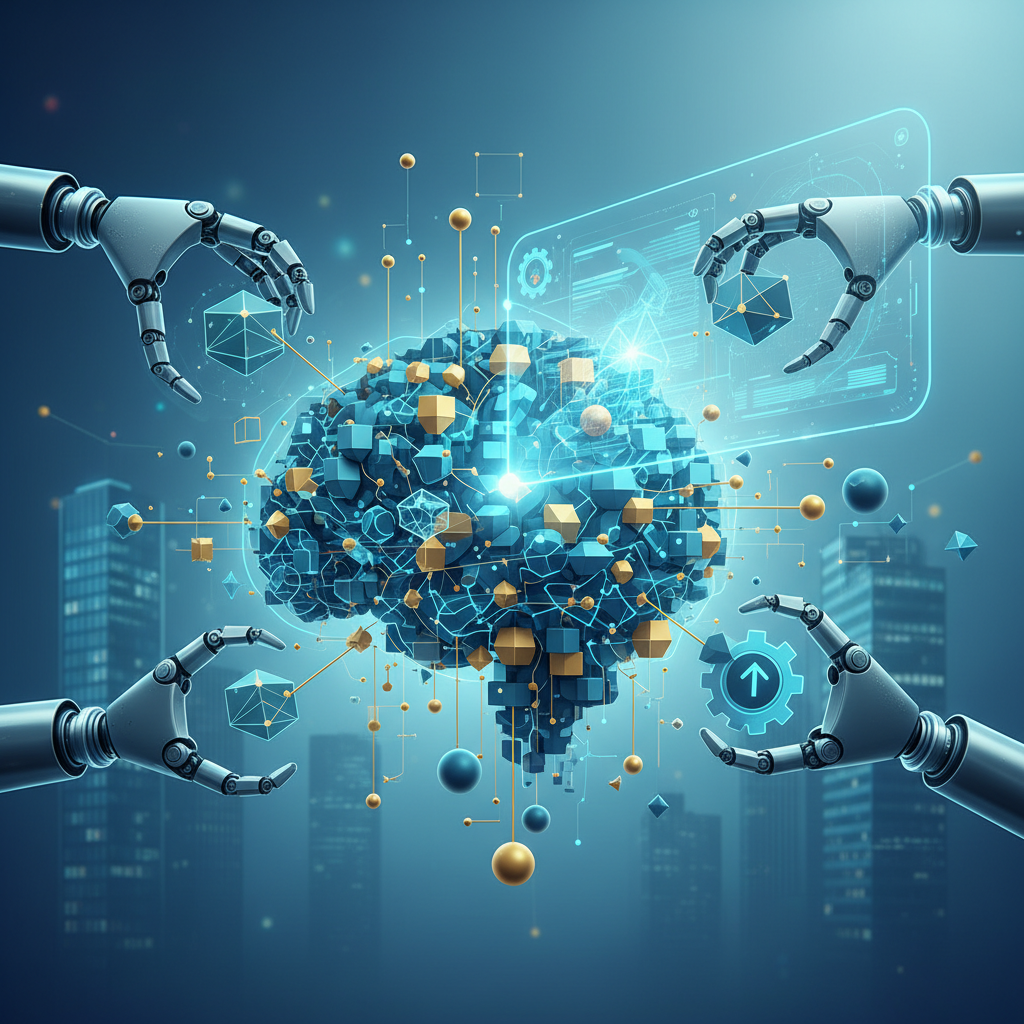
One of the major upheavals lies in the ability of business users to trigger self-service processes without involving IT. Generating contract notes, autonomous invoice processing, synthesizing customer feedback: these tasks are now executed via conversational interfaces or pre-configured templates.
This democratization relies on low-code and no-code tools that allow teams to reconfigure agents, add new data sources, or modify workflows without writing a single line of code. The workflow automation market, projected to reach nearly $20 billion by 2026 according to analysts, testifies to this massive adoption. Furthermore, Gartner's 2026 trends highlight the importance of intelligent automation for businesses, as detailed in this ManageEngine article.
“Automation generates immediate and measurable savings, with an ROI of 30% to 200% in the first year.”
Organizations are seeing concrete gains: up to 15 hours saved per week per employee, a drastic reduction in manual errors, and the ability to process data volumes impossible to manage humanly. But beyond raw efficiency, it's decision quality that improves: advanced RAG agents automatically cross-reference multiple sources, detect inconsistencies, and provide reasoned recommendations.
Governance and Security: Foundations of Trust
With power comes responsibility. Autonomous RAG architectures require strict safeguards to prevent misuse. Three major risks emerge: malicious prompt injection, excessive permissions, and sensitive data exfiltration. A misconfiguration can expose the entire internal information system.
Companies now demand:
- Strict compartmentalization of action perimeters by agent
- Complete traceability of every source fragment and decision made
- Human validation points for high-impact tasks
- Regular robustness tests simulating attack scenarios
This “human-in-the-loop” approach does not mean abandoning autonomy, but ensuring that a business owner validates binding decisions. The system proposes, the expert disposes. This intelligent supervision maintains the balance between performance and risk control.
Regulatory compliance is another essential pillar. With the entry into force of the European AI Act and strengthened GDPR requirements, RAG solutions must natively integrate governance mechanisms: sovereign hosting, data anonymization, revocability of permissions, and complete auditability of processing.
From Learning to Action: A Continuous Cycle
What truly characterizes RAG systems in 2026 is their ability to form an autonomous learning and action cycle integrated into enterprise workflows. Unlike static implementations that require manual updates, these evolving architectures continuously enrich themselves with interactions, user feedback, and new business data.
An agent can detect that a type of query regularly generates unsatisfactory responses, identify gaps in the knowledge base, and automatically suggest adding new sources or re-indexing existing documents. This guided self-improvement significantly reduces maintenance costs while increasing relevance over time.
Native integration with enterprise systems (ERP, CRM, collaborative tools) also transforms the very nature of knowledge work. Information no longer remains siloed in departmental compartments. It circulates, combines, and updates automatically to feed real-time decisions. A salesperson can obtain a complete customer analysis in seconds, cross-referencing purchase history, support tickets, market studies, and sectoral trends.
Hybrid Architectures and Domain Specialization
The most mature organizations are now deploying hybrid architectures combining several specialized agents coordinated by a central orchestrator. Each agent focuses on a specific domain (legal, financial, technical, HR) with its own data sources, optimized language model, and business rules.
This specialization avoids the frequent hallucinations of generalist models while ensuring expert-level knowledge. A legal agent trained exclusively on case law and regulatory texts will provide much more reliable analyses than a general LLM, even a large one.
The central orchestrator manages intelligent query routing, coordination between agents for complex questions requiring multiple expertises, and consolidation of partial responses into a coherent summary. This modular architecture also facilitates progressive evolution: adding new agents, targeted updating of a domain, A/B testing of new approaches on a limited scope.
The Impact on Knowledge Professions
This technical transformation leads to a profound redefinition of professional roles. Repetitive tasks of searching, compiling, and formatting gradually disappear, freeing up time for strategic analysis, creativity, and high-value human interactions.
Contrary to initial fears, knowledge automation creates as many opportunities as it eliminates. Analysts predict that by 2030, automation and AI technologies will generate a net positive balance of several tens of millions of skilled jobs worldwide. Skills are evolving: less manual entry, more agent supervision, workflow design, and critical interpretation of AI recommendations.
Companies that succeed in this transition invest heavily in training their teams. It's not just about training on tools, but about developing a new professional posture: that of the “augmented supervisor” capable of leveraging AI while retaining the indispensable human discernment. To learn more about the impact of AI on employment, you can consult our article on AI humanoids: the industrial revolution of 2027 underway.
Prospects for Strategic Adoption
To successfully deploy advanced RAG architectures, organizations must adopt a progressive and pragmatic approach. Start by identifying knowledge-intensive processes where automation generates a rapid impact: processing contractual documents, level 1 customer support, regulatory watch, research synthesis.
Comparison: Classic RAG vs. RAG 2026
| Characteristic | Classic RAG (before 2026) | RAG 2026 (Autonomous) |
|---|---|---|
| Process | Linear, Back-and-forth | Recursive, Adaptive |
| Data Sources | Primarily text | Multimodal, Hybrid |
| Autonomy | Limited, Assisted | Operational, Self-correction |
| Decisions | Factual responses | Contextualized decisions, Action-taking |
The pilot phase must involve business units from the design stage. End-users are best placed to identify relevant use cases, validate response quality, and define necessary control points. This co-construction ensures adherence and reduces the risks of technological rejection.
The underlying infrastructure deserves particular attention: quality of source data, freshness of indexing, robustness of connectors, scalability. A poorly fed RAG system will remain mediocre even with the most sophisticated algorithms. Operational excellence relies as much on data governance as on AI models.
Finally, continuous performance evaluation is essential. Defining precise metrics (relevance of responses, required human validation rate, processing time, user satisfaction) allows for rapid identification of areas for improvement and justification of investments to management.