
GPT OpenAI in Business: Concrete Integrations and Feedback

Tutorials on ChatGPT are multiplying, but one question remains rarely explored: how do companies really integrate OpenAI's GPT models into their daily operations? Far from marketing demonstrations, professional adoption reveals a pragmatic approach, targeting high-value processes and requiring rigorous governance.
From automated lead qualification to personalized report generation, and the orchestration of autonomous agents, concrete use cases are drawing a new map of productivity. But this transformation requires much more than a simple API subscription: a solid technical architecture, risk management, and regulatory compliance are essential prerequisites.
API Integration: The Core of Business Automation
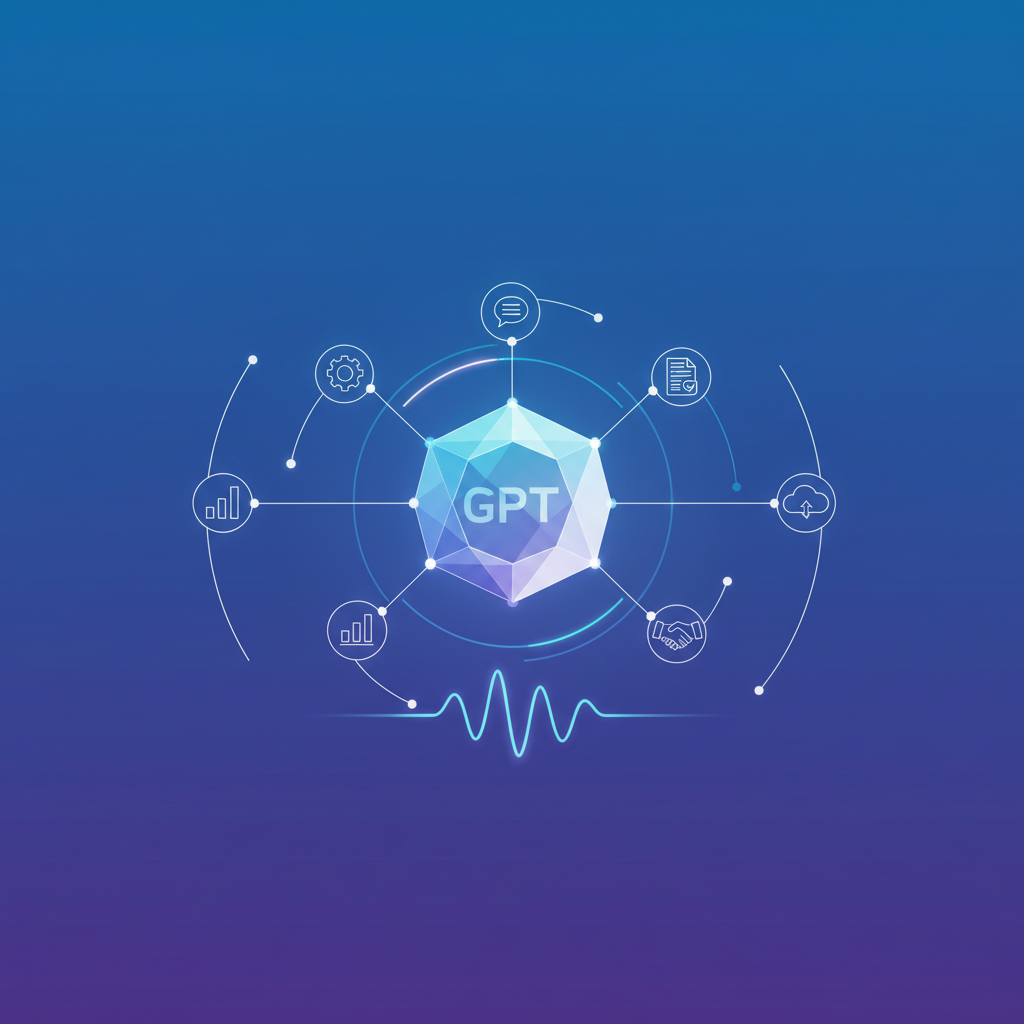
Access to GPT models via API forms the technical foundation for most professional deployments. Unlike the public ChatGPT interface, APIs allow a direct connection to existing information systems, thus enabling the automation of complex workflows.
Companies use these robust APIs to connect language models to their databases, CRMs, customer support platforms, or content management tools. This technical integration offers several decisive advantages: real-time processing, personalization of responses according to business context, and scalability adapted to query volumes.
The OpenAI ecosystem extends far beyond ChatGPT: it encompasses specialized APIs, multimodal models, and advanced features like fine-tuning. As LVLUP agency points out, this architecture requires structured governance and rigorous risk assessment, especially when sensitive data passes through third-party cloud services.
Low-code Orchestration: Democratizing Access
Low-code orchestration platforms like n8n or Make have accelerated adoption by allowing business teams to create automated workflows without advanced development skills. These tools connect GPT APIs to other services (Slack, Google Sheets, Notion) via intuitive visual interfaces.
A marketing department can thus automate the creation of social media posts, while an HR team generates varied interview questions tailored to each candidate profile. This technical democratization reduces reliance on IT teams and accelerates time-to-value.
Operational Use Cases: From Customer Support to Content Production
Concrete applications of GPT in business focus on automating repetitive tasks and enriching existing processes. The analysis and synthesis of technical documents are among the most common uses: extraction of structured information from unstructured sources, generation of executive summaries, automatic content classification.
In commercial functions, GPT models are used to:
- Qualify incoming leads by analyzing their messages and behaviors
- Generate personalized prospecting scripts based on sector and profile
- Create commercial proposals adapted to the client context
HR teams leverage these capabilities to produce tailored onboarding materials, write optimized job descriptions, or analyze employee feedback at scale. The automated drafting of standardized responses frees up time for higher-value human interactions.
The integration of GPT in business results in targeted automation of high-value processes, generating measurable productivity gains while preserving the human dimension of strategic interactions.
Fine-tuning and Personalization: Beyond Generic Performance
For use cases requiring increased precision or specific professional vocabulary, fine-tuning GPT models on proprietary data becomes a strategic option. This approach allows for superior performance in drafting technical product descriptions, analyzing legal documents, or generating recommendations based on customer history.
Companies in the financial sector use this personalization for predicting key indicators from large volumes of structured and unstructured data. E-commerce teams refine models to improve the creation of product metadata and optimize conversion rates.
This approach nevertheless raises critical issues of data governance: the information used for training must comply with internal confidentiality policies and regulatory requirements (GDPR, sectoral). Mastering compliance becomes a key success factor, as illustrated by IBM's documented use cases.
The Risk-Benefit Equation
Fine-tuning also introduces technical risks: overlearning on biased data, degradation of generalization capability, or unintentional exposure of sensitive information in model outputs. A rigorous validation and testing strategy is essential before any production deployment.
| Fine-tuning Risk | Description |
|---|---|
| Overfitting | Model too specialized on training data. |
| Data Bias | Amplification of biases present in the data. |
| Information Leakage | Exposure of sensitive data in responses. |
| Limited Generalization | Loss of ability to handle new cases. |
Autonomous Agents: The New Frontier of Automation
New OpenAI agents like Operator or the ChatGPT agent mark a significant evolution: these systems can now interact with web interfaces, fill out forms, navigate between multiple services, and perform multi-step tasks without human intervention.
DataCamp highlights that Operator makes AI accessible to users without technical skills, allowing them to accomplish tasks such as filling out forms or navigating complex websites using natural language. This approach contrasts with competing solutions like Anthropic Computer Use, which currently require programming knowledge.
Emerging professional applications include:
- Automation of competitive research and strategic intelligence
- Autonomous management of recurring bookings and transactions
- Interaction with legacy systems via their web interfaces
These capabilities also open up prospects for accessibility: with enhanced voice integration, these agents could become essential tools for people with disabilities, particularly visual impairments.
Compliance and Security: The Safeguards of Adoption
Integrating GPT into a business cannot forgo an adapted risk management strategy. Several dimensions must be mastered simultaneously: protection of sensitive data, traceability of AI-assisted decisions, management of potential biases, and compliance with sectoral regulations.
Companies in regulated sectors (health, finance, energy) deploy specific architectures: private Azure OpenAI instances, end-to-end encryption, exhaustive logging of requests, and human validation mechanisms for critical decisions.
The question of intellectual property of generated outputs also remains sensitive: who owns the rights to marketing content created by GPT? How to guarantee the absence of unintentional plagiarism? These legal questions evolve with case law and require specialized legal support.
Prompt Governance and Quality Control
Beyond regulatory compliance, companies structure prompt governance: centralized libraries of validated queries, approval processes for new uses, output quality metrics. This emerging discipline becomes a differentiating factor between successful adoptions and chaotic deployments.
Feedback: Measurable Gains and Identified Limitations
Initial feedback reveals tangible productivity gains in targeted areas. Customer support teams note a significant reduction in first response time, while marketing functions observe an acceleration in the production of diverse content.
Identified limitations primarily concern variable reliability depending on the context: factual hallucinations on niche topics (see aimultiple.com and dentistmankato.com), difficulties with complex mathematical reasoning, sensitivity to ambiguous phrasing. These constraints necessitate systematic human validation for critical outputs.
The organizational learning curve also remains significant: training teams in prompt engineering, adapting existing processes, managing change among skeptical or anxious users. Successful deployments are accompanied by strong managerial support and transparent communication about both benefits and limitations.
To delve deeper into the technical dimensions of AI-assisted automation, our article on AI copilots for developers explores complementary use cases in the software development environment.
Perspectives: Towards Multi-Agent Orchestration
The foreseeable evolution of GPT integrations in business points towards the orchestration of multiple specialized agents, each mastering a precise functional domain. This modular approach improves overall reliability while facilitating system maintenance and evolution.
Pioneering companies are already experimenting with architectures where a coordinating agent distributes tasks among specialist agents (financial analysis, content generation, documentary research), aggregates their outputs, and produces complex deliverables. This technical sophistication brings enterprise AI closer to true versatile virtual assistants.
The democratization of conversational interfaces and autonomous agents, as discussed in our analysis of AI video integration in business, suggests an ecosystem where barriers between different AI modalities gradually blur.
Conclusion
The real integration of GPT OpenAI in business goes far beyond tutorial demonstrations: it requires thoughtful technical architecture, rigorous data governance, and continuous risk management. Operational use cases focus on automating document processes, enriching customer interactions, and assisting commercial and HR functions.
Fine-tuning and emerging autonomous agents open new perspectives, while raising compliance and security challenges. Feedback confirms measurable productivity gains, but also highlights the importance of sustained human validation and organizational change management.
As these technologies mature, the challenge shifts from technical experimentation to creating sustainable value and embedding AI in the corporate culture. Organizations that succeed in this transition will be those that can balance technological innovation with risk control, while placing people at the heart of their adoption strategy.