
Ethereum and Supply Chain: Practical Cases and 2026 Challenges

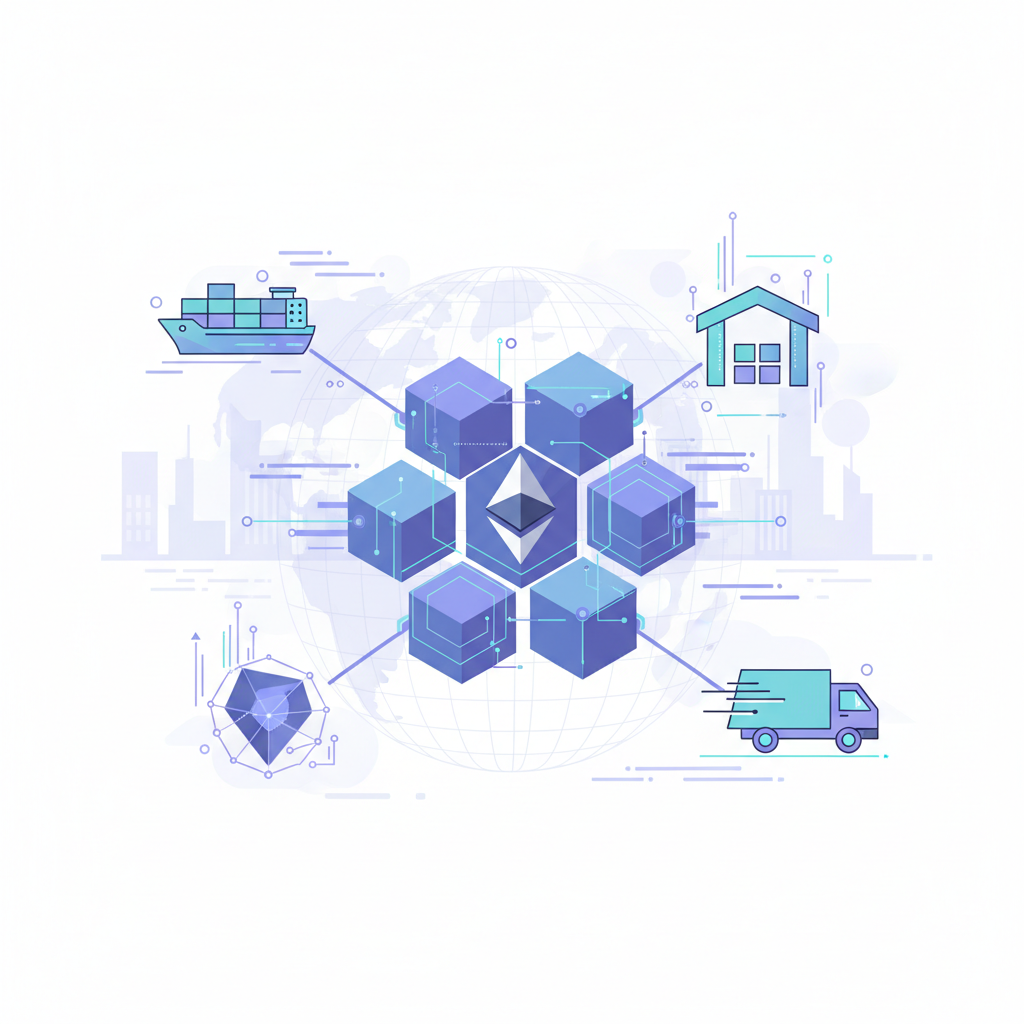
Walmart verifying the origin of a pork batch in real-time. Maersk accelerating customs clearance by 30% thanks to smart contracts. De Beers guaranteeing the authenticity of each diamond via a non-fungible token. In 2026, Ethereum is no longer content to just power decentralized finance: it is transforming the global supply chain into a programmable trust infrastructure.
The theoretical promises of blockchain — transparency, traceability, disintermediation — are now materializing in concrete use cases, driven by industrial giants. But this adoption comes with technical, regulatory, and organizational challenges that still hinder large-scale deployment.
IBM Food Trust and Walmart: Real-Time Food Traceability
The IBM Food Trust platform illustrates one of the most advanced use cases of Ethereum in the supply chain. By integrating Ethereum smart contracts, it records every step of a food product's journey, from farm to point of sale.

Walmart, a long-standing partner in the project, uses this infrastructure to verify the origin and compliance of its products in real-time. When a batch of pork arrives in stores, teams can consult the complete history: origin farm, slaughter dates, transport conditions, veterinary controls. This end-to-end visibility drastically reduces the risks of food fraud and facilitates product recalls.
The system relies on a combination of IoT sensors, RFID scanners, and smart contracts that automate the validation of critical steps. Each actor in the chain — producer, transporter, distributor — records their data on the blockchain, creating an immutable audit trail.
“The Ethereum blockchain allows us to answer in a few seconds a question that once took several days: where exactly does this product come from?” — Supply Chain Manager, Walmart
TradeLens and Maersk: Global Logistics Harmonization
The TradeLens consortium, supported by Maersk, has migrated several container tracking modules to Ethereum smart contracts to harmonize data exchanges between shippers, customs, and carriers.
The objective: eliminate manual entry errors and accelerate customs processes. In 2026, the results are tangible: customs clearances have been accelerated by 30%, while disputes related to transport documents have significantly decreased.
The technical architecture relies on Layer 2 solutions (notably zkEVM rollups) to manage the massive volumes of transactions generated daily by global logistics flows. Each container is associated with a unique identifier on the blockchain, allowing real-time tracking of its position, content, and regulatory status.
This standardization of data exchanges reduces administrative costs by eliminating intermediaries and automating compliance checks. Customs can directly consult cargo manifests, verify export licenses, and validate tax payments, all via a single interface connected to Ethereum.
De Beers and Diamond Tokenization
In the luxury sector, De Beers has deployed an asset tokenization solution on Ethereum to guarantee the authenticity and ethics of its diamonds. Each stone is linked to a non-fungible token (NFT) that tracks its complete history: origin mine, cutting process, chain of ownership, successive sales.
This approach responds to a growing consumer demand for more transparency regarding the origin of luxury products. By scanning a QR code, a buyer can verify that their diamond does not come from a conflict zone and consult its entire journey since extraction.
The system uses cryptographic oracles to validate off-chain data (gemology reports, authenticity certificates) and anchor them on the blockchain. This hybrid architecture combines Ethereum's security with the flexibility needed to integrate complex business processes.
Tokenization also allows for the creation of secondary markets for diamonds, facilitating the resale and authentication of precious stones on digital platforms. Each transfer of ownership is automatically recorded via a smart contract, eliminating the risks of documentary fraud.
Measurable Benefits for Businesses
The adoption of Ethereum in the supply chain generates several concrete, now quantifiable, advantages:
- End-to-end visibility: ability to track a product in real-time from production to delivery, facilitating targeted recalls and inventory management
- Reduced administrative costs: elimination of intermediaries and automation of compliance checks via smart contracts
- Improved customer trust: immutable proof of origin, authenticity, and adherence to ESG standards
These benefits translate into operational efficiency gains and commercial differentiation. In sectors where trust is a critical issue — agri-food, pharmaceutical, luxury — blockchain becomes a tangible competitive advantage.
Summary of Ethereum Use Cases in the Supply Chain
| Sector | Main Use Case | Key Technology | Major Benefit |
|---|---|---|---|
| Food | Real-time traceability | Ethereum smart contracts | Reduced fraud risks, targeted recalls |
| Maritime Logistics | Accelerated customs clearance | Layer 2 (zkEVM rollups) | Reduced administrative costs, standardization |
| Luxury (Diamonds) | Authentication and traceability | Non-fungible tokens (NFTs) | Consumer transparency, fight against conflict diamonds |
Technical Obstacles: Scalability and Interoperability
Despite advances in 2026, several technical obstacles persist. The processing capacity of Ethereum's Layer 1 remains limited for the massive volumes required by large logistics players.
The “Glamsterdam” update, which introduces parallel execution, native account abstraction, and an increased gas limit beyond 100 million, significantly improves performance. But for industrial use cases, the use of Layer 2 solutions often remains essential.
However, interoperability between these different Layer 2s (Arbitrum, Optimism, zkSync) remains a challenge. Each solution has its own standards, governance mechanisms, and transaction costs. This fragmentation complicates integration for companies operating on a global scale.
Developers often have to adapt their smart contracts to multiple environments, maintain several bridges between chains, and manage the complexity of a multi-layer architecture. This situation slows down adoption and increases development costs.
As Benzinga's report on Ethereum improvement proposals for 2026 highlights, standardization efforts and fee optimization remain an absolute priority for the ecosystem. To learn more about the technical developments impacting Ethereum's evolution, you can also consult resources on Ethereum ETFs and Ethereum's priorities for 2026.
The Problem of Off-Chain Data Reliability
A famous adage in the blockchain world summarizes one of the major challenges: “garbage in, garbage out.” The veracity of data recorded on Ethereum depends entirely on the quality of the entry point.
In the context of the supply chain, this input comes from IoT sensors, RFID scanners, ERP systems, and human operators. Each of these vectors can introduce errors, voluntary or involuntary. A defective sensor, a malicious employee, or a poorly calibrated system can compromise the integrity of the entire chain.
To mitigate this risk, companies are investing in cryptographic attestation devices: hardware security modules (HSM), certified chips, multi-party signature protocols. The goal is to ensure that data is authentic from its creation, even before it reaches the blockchain.
Integration standards are also emerging to harmonize data collection across different sectors. Industrial consortiums are developing common protocols for IoT sensors, data formats, and validation mechanisms.
This issue illustrates a fundamental limitation of blockchain: it secures data once recorded, but cannot guarantee its initial accuracy. Hybrid solutions, combining on-chain technologies and physical verification mechanisms, remain essential.
Regulatory Challenges: GDPR and Digital Identities
The legal framework is evolving rapidly, creating new constraints for blockchain deployments. In Europe, the GDPR imposes strict obligations on personal data protection: right to be forgotten, data minimization, explicit consent.
However, the immutable nature of blockchain conflicts with these principles. How can the right to erasure be guaranteed on a distributed ledger designed to be permanent? How can data be anonymized while maintaining its operational utility?
Developers are adopting several strategies: off-chain storage of sensitive data with only hashes on Ethereum, advanced encryption allowing selective revocation, zero-knowledge architectures to validate information without revealing it.
Legal risks related to blockchain in 2026 require multidisciplinary expertise, combining technical and legal skills. Companies must navigate between technological innovation and regulatory compliance, a delicate balance that requires specialized support.
European and American regulators also demand greater traceability of digital identities, complicating the design of decentralized systems. Private consortiums (permissioned blockchains) are emerging as a compromise, offering the security of blockchain while maintaining control over participants. For a broader perspective on the evolution of the blockchain market, reports such as the Blockchain Technology Market Growth Report 2034 can be consulted.
Resistance to Change and Scarce Skills
Beyond technical and legal obstacles, the human factor remains decisive. Migration to Ethereum-based architectures implies rethinking legacy systems often decades old.
Large logistics or agri-food companies operate on complex ERPs, proprietary databases, and deeply entrenched business processes. The transformation requires not only technological investments but also large-scale change management.
The lack of specialized skills slows down this transition. Profiles mastering blockchain, industrial information systems, and supply chain business challenges remain rare. Companies struggle to recruit and often have to train internally, extending deployment cycles.
This situation hinders adoption, even when the benefits are clearly demonstrated. Pilots are multiplying in the agri-food, pharmaceutical, logistics, and fashion sectors, but scaling up requires difficult organizational alignment.
To explore how Ethereum positions itself in the global crypto ecosystem, consult our analysis on Layer 2 Arbitrum and innovations beyond traditional DeFi, which presents complementary solutions to Ethereum's main infrastructure.
2026-2028 Outlook: Maturity and Standardization
Despite these challenges, the outlook remains favorable. The Ethereum ecosystem is rapidly maturing, driven by continuous protocol improvements and increasing institutional adoption.
Standardization of interfaces and integration protocols will facilitate multi-company deployment. Initiatives like ERC-3643 (for regulated asset tokenization) or the work of the Enterprise Ethereum Alliance lay the foundations for increased interoperability.
Hybrid solutions, combining public and private blockchains, are emerging as the dominant model for the supply chain. They offer the transparency and security of Ethereum while maintaining control over sensitive data and critical processes.
Continuous performance improvements — particularly through parallel execution and rollup optimization — bring Ethereum closer to the processing requirements of large enterprises. Transaction costs continue to decrease, making previously inaccessible use cases economically viable.
Finally, the emergence of clear regulatory frameworks in Europe (MiCA) and the United States reduces legal uncertainty and facilitates investments. Companies now have guardrails to deploy compliant blockchain solutions.
To understand the broader regulatory context affecting the crypto ecosystem, our article on European CBDCs and their 2026-2029 timeline offers complementary insights into digital sovereignty issues.
A Progressive but Irreversible Transformation
The integration of Ethereum into the supply chain will be neither immediate nor universal. Technical, regulatory, and organizational obstacles will slow down large-scale adoption. But the measurable benefits — transparency, efficiency, trust — make this transformation inevitable.
Companies investing in these technologies today are building a sustainable competitive advantage. Tomorrow's supply chain will be programmable, transparent, and audited in real-time. Ethereum, despite its current imperfections, lays the foundations for this infrastructure.
The coming years will be decisive for refining standards, solving interoperability problems, and training the necessary skills. The ecosystem has the resources and vision to meet these challenges. The question is no longer whether blockchain will transform the supply chain, but how quickly.
FAQ (JSON format - translate question and answer fields only): [ { "answer": "Ethereum offers end-to-end traceability, reduces administrative costs through smart contract automation, and enhances customer trust with immutable data proof. Companies can track products in real-time, facilitate targeted recalls, and ensure compliance with ESG requirements, thereby creating a tangible competitive advantage.", "question": "What are the main benefits of Ethereum for the supply chain?" }, { "answer": "While the “Glamsterdam” update improves parallel execution and increases the gas limit, the massive volumes of the global supply chain often require Layer 2 solutions. Interoperability between these different layers (Arbitrum, Optimism, zkSync) remains complex, with varied standards and governance mechanisms that complicate integration for companies operating internationally.", "question": "Why does scalability remain a challenge despite 2026 improvements?" }, { "answer": "Companies invest in cryptographic attestation devices (hardware security modules, certified chips) to validate data from its creation. Integration standards are emerging to harmonize data collection via IoT sensors and ERP systems. Hybrid solutions combine on-chain verifications and physical validation mechanisms to mitigate the “garbage in, garbage out” risk.", "question": "How to ensure the reliability of data entered on the blockchain?" }, { "answer": "Developers adopt several strategies: off-chain storage of sensitive data with only hashes on Ethereum, advanced encryption allowing selective revocation, and zero-knowledge architectures to validate information without revealing it. Private consortiums (permissioned blockchains) also offer a compromise between decentralization and personal data control.", "question": "How do Ethereum smart contracts comply with GDPR?" }, { "answer": "The agri-food (IBM Food Trust, Walmart), logistics (TradeLens, Maersk), luxury (De Beers), and pharmaceutical sectors are leading adoption. These industries share critical issues of trust, authenticity, and regulatory compliance. Pilots are also multiplying in fashion and electronics, sectors where ethical traceability is becoming a major commercial argument.", "question": "Which sectors are adopting Ethereum fastest in their supply chain?" } ]