Web3 Infrastructure: Critical Challenges for Mass Adoption

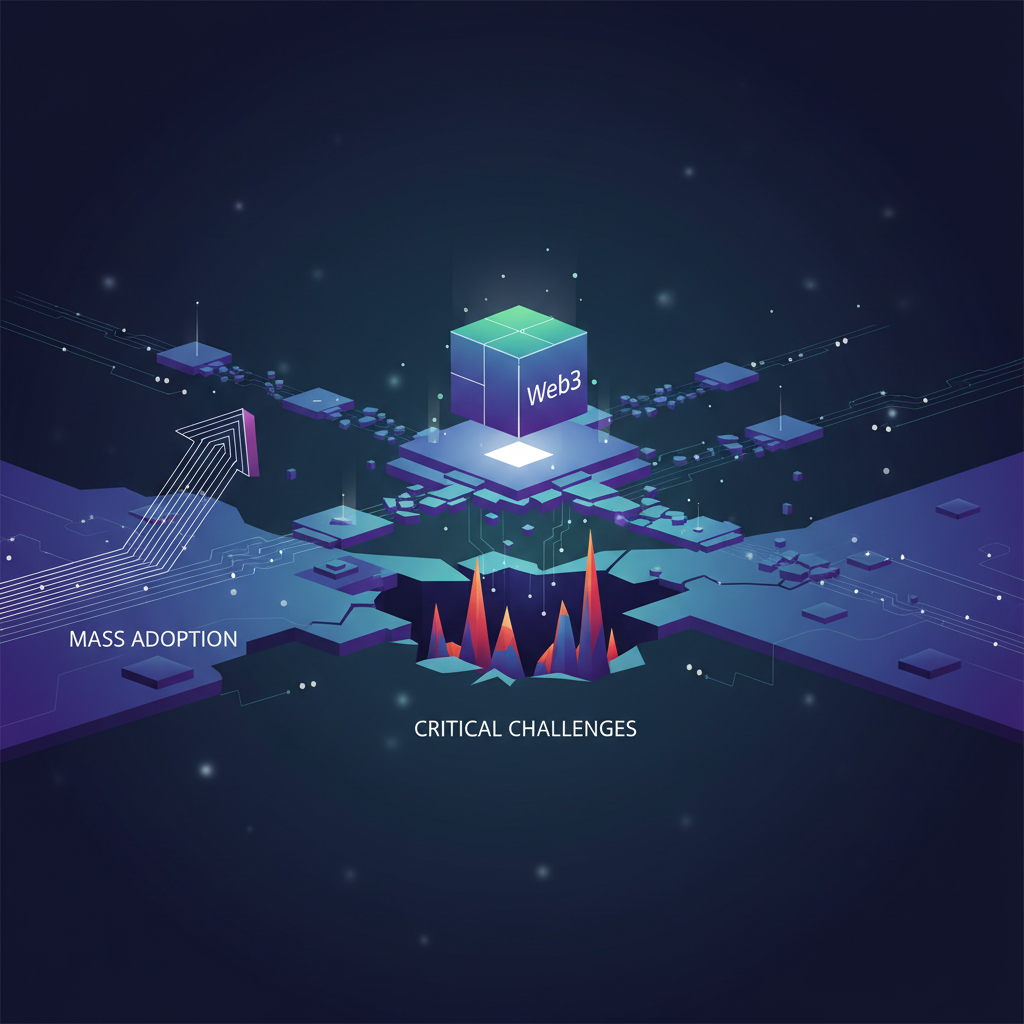
The Web3 ecosystem is at a decisive turning point. While decentralized applications (dApps) have proven their potential, the underlying infrastructure remains the true challenge for mass adoption. Beyond mere applications, an entire technological paradigm must evolve to support millions of users simultaneously.
According to 2025 industry data, Web3 infrastructure is growing at a sustained annual rate of nearly 30%, but this expansion reveals critical bottlenecks. Between limited interoperability, insufficient scalability, and security challenges, the foundations of the decentralized web require a profound overhaul, as confirmed by several analyses on the challenges of Web 3.0 and decentralization.

Interoperability: Breaking Blockchain Silos
One of the major obstacles to mass Web3 adoption lies in the fragmentation of blockchain networks. Each chain operates within its isolated ecosystem, creating technological silos that limit user experience and hinder innovation.
Emerging Cross-Chain Solutions
Interoperability protocols like Chainlink CCIP, LayerZero, and Axelar are emerging as essential bridges between blockchains. These solutions enable the transfer of assets and data between heterogeneous networks, but paradoxically introduce a form of centralization.
"Technical interoperability often relies on selected validators, creating a dependency that questions the promise of decentralization." - 2025 Industry Analysis
Cross-chain bridges and decentralized oracles form the backbone of this interconnection. They ensure reliable read/write operations between disparate blockchains, progressively eliminating the technical barriers that fragment the ecosystem.
Unified Digital Identity
Beyond asset transfers, interoperability also concerns self-sovereign digital identities. Open standards harmonize user profiles across different platforms, creating a fluid experience that masks underlying complexity.
| Interoperability Challenge | Key Solutions | Impact on Web3 |
|---|---|---|
| Blockchain Fragmentation | Cross-chain protocols (CCIP, LayerZero) | Inter-network asset/data transfer |
| Technological Silos | Cross-chain bridges, Decentralized Oracles | Reliable interconnection and barrier reduction |
| Usage Complexity | Self-sovereign digital identities | Profile harmonization and UX simplification |
Scalability: Rethinking Network Architecture
Scalability remains the Achilles' heel of traditional blockchain networks. Ethereum, on its main layer, processes only about fifteen transactions per second, far from the thousands needed to compete with centralized systems.
Layer 2 Solutions
Layer 2s like Optimism, Arbitrum, and Base are revolutionizing the scalability approach. These solutions:
- Offload transactions from main chains, often called layer 1.
- Maintain the security of the original consensus (e.g., Ethereum's consensus).
- Significantly multiply transactional throughput, making dApps more responsive.
- Drastically reduce gas fees, improving accessibility.
Sharding, a technique that divides networks into parallel sub-sets, significantly increases throughput without compromising decentralization. This distributive approach transforms the traditional monolithic architecture.
Decentralized Physical Infrastructure (DePIN)
DePIN networks represent a major innovation where participants share storage resources, bandwidth, and computing power. This mutualization enhances resilience while reducing dependence on centralized providers.
This distributed infrastructure proves particularly effective for applications requiring high availability and consistent performance on a global scale.
Security: New Protection Paradigms
Security in the Web3 ecosystem goes beyond simple cryptographic protection. It encompasses governance, smart contracts, and the resilience of distributed networks.
Advanced Consensus Mechanisms
Proof-of-Stake (PoS) protocols offer an optimal balance between energy efficiency and robustness against attacks. These systems use economic participation as a security guarantee, reducing the ecological footprint while maintaining network integrity.
Automated smart contract audits, integrated into development pipelines, detect vulnerabilities before deployment. This proactive approach minimizes the risk of costly exploits.
Decentralized Governance via DAOs
Decentralized Autonomous Organizations (DAOs) transform governance by eliminating centralized points of failure. These structures enable transparent collective decision-making, strengthening the legitimacy and resilience of protocols.
Distributed governance extends to protocol update mechanisms, ensuring consensus-driven evolution rather than one imposed by central entities.
User Experience: Masking Complexity
Mass adoption of Web3 fundamentally depends on user experience. Current interfaces, complex and unintuitive, are a major barrier to democratization.
Essential Technical Abstractions
Social login wallets revolutionize onboarding by allowing access via Google, Twitter, or Facebook. This simplification eliminates complex private key management while preserving security.
Modern interfaces automatically mask:- The complexity of transaction fees.
- Repetitive cryptographic signatures.
- Multi-chain management.
- Token conversions.
Integration with Existing Systems
Unlike earlier generations that required complete rebuilding, utility Web3 solutions are now integrating with traditional infrastructures. This hybrid approach facilitates the gradual transition to decentralization.
Convergence with Artificial Intelligence
AI-blockchain integration opens up unprecedented prospects for 2026. Machine learning models powered by decentralized data create powerful synergies between transparency and artificial intelligence.
These technological convergences enable:- Automatic optimization of transaction fees.
- Proactive detection of security anomalies.
- Personalization of user experiences.
- Automation of governance processes.
Regulatory Challenges and Institutional Adoption
Regulatory clarity is progressing significantly in 2025-2026, with regulatory clarification initiatives in the United States. This evolution facilitates institutional adoption by reducing legal uncertainty.
Companies are gradually integrating blockchain solutions into their accounting, normalizing the use of digital assets in traditional balance sheets.
According to Coinbase's analysis, interoperability remains essential to unlock the true potential of decentralized networks, despite the centralization compromises it sometimes entails.
Evolution Prospects
Web3 infrastructure in 2026 will be characterized by increased technical maturity, simplified user interfaces, and harmonious integration with the existing digital ecosystem. The current challenges of interoperability, scalability, and security are gradually finding viable solutions. These trends are confirmed by industry forecasts for 2025.
This evolution is not without compromise. As TradingView's analysis highlights, some interoperability solutions introduce forms of centralization that question the initial promises of absolute decentralization.
Nevertheless, the balance between practicality and decentralized ideology seems to be moving towards hybrid solutions that preserve the advantages of blockchain while offering the performance necessary for mass adoption. In this context, the rise of utility-focused dApps will be crucial for Web3's mass adoption.
Web3 infrastructure is evolving towards a mature ecosystem where transparency, trust, and performance coexist on a global scale. This profound transformation redefines not only decentralized applications but our entire relationship with the digital world.