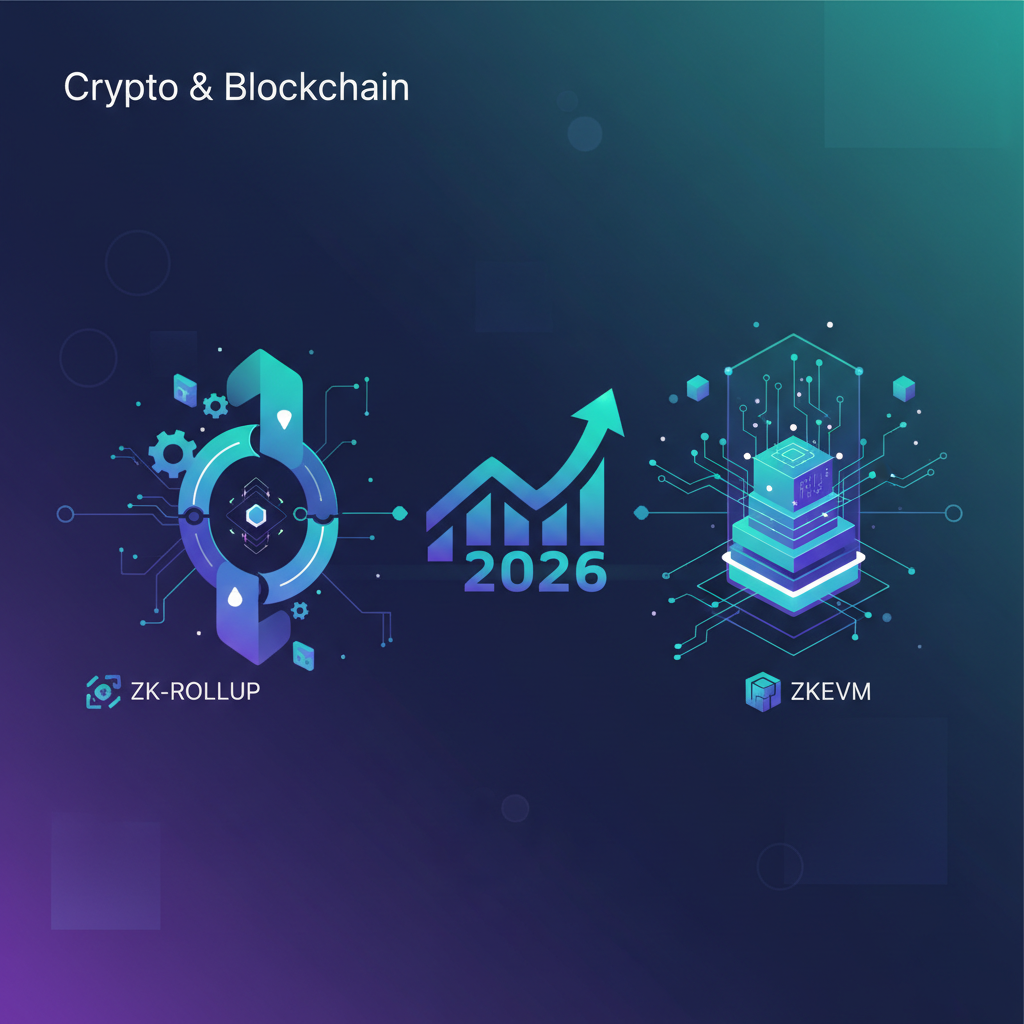
ZK-Rollups vs. zkEVMs: Which Solution Dominates Scalability in 2026?

Blockchain developers face a crucial dilemma: prioritize the maximum performance of native zk-Rollups or the immediate compatibility of zkEVMs? In 2026, this question structures the Ethereum scalability landscape, as both technologies offer fundamentally different trade-offs.
Technical Fundamentals: Two Approaches, Two Philosophies
Native zk-Rollups batch hundreds of off-chain transactions before submitting an ultra-compressed cryptographic proof to Ethereum's Layer 1. This minimalist architecture drastically reduces computational load: each SNARK or STARK proof validates thousands of operations in just a few bytes of data.
zkEVMs, on the other hand, replicate the Ethereum execution environment at Layer 2. This full compatibility allows developers to deploy their existing Solidity contracts without modification, using the same tools as Hardhat, Remix, or Foundry.
The distinction lies in the fundamental trade-off: native rollups optimize each instruction for proof generation, while zkEVMs preserve compatibility at the cost of computational overhead.
Performance and Throughput: The Measurable Advantage of Native Rollups
From a strictly technical standpoint, native zk-Rollups show remarkable performance metrics. Their processing capacity reaches tens of thousands of transactions per second, with confirmation latency ranging between 1 and 2 seconds.
zkEVMs like zkSync Era, Scroll, or StarkNet 2.0 have made significant progress, but their fees generally remain 20 to 40% higher than those of native rollups. This difference is explained by the increased complexity of proof generation: replicating the EVM in zero-knowledge requires much larger arithmetic circuits.
In 2026, native rollups offer transaction fees often below $0.001, compared to approximately $0.0015 for zkEVMs during standard traffic periods.
Layer 1 finality is another point of divergence. Native rollups can aggregate their proofs more efficiently, while zkEVMs sometimes require additional aggregation that slightly extends the final confirmation time.
Adoption and Developer Ecosystem: The zkEVM Advantage
While native rollups technically dominate, zkEVMs have won the battle for developer adoption. More than 150 dApps in production now run on these EVM-compatible platforms, covering DeFi, NFTs, blockchain games, and prediction markets.
This explosion is explained by the ease of migration: an established DeFi protocol on Ethereum mainnet can deploy on zkSync or Scroll in a few days, without rewriting its business logic. Teams retain their CI/CD pipelines, unit tests, and technical stack.
Projects choosing native rollups, however, must learn new languages (Cairo for StarkNet, Move for certain solutions), rebuild their libraries, and train their developers. This additional cost in time and expertise hinders adoption, even when performance gains would justify the transition.
The incentives dynamic also plays a role: zkSync and Polygon have deployed airdrop and grant programs that attract teams looking to diversify their multi-chain deployments.
Use Cases: When to Prioritize Each Solution?
For applications requiring maximum throughput and minimal costs – microtransaction payments, high-frequency on-chain gaming, massive volume NFT marketplaces – native zk-Rollups remain the optimal choice. Their economic efficiency becomes decisive when every fraction of a cent counts.
zkEVMs excel in three distinct scenarios:
- Established DeFi projects seeking rapid Layer 2 expansion
- Teams with limited Solidity expertise or tight deadlines
- Protocols requiring immediate interoperability with the Ethereum ecosystem
Ambitious new projects – those with substantial R&D resources and a long-term vision – tend to seriously evaluate native rollups. The initial development investment is offset by structural savings on transaction fees and a more streamlined architecture.
Ongoing Technological Evolution: Convergence or Divergence?
The boundary between the two families is becoming blurrier. Projects like StarkNet are working on hybrid virtual machines capable of executing Solidity while preserving Cairo's optimizations. Polygon is exploring "Type 1" zkEVMs that exactly replicate the EVM without compromise.
This technological convergence could eventually erase current distinctions. Several scenarios are emerging for 2027-2028:
- Complexity abstraction: multi-rollup development frameworks allowing compilation to different architectures from a single codebase
- Vertical specialization: native rollups optimized for specific use cases (gaming, finance, identity)
- Interoperability standards: messaging and liquidity bridging protocols making the choice of rollup less restrictive
Blockchain development companies are already adapting their offerings to support both paradigms, recognizing that no single solution meets all needs.
Cost Comparison and Impact
| Technology | Initial Development Costs | Recurring Operational Costs |
|---|---|---|
| Native zk-Rollups | High (learning, refactoring) | Low (L1 savings) |
| zkEVMs | Low (easy migration) | Higher (L2 gas fees) |
Real Costs: Beyond Transaction Fees
The financial comparison goes beyond simple gas fees. Development costs vary considerably: an existing Solidity team deploys on zkEVM with minimal marginal budget, while a native rollup requires several months of training and refactoring.
Operational costs also include sequencer maintenance, security audits (more complex for non-Solidity languages), and user experience management (wallets, explorers, integrations).
On scale, however, the structural savings of native rollups eventually compensate for the initial investment. A protocol processing several million transactions monthly saves tens of thousands of dollars annually in Layer 1 fees.
Outlook for Developers: Preparing for 2026 and Beyond
Savvy developers adopt a multi-level strategy. They rapidly prototype on zkEVM to validate their product-market fit, then evaluate a migration to a native rollup once user volume justifies the optimization.
This pragmatic approach recognizes that time-to-market often trumps pure technical efficiency. Crypto markets reward rapid execution, and a zkEVM deployment in three weeks is better than an optimal native rollup delivered six months later.
For projects related to cryptocurrencies and digital currencies, compatibility with existing standards remains critical. The question of infrastructure security also remains central, regardless of the chosen Layer 2 solution. It is useful to recall Vitalik Buterin's remarks on the evolution of Ethereum and the importance of scalability solutions for the platform, as he mentioned when advocating for the revival of ICOs and DAOs for the development of Ethereum's broader ecosystem and its 10x capabilities.
The choice between zk-Rollups and zkEVMs actually crystallizes a classic engineering trade-off: iteration speed versus long-term optimization, immediate compatibility versus maximum performance. In 2026, both technologies coexist because they meet legitimately different needs, and this diversity strengthens the Ethereum ecosystem rather than fragmenting it.
FAQ (JSON format - translate question and answer fields only):