
The Best Strategies for Preparing for Your Retirement: A Complete Guide

Retirement planning is one of the most crucial financial steps in life. In a world where life expectancy is increasing and pension systems are evolving, anticipation becomes not only wise, but essential. Failing to prepare means risking a significant decrease in your standard of living or being forced to work longer than desired. Fortunately, there are proven strategies and effective tools to build a serene financial future.
This article explores the fundamental approaches to ensuring a comfortable retirement. We will cover key aspects, from the initial steps of saving to diversified investments, including tax optimization and protecting your assets. The goal is to provide you with a clear and actionable roadmap, adapted to current economic realities, particularly considering the dynamics of key interest rates, as we analyzed in our article on projections for key interest rates in Canada and real estate in 2026.
On average, one in three Canadians believes they have not saved enough for retirement, according to a 2024 survey. Time is your best ally when it comes to retirement: the earlier you start, the more the effect of compound interest will work in your favor, transforming small, regular amounts into a substantial capital.
Understanding and Assessing Your Current Situation
Before embarking on investment strategies, it is imperative to conduct a complete assessment of your current financial situation. This step allows you to define realistic goals and measure the progress needed. A thorough analysis of your income, expenses, assets, and liabilities is the cornerstone of any effective retirement planning.
Calculate your ideal retirement age and financial needs
How old do you want to be when you stop working? And what standard of living do you wish to maintain? These are fundamental questions. The retirement age directly influences the duration of your savings phase and the amount needed to accumulate. Your financial needs, in turn, will determine the size of your retirement fund.
- Define retirement age: Whether you aim for 60, 65, or 70, every year counts.
- Estimate your future expenses: Take into account the cost of living, leisure activities, healthcare, and any potential projects (travel, moving).
- Account for inflation: The purchasing power of your savings will decrease over time, a crucial factor to integrate into your calculations.
According to the Financial Planning Institute of Canada, most retirees aim to replace 60% to 80% of their pre-retirement income to maintain their standard of living.
Evaluate your existing income and savings sources
Take stock of what you already own. This includes not only your savings and investments, but also state pensions, company pension plans, and other assets. This assessment will give you a solid foundation for building your plan.
- Public pension plans: Know your rights and estimated amounts (CPP/QPP in Canada, Social Security in the United States).
- Company plans: Pension funds, group retirement savings plans (Group RRSPs, 401k).
- Personal savings: Savings accounts, TFSAs, RRSPs, non-registered investments.
Implementing an Effective Savings Strategy
Regular and disciplined saving is the pillar of any retirement preparation. It's not just about setting money aside, but doing so strategically, maximizing tax advantages and automating the process.
Automate your savings and increase contributions
The best way to ensure the regularity of your savings is to automate it. Set up automatic transfers from your checking account to your retirement savings accounts each month. Furthermore, every increase in income should be an opportunity to increase your contributions.
- Automatic transfers: Set a fixed date to transfer a determined amount.
- "Pay yourself first" principle: Consider your retirement savings as a priority expense.
- Increase contributions with salary raises: Try to allocate a portion of your raises to your savings.

Explore different retirement savings vehicles
There are a multitude of options for saving for retirement, each with its own tax advantages and rules. Choosing the right vehicles is essential to optimize your wealth growth.
- RRSP (Registered Retirement Savings Plan): In Canada, contributions are tax-deductible, and earnings grow tax-deferred until withdrawal.
- TFSA (Tax-Free Savings Account): Ideal for short and long-term goals, withdrawals are entirely tax-free.
- 401(k) / IRA (United States): Plans similar to RRSPs, offering significant tax advantages for retirement savings.
Investment Strategies for Wealth Growth
Saving is one thing, investing is another. For your retirement capital to grow significantly, it is crucial to invest it intelligently. Diversification and a good understanding of financial markets are major assets.
Diversify your investments: a golden rule
Don't put all your eggs in one basket. Diversification is essential to reduce risks while maximizing potential returns. A diversified portfolio generally includes stocks, bonds, real estate, and other asset classes.
- Stocks: High growth potential, but also higher volatility.
- Bonds: Less risky, they offer regular income.
- Mutual funds and ETFs: Allow for easy and accessible diversification.
- Real estate: Can offer potential for income and capital appreciation. For an overview of current trends, consult our analysis of Wall Street trends and stock market outlook.
The importance of investment horizon and risk tolerance
Your investment horizon (the time you have left before retirement) and your risk tolerance are determining factors for the composition of your portfolio. A young investor can afford more risk than someone approaching retirement.
"Retirement planning is not a sprint, but a marathon. Patience and discipline are your best allies." - Warren Buffett
Tax Optimization and Withdrawal Management
Taxation plays a major role in the growth and preservation of your retirement wealth. Understanding how to optimize your taxes and plan your withdrawals is crucial to maximizing the net amount you receive.
Strategies to minimize retirement income tax
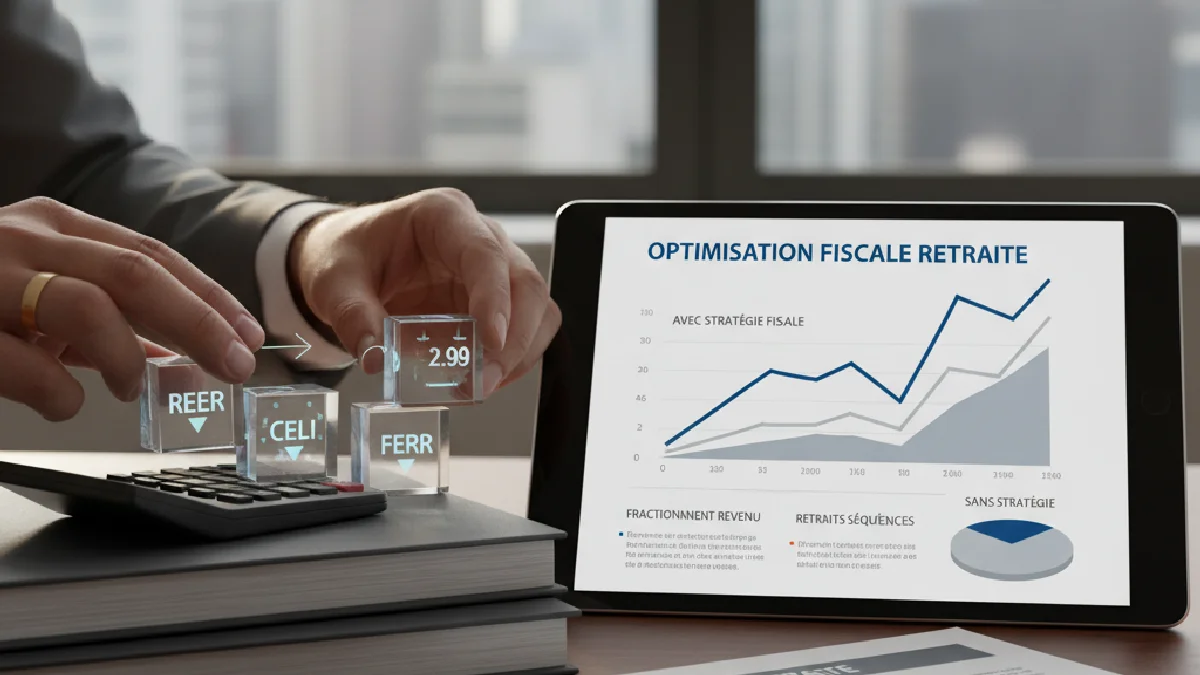
There are several ways to reduce the tax impact on your retirement income. Planning ahead allows you to take advantage of tax credits, spousal transfers, and the correct sequence of withdrawals.
- Pension income splitting: In Canada, allows you to share a portion of your pension income with your spouse to reduce overall tax.
- Strategic withdrawals from RRSPs/RRIFs and TFSAs: Use TFSAs first during low-income years after retirement, and defer withdrawals from RRSPs/RRIFs.
- Charitable donations: Planning donations can generate significant tax credits.
Plan the sequence of your withdrawals for financial longevity
The order in which you withdraw funds from your different accounts can have a significant impact on the lifespan of your savings. Careful planning is essential.
| Account Type | Tax Advantages | Withdrawal Recommendation (general) |
|---|---|---|
| TFSA / Roth IRA | Tax-free withdrawals | First (low tax impact) |
| Non-registered accounts | Growth taxed annually | Second |
| RRSP / RRIF / Traditional 401(k) | Taxable withdrawals | Last (defer tax) |
Complementary Solutions and Emergency Plans
Beyond classic savings and investment strategies, it is wise to explore complementary solutions and plan for unforeseen events. Health and well-protected assets are essential components of a serene retirement.
Real estate as a source of complementary income or asset
Real estate investment can play an important role in a retirement strategy. Whether as a mortgage-free primary residence or as a rental investment, real estate offers significant advantages. Moreover, central bank decisions, such as the Fed's rate cut in 2026, can strongly influence real estate markets.
- Debt-free property: Eliminating the burden of mortgage payments significantly reduces retirement expenses.
- Rental income: Investing in rental properties can generate a passive income stream.
- Capital appreciation: Real estate has historically shown a tendency to appreciate over the long term.
Forecasting healthcare expenses and insurance
Healthcare expenses are often underestimated in retirement planning. In Canada, despite the public system, certain expenses (medication, dental care, optical care) remain the responsibility of the individual. In the United States, the cost is even higher. Taking out supplementary insurance is a solution to consider.
- Supplementary health insurance: Covers costs not covered by the public system.
- Long-term care insurance: Protects against the high costs of home care or institutional care.
- Health emergency fund: Set aside funds specifically for medical emergencies.
Conclusion
Preparing for retirement is a journey that requires planning, discipline, and adaptability. By starting early, setting clear goals, diversifying your investments, and optimizing your taxes, you can build a solid financial future and fully enjoy your retirement years. Remember that everyone's situation is unique, and it is often wise to consult a certified financial planner to develop a personalized strategy. The importance of saving and judicious investments cannot be underestimated to ensure your long-term financial security. Explore our other articles on Finance & Investment for additional insights.
FAQ (JSON format - translate question and answer fields only):