
Tech IPOs: The Return to Grace of Initial Public Offerings Post-2023

Three years of scarcity, then an explosion. After almost disappearing from the financial landscape in 2023, technology initial public offerings are making a spectacular comeback, reshaping the contours of innovation investment. This dramatic resurgence is no accident: it results from a combination of favorable macroeconomic factors and a profound redefinition of investor expectations.

The End of a Long Winter: Conditions for Recovery
The freeze on tech IPOs in 2023 stemmed from a convergence of unfavorable factors: persistent inflation, rising key interest rates, and geopolitical tensions. But as early as 2024, the signals reversed. The gradual easing of macroeconomic tensions, combined with the stabilization of regulatory frameworks – notably the implementation of the MiCA regulation in Europe – created an environment conducive to the return of innovation investments.
The rebuilding of private equity fund balance sheets is the other major catalyst for this recovery. These investment vehicles have injected over 3.8 billion euros into 29 listed funds, creating a substantial pipeline of companies ready to go public.
"Confidence is returning to the European IPO market as the economic situation improves and interest rates gradually decline." - Morningstar, 2025
This dynamic is accompanied by a profound transformation of investment strategies, where the pursuit of profitability now takes precedence over promises of growth.
The Revolution of Investment Criteria
The era of unprofitable unicorns achieving stratospheric valuations based solely on the promise of a gigantic total addressable market seems to be over. Investors in 2026 are applying a radically different framework, focused on solid financial fundamentals.
The New Financial Imperatives
Profitability or a clear path to break-even is now the cardinal criterion. Companies seeking an IPO must demonstrate:
- Positive cash flow or controlled burn-rate leverage
- Sufficient liquidity to ensure market depth
- A minimum capitalization to attract institutional investors
This evolution is reflected in striking figures: the share of profitable IPOs climbed to nearly 90% in 2024, compared to just 66.4% the previous year, according to Morningstar's analysis.
| Investment Criterion | Before (Unicorns) | Today (Post-2023) |
|---|---|---|
| Primary Focus | Growth Promise | Profitability / Solid Fundamentals |
| Profitability | Often Unprofitable | Positive Cash Flow or Clear Trajectory |
| Liquidity | Secondary | Essential |
Sectors in Pole Position
This increased selectivity has naturally directed flows towards sub-sectors where demand remains robust and business models are proven.
Fintechs: The Age of Maturity
The financial technology services sector leads the way with 42 IPOs completed in 2025, totaling $9.5 billion raised. This performance exceeds the previous three years combined, illustrating the maturity achieved by this sector.
Mega-deals dominate this landscape, accounting for 79% of the amounts raised:- Klarna: $1.37 billion, the sector's largest IPO
- Circle: $1.05 billion, a major stablecoin player
- Chime: $864 million, a US neobank
Other Promising Sectors
Beyond fintechs, several other areas are performing well:
- Cybersecurity and cloud computing: The accelerated digitalization of businesses maintains sustained demand for SaaS solutions and IT security services.
- Greentech and cleantech: Environmental technologies benefit from a favorable regulatory context and growing demand for energy transition.
- Biotechnologies: Despite their risky profile, biotechs continue to attract capital, driven by post-pandemic therapeutic innovation.
The Geographical Effect: Between Opportunities and Challenges
The geography of tech IPOs reveals striking disparities. US markets retain their attractiveness, offering greater depth and better adaptation to the growth profiles of tech companies.
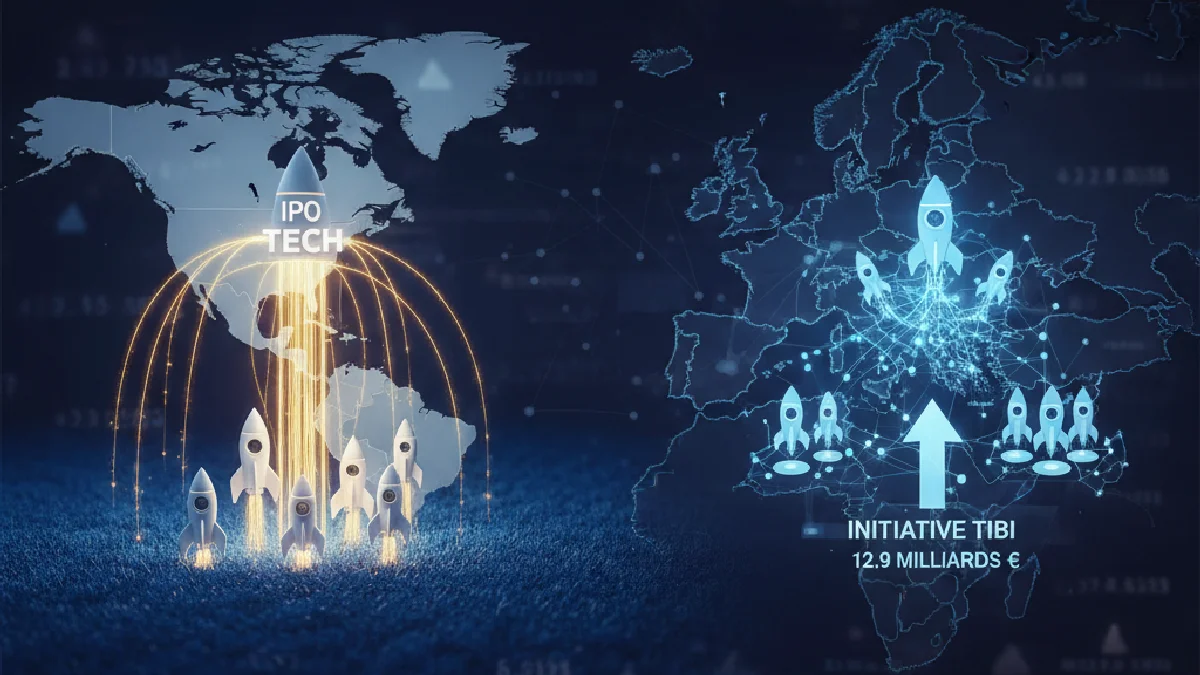
Europe, despite the progress of the MiCA regulation, still struggles to compete. France illustrates this difficulty with only six tech IPOs in 2023. However, the Tibi initiative is beginning to bear fruit: 34 institutional investors have announced cumulative commitments exceeding 12.9 billion euros to support the French technology ecosystem.
Volatility, the New Market Reality
While interest in going public is strong, the balance between supply and demand remains fragile. The example of Circle illustrates this extreme volatility: despite a successful fundraising, the stock experiences significant fluctuations, reflecting the persistent nervousness of investors towards technology companies, particularly those positioned at the intersection of tech, finance, and cryptocurrencies.
This instability reflects a transitional period where banking applications and strategic partnerships are redefining traditional business models.
The Future of Tech IPOs: Consolidation and Specialization
Analysis of current trends outlines a more mature and selective market. Mega-deals will likely continue to concentrate the bulk of volumes, leaving little room for small structures without robust business models.
This evolution is part of a broader context where investment strategies are evolving under the influence of central bank monetary policies.
Sectoral specialization is expected to intensify, with a premium placed on companies capable of demonstrating their resilience in niche markets or their innovation capacity in strategic areas such as artificial intelligence, cybersecurity, or green technologies.
For entrepreneurs and investment funds, this new reality implies more rigorous preparation of IPO dossiers, with a particular focus on demonstrating short-term profitability and the solidity of the business model. The era of distant promises is giving way to that of tangible performance.