ECB: Stable Rates in 2026, What Are the Implications for Savings and Credit?
For the fifth consecutive time, the ECB decided to keep its key interest rates unchanged at its meeting on February 5, 2026, as detailed in the ECB Economic Bulletin, Issue 1 / 2026. The deposit facility rate remains at 2%, the main refinancing operations rate at 2.15%, and the marginal lending facility rate at 2.40%. This decision, largely anticipated by the markets, marks a strategic turning point: after a period of aggressive hikes to combat inflation, the European Central Bank is now prioritizing stability. But beyond the official communiqués, what are the real consequences for households and businesses?
This prolonged monetary pause is reshaping the European financial landscape. Inflation is now hovering around the 2% target according to Morningstar data, offering the ECB unprecedented room for maneuver since 2022. For savers, borrowers, and entrepreneurs, this stabilization creates a predictable environment but also delicate trade-offs between return and security.

Mortgage Lending: Stability Changes the Game
The mortgage market shows a new face at the beginning of 2026. Average rates are around 3.3% for new home loans, according to the French real estate market in March 2026 and the latest data from the Observatoire Crédit Logement CSA. After reaching a low of 3.06% in June 2025, then rising to 3.17% in December, the curve has stabilized.
Impact on Mortgage Affordability
This slight increase in bank rates has measurable repercussions on households' borrowing capacity. A 0.3 percentage point increase reduces the purchasing budget by approximately 3 to 5%, depending on the loan term and the borrower's profile. For a couple wishing to borrow 250,000 euros over 20 years, this represents a loss of purchasing power between 7,500 and 12,500 euros.
First-time buyers and borrowers with a low down payment are particularly exposed. Banks maintain increased selectivity, favoring solid applications with a comfortable debt-to-income ratio and strengthened guarantees. The minimum down payment required often remains above 10% of the property value, compared to 5% before the health crisis.
“With interest rates already low at 2% and inflation hovering around the European Central Bank's target level of 2%, the bank is in no hurry to change its rates.” — Michael Field, Chief European Markets Strategist at Morningstar
Increased Visibility for Purchase Projects
However, the stabilization of key interest rates offers a valuable advantage: predictability. Households can now plan their real estate projects without fearing a sudden surge in financing costs, as was the case between 2021 and 2023. This visibility improves the ability to negotiate with sellers and secure borrowing conditions for several months.
The volume of loans granted remains nearly 29% lower than the average levels of the 2016-2019 period, a sign of a market still recovering but gradually normalizing.
| Indicator (Mortgage Lending) | Value in early 2026 | Impact / Remark |
|---|---|---|
| Average new loan rates | 3.3 % | Stabilized after variation |
| Purchase budget reduction | 3-5 % | Due to rate increase |
| Minimum down payment required | > 10 % | Increased bank selectivity |
Savings: Modest but Positive Real Returns
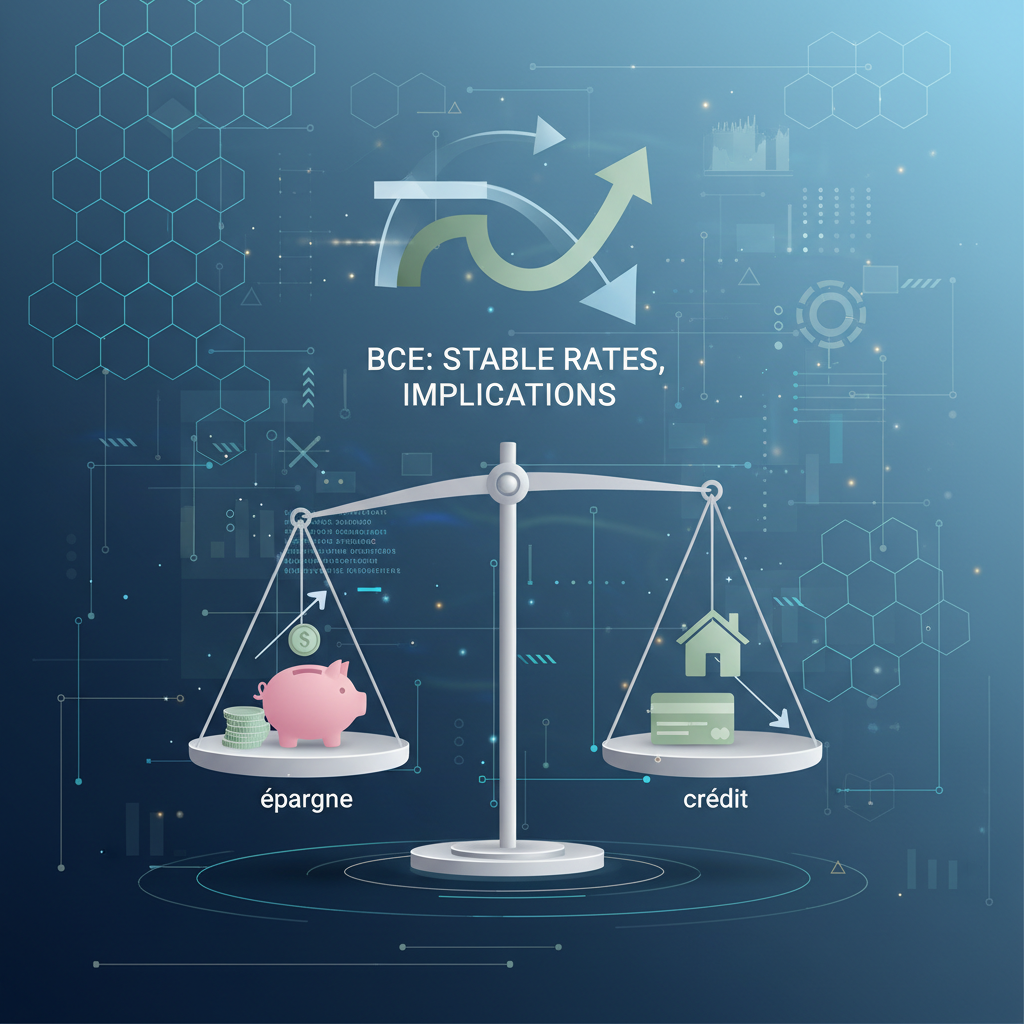
On the savings front, the landscape has profoundly transformed. The Livret A (French regulated savings account) was reduced to 1.5% on February 1, 2026, marking a logical decrease after the exceptional rates of 2022-2023. With inflation stabilized around 1.7% according to Eurostat flash data, this emblematic placement now offers a positive real return of approximately 0.5% after inflation.
Trade-off Between Security and Performance
This situation contrasts with that of 2022-2023, when rampant inflation eroded savers' purchasing power. However, a real return of 0.5% remains modest and prompts many households to reconsider their asset allocation. Term deposits, with a composite deposit rate for households and businesses at 0.9%, struggle to compete with other alternatives.
Euro funds in life insurance contracts show varying performances, generally between 2% and 2.8% for the best contracts. This range remains attractive for cautious profiles but raises questions for savers seeking more dynamic wealth growth.
Precautionary Savings on the Rise
Household savings rates remain high, fueled by persistent caution in the face of geopolitical and economic uncertainties. Rather than consuming or investing massively, many households prioritize building financial reserves. This defensive attitude is explained by the still fresh memory of successive shocks: pandemic, inflation, energy tensions.
To diversify without taking excessive risks, some savers turn to thematic ETFs, which allow controlled exposure to promising sectors while benefiting from appreciable liquidity and transparency.
Business Financing: Selectivity and Opportunities
Businesses are operating in a stabilized but demanding financing environment. New bank loans show an average rate of 3.6%, while bank credit growth has increased by 3% year-on-year. However, the overall volume of financing remains 25% lower than pre-2019 levels.
Strengthened Lending Criteria
Banks maintain a selective approach, favoring applications that demonstrate:- proven balance sheet strength,
- demonstrated profitability,
- clear market prospects.
Demands for personal guarantees and sureties have strengthened, particularly for VSEs and SMEs. The equity contribution required can reach 30 to 40% for certain investment projects.
This selectivity curbs the riskiest projects but promotes better credit portfolio quality. Businesses whose economic model withstands economic turbulence thus benefit from relatively favorable financing conditions.
Investment and Strategic Planning
Rate predictability is a major asset for medium-term investment decisions. Businesses can now develop equipment, modernization, or expansion plans without fearing a sudden deterioration in financing conditions. This visibility encourages structural projects, even if the absolute level of rates remains higher than in the 2015-2020 period.
Capital-intensive sectors – industry, logistics, energy – particularly benefit from this stability to calibrate their investment expenditures. In parallel, strategies for optimizing cash flow and managing dividends and distributions are becoming key levers for strengthening financial resilience.
Transatlantic Divergence and Impacts on the Euro
The European monetary policy clearly differs from that of the US Federal Reserve (Fed). While the ECB prioritizes stability, the Fed maintains higher rates to contain inflationary pressures across the Atlantic. This monetary divergence directly influences the euro-dollar exchange rate, with consequences for exporting companies and international investors.
A weaker euro favors European exports but makes imports more expensive, especially energy and raw materials. For households, the impact remains indirect but tangible: cost of travel, prices of certain imported goods, and indirectly, the profitability of listed companies.
Diversified investors must integrate this dimension into their stock market strategies, particularly to adjust their exposure to US markets and dollar-denominated assets.
Outlook and Adaptation Strategies
The ECB's strategy is based on a pragmatic approach: evaluating data meeting by meeting, without rigid pre-commitment. This flexibility means that any significant deterioration in inflation or growth could trigger a rate adjustment, both upwards and downwards.
For Potential Borrowers
- Anticipate rather than wait: even if rates remain stable, bank selectivity does not weaken. Building a solid application with a substantial down payment maximizes the chances of obtaining the best conditions.
- Actively negotiate: competition among banks remains real, and specialized brokers can leverage this competition to obtain more favorable rates or reduced fees.
For Savers
- Gradually rebalance: with modest real returns on risk-free investments, diversification into slightly more dynamic assets (unit-linked life insurance, diversified ETFs) may prove judicious for moderate profiles.
- Maintain a precautionary reserve: liquidity remains essential in an still uncertain context. Keeping the equivalent of three to six months of expenses in readily available accounts remains a rule of prudence.
For Businesses
- Secure structural financing: long-term projects benefit from being launched in this context of predictable rates, ensuring impeccable applications.
- Optimize cash flow management: short-term investments, negotiated treasury credits, and currency hedges for exporting companies become performance levers.