HL-LHC 2030: Superconducting Magnets and Physics Beyond the Standard Model
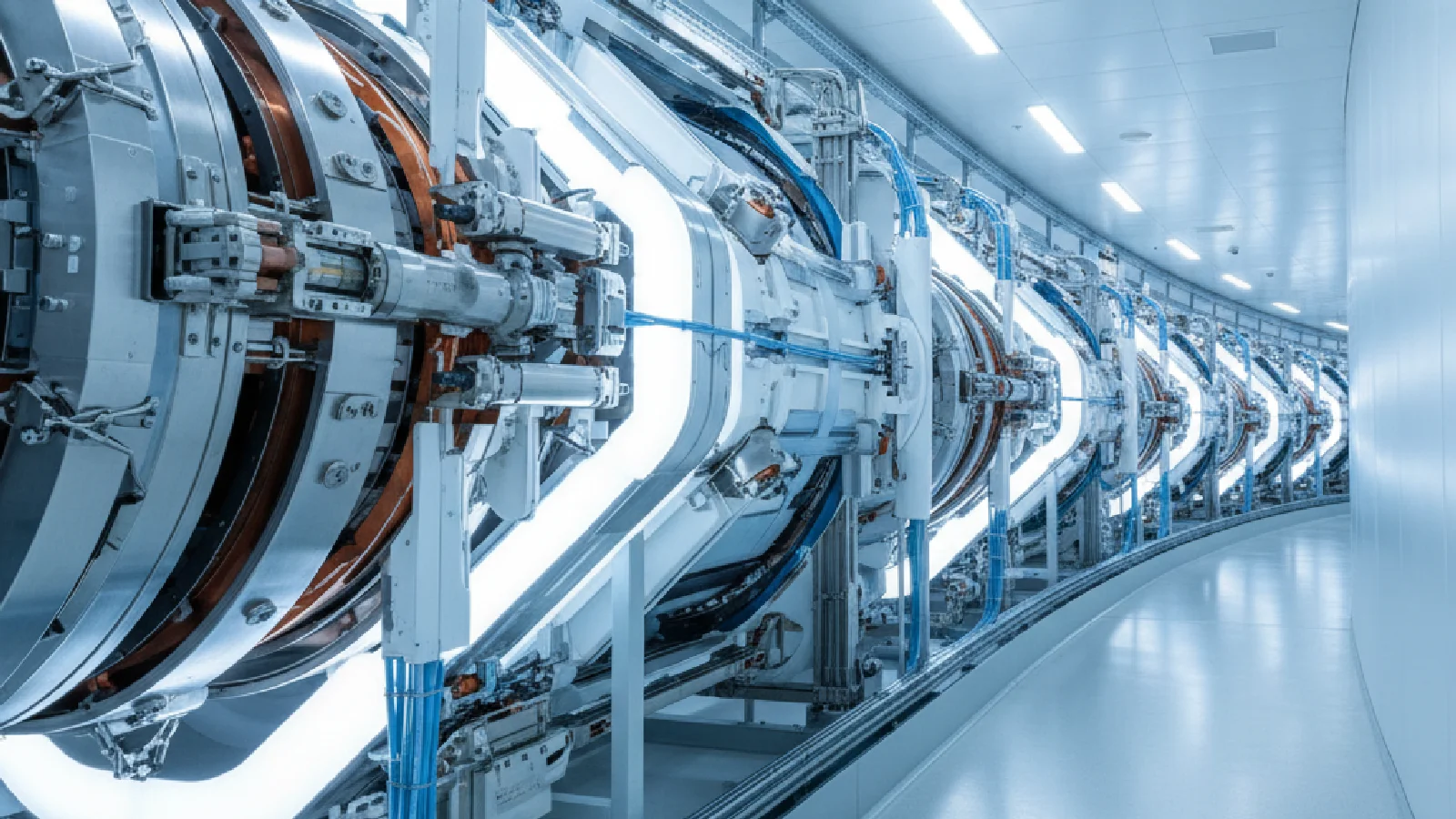
Under the Franco-Swiss border, within the 27-kilometer ring of the Large Hadron Collider, an unprecedented transformation is underway. After revealing the Higgs boson in 2012, the LHC is preparing to cross a new technological threshold. Starting in 2030, the High-Luminosity LHC (HL-LHC) will multiply the amount of data collected tenfold, opening a hunt for the universe's rarest phenomena. Between next-generation superconducting magnets and AI-powered processing systems, this transformation shapes the future of particle physics for the next fifteen years.
Adopted as the absolute priority of the European Strategy for Particle Physics in 2013, the HL-LHC project represents a colossal technical and scientific investment, with initial installation work set to begin in mid-2026.
Luminosity Multiplied by Five to Seven
The concept of luminosity refers to the number of particle collisions produced per second in the detectors. The higher the luminosity, the more rare events physicists can observe – and thus probe unexplored territories of the Standard Model. The HL-LHC aims for an instantaneous luminosity five to seven times higher than that of the current LHC, allowing for the collection of approximately 3000 fb⁻¹ of integrated data by the end of the 2030s.
Concretely, this means several hundred million Higgs bosons produced, compared to a few tens of millions until now. This abundance will enable unprecedented precision measurements of Higgs couplings, with error margins of around 1% or better, revealing potential deviations from theoretical predictions.
| Key Indicator | Current LHC | HL-LHC (Target) |
|---|---|---|
| Instantaneous Luminosity | Reference | x5 to x7 |
| Integrated Data | A few hundred fb⁻¹ | 3000 fb⁻¹ |
| Higgs Bosons Produced | Tens of millions | Hundreds of millions |

However, this beam intensification poses colossal challenges: increased radiation, extreme thermal load, and data volume exceeding several terabytes per second. Every component of the collider and detectors must be redesigned to withstand these new constraints.
Niobium-Tin Superconducting Magnets
At the heart of the HL-LHC are the superconducting magnets, key components that guide and focus proton beams at considerable energies. The current LHC magnets, made of niobium-titanium (NbTi) alloy, generate magnetic fields of approximately 8 teslas. For the HL-LHC, over 130 new large-aperture quadrupole magnets and 11 to 12-tesla dipole magnets made of niobium-tin (Nb₃Sn) will be installed.
“Nb₃Sn allows for much higher magnetic fields than NbTi, but its manufacturing and use require cutting-edge technologies.”
This transition to Nb₃Sn represents a major technological leap. The material, more performant but also more fragile and sensitive, requires ultra-precise manufacturing processes. Experimental dipoles reaching 13 teslas are even being tested for future applications, pushing the limits of the usable magnetic field in an accelerator even further.
The Irfu of CEA, in particular, crossed the symbolic threshold of 30 teslas in 2024 with a hybrid magnet composed of a high-temperature superconducting (HTS) insert coupled to a commercial magnet, validating the winding technologies and magneto-mechanical couplings essential for increasing the field.
Crab Cavities and Ultra-Focused Beams
To maximize the number of proton collisions, CERN engineers have developed superconducting crab cavities – devices that literally “tilt” proton bunches just before their collision, thereby increasing the overlap area of the beams. This transverse rotation, controlled with nanometer-scale precision, drastically improves the density of useful collisions.
Crab cavities, coupled with new large-aperture quadrupoles, allow beams to be concentrated into an extremely small section at the interaction point, thus increasing the probability of rare events without increasing particle energy. CERN announced in 2025 that it had already successfully completed the first bright beam tests, an encouraging sign for the commissioning of the HL-LHC around 2030.
Enhanced Collimation, Cryogenics, and Protection
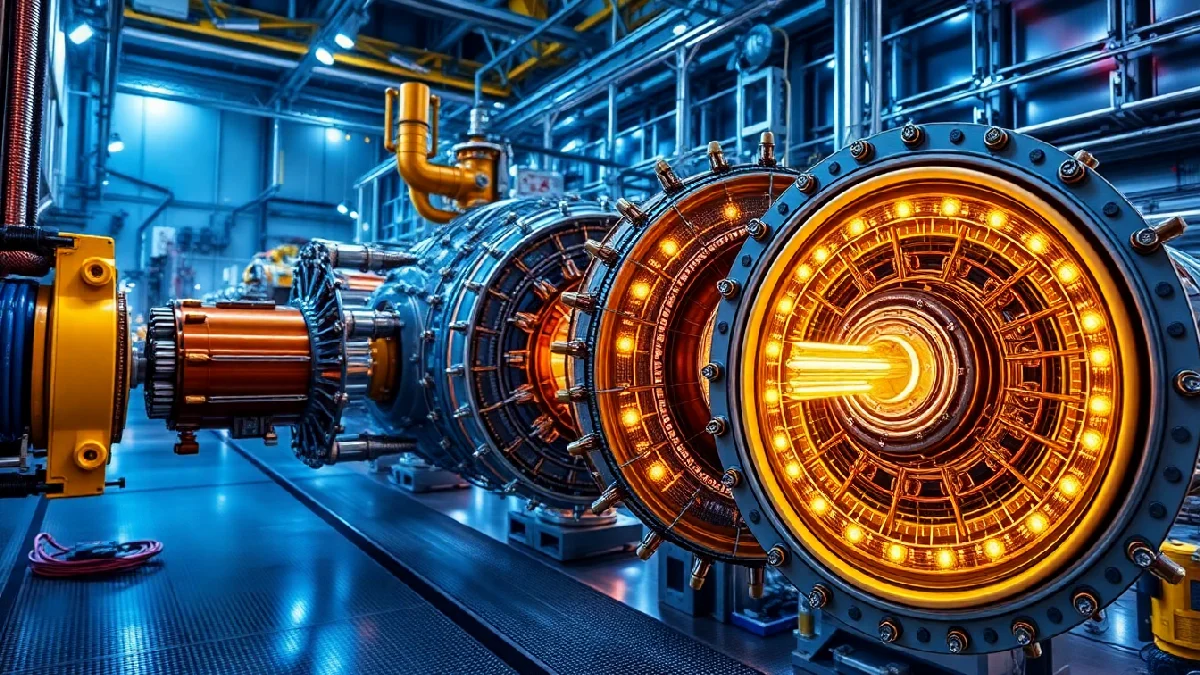
Increased beam intensity comes with an increased risk to the infrastructure. New collimation systems – magnetic “bumpers” – absorb stray particles before they can damage magnets or detectors. These collimators, integrated into strategic sections of the ring, must withstand phenomenal energy deposits.
In parallel, the cryogenic network is reinforced to maintain the magnets at a temperature close to absolute zero (approximately 1.9 Kelvin), an essential condition for superconductivity. Very high-current superconducting lines ensure energy transport with near-zero losses, while power supplies and vacuum systems are modernized to cope with the increased thermal and radiative load.
ATLAS and CMS Detectors: A Complete Renovation
The two giant LHC detectors, ATLAS and CMS, will be entirely renovated to withstand the extreme conditions of the HL-LHC. The cumulative radiation dose will be such that many current components would not survive a decade of operation. New generations of sensors, semiconductors, and electronic readout systems must combine resistance, speed, and precision.
Universities and laboratories worldwide are contributing to this modernization. The University of Geneva, for example, has significantly participated in ATLAS improvements, as highlighted by Mark Thomson, the next CERN Director-General, who will take office in January 2026 and will be responsible for overseeing the realization of the HL-LHC during his first mandate.
Artificial Intelligence and Massive Data Processing
With several terabytes of data produced every second, the computational challenge of the HL-LHC is staggering. Current processing systems, already among the most powerful in the world, would not suffice. This is why teams are relying on artificial intelligence and distributed computing architectures to sort, filter, and analyze in real-time the millions of recorded events.
Deep learning algorithms will be deployed at the detector level to quickly identify potentially interesting collisions, thereby reducing the volume of data to be stored without losing crucial information. This methodological innovation transforms how experimental physics is conducted, bringing data science and fundamental research closer together – a convergence also observed in other fields such as global cancer research.
Beyond the Standard Model: Dark Matter, Supersymmetry, and Hidden Dimensions
While the Standard Model successfully describes known particles and forces, it leaves countless questions unanswered. What is dark matter, which accounts for 85% of the universe's matter? Why has antimatter almost disappeared? Do neutrinos hide new physics? Do extra dimensions of spacetime exist?
The HL-LHC aims to explore these unknown territories through precision and data volume. Priority areas include:
- Supersymmetry (SUSY): search for supersymmetric particles, hypothetical partners of known particles, which could explain dark matter.
- Dark matter: detection of indirect signatures of weakly interacting massive particles (WIMPs) or other exotic candidates.
- CP violation and matter-antimatter asymmetry: ultra-precise measurement of asymmetries to understand why the universe is made of matter and not antimatter.
- Extra dimensions: search for deviations in Higgs couplings or other rare processes that could betray the existence of hidden dimensions.
As highlighted by the Canadian Long Range Plan for Subatomic Physics 2022-2026, exploration beyond the Standard Model mobilizes international collaboration whose benefits extend beyond fundamental physics, also fueling technological and medical innovation – a parallel observable with advances in biotechnology and biomedical research.
An Ambitious Schedule Until 2040
The long technical shutdown LS3 (Long Shutdown 3), scheduled from 2026 to 2029, will mark the beginning of the HL-LHC equipment installation. During this period, entire sections of the ring will be dismantled, hundreds of magnets replaced, and detectors reconfigured. Progressive commissioning will extend until the early 2030s, with a gradual increase in luminosity. CERN's budget for 2026, as detailed in a document on the CERN Document Server, includes the necessary investments for this transition.
By 2040, the HL-LHC will have collected the equivalent of ten times the data accumulated by the LHC since 2008, representing an unprecedented scientific legacy for future generations of physicists. This prospect also fuels discussions about the post-HL-LHC era: the Future Circular Collider (FCC) project, a 100-kilometer ring capable of reaching even higher energies, remains under discussion at CERN, as confirmed by Mark Thomson during his first statements in 2025. For more information on the LHC's successor and future plans, resources are available, including an article explaining that the HL-LHC will succeed the LHC in 2030.