LK-99 and the Quest for the Holy Grail: What's the Status of the Superconductor?
In July 2023, a group of South Korean researchers shook the global scientific community by announcing the synthesis of LK-99, a material that could exhibit superconductivity properties at ambient temperature and pressure. For a few weeks, the excitement was palpable: laboratories, media, and financial markets held their breath at what could be one of the greatest technological breakthroughs of the century. But very quickly, rigorous verification of the results revealed a completely different reality.

The Announcement That Ignited the Scientific World
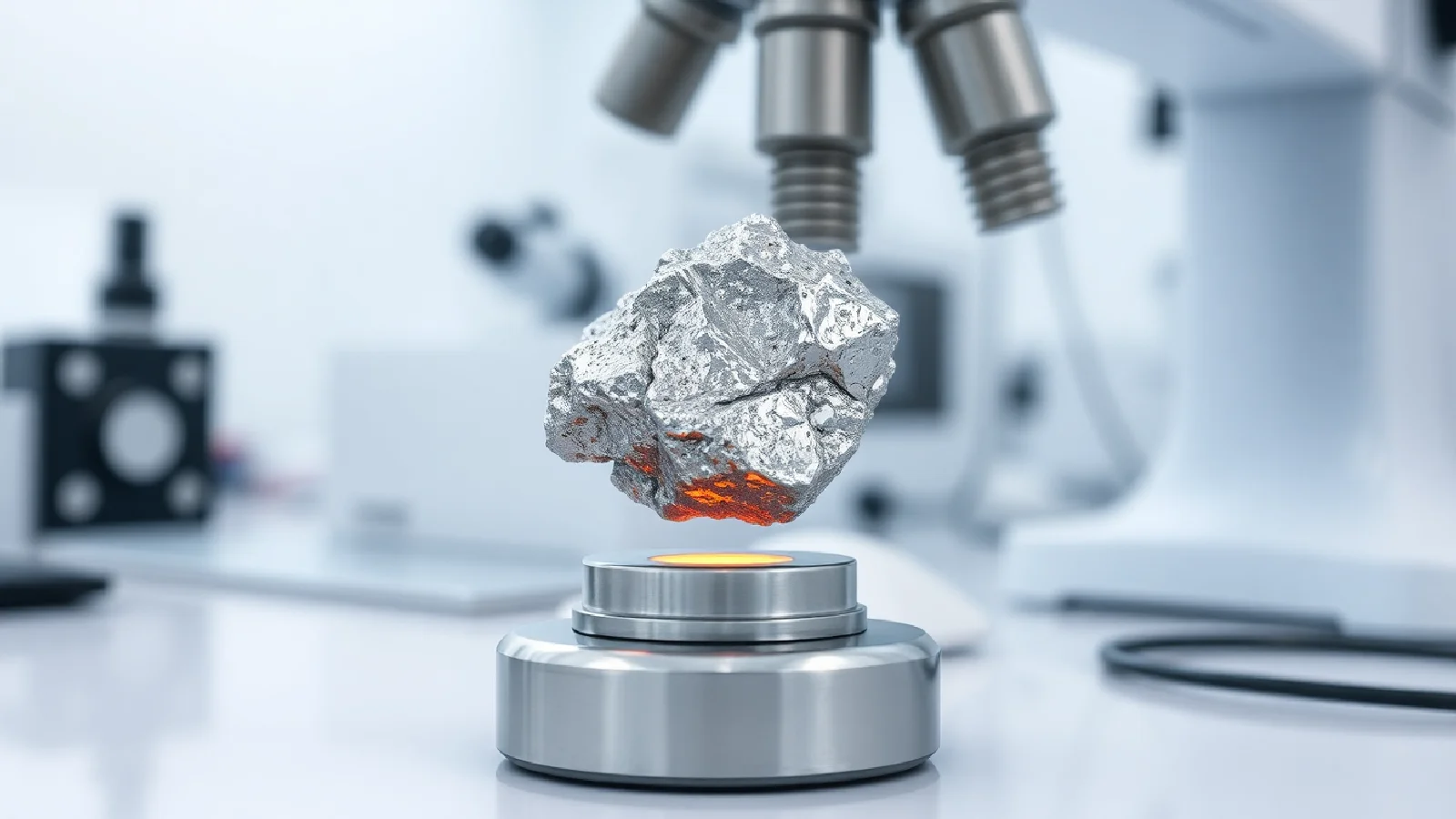
When physicists Sukbae Lee and Ji-Hoon Kim posted their work on the arXiv preprint server, videos accompanying their articles showed an LK-99 sample in partial levitation above a magnet, one of the emblematic signs of superconductivity. The material, a compound based on lead, copper, and phosphate (Pb₁₀₋ₓCuₓ(PO₄)₆O), promised zero electrical resistance without requiring extreme cooling.
The potential impact would be colossal. A superconductor operating under ordinary conditions would revolutionize entire industries: lossless electrical grids, affordable magnetic levitation trains, tenfold increase in quantum computer power, revolutionized medical imaging. The scientific community immediately mobilized to try and reproduce the results.
The Race to Replication and the First Doubts
In the following days, dozens of laboratories worldwide embarked on a frantic race to synthesize and test LK-99. From the Max Planck Institute in Germany to Peking University, and American research centers, everyone tried to validate or invalidate the announced properties.
Soon, replication attempts systematically failed. The produced samples did not show a superconducting transition at room temperature. Some groups did observe slight magnetic levitation, but this was explained by a common phenomenon of ferromagnetism or diamagnetism, unrelated to superconductivity.
“The tragedy of science is that a beautiful hypothesis can be destroyed by an ugly fact,” recalled biologist Thomas Henry Huxley, a quote particularly relevant in this context.
By the end of August 2023, the scientific consensus began to emerge: LK-99 is ultimately not a superconductor at ambient temperature and pressure.

The Parasitic Phase That Explains Everything
In September 2023, several research teams published detailed analyses identifying the origin of the misleading observations. The material contains a parasitic phase, notably copper sulfide (Cu₂S), which explains both the apparent drop in electrical resistance and the observed magnetic properties.
This crystalline impurity exhibits characteristics that can, under certain experimental conditions, superficially mimic the signatures of a superconductor. Researchers explain that the synthesis of LK-99 generates secondary compounds whose properties were confused with superconductivity. The scientific community now understands what might have misled the South Korean team, without suggesting deliberate fraud.
This conclusion is unanimous among physicists. Julien Bobroff, professor at Paris-Saclay University, emphasizes the need for rigorous validation before any major announcement, recalling other recent controversies in the field.
| Aspect of the LK-99 Controversy | Explanation |
|---|---|
| Initial Observation | Partial levitation and drop in electrical resistance. |
| Discovery of the Error | Presence of a parasitic phase (copper sulfide, Cu₂S) mimicking superconductivity properties. |
| Experts' Conclusion | LK-99 is not a superconductor at ambient temperature and pressure. |
Lessons from a Scientific Saga
The LK-99 episode is part of a series of false hopes that punctuate the history of superconductivity research. In 2020, a publication in the journal Nature by physicist Ranga Dias, announcing a room-temperature superconductor under high pressure, had already been retracted in November 2023 following allegations of data fabrication. Eight of the eleven co-authors then acknowledged that the article “did not accurately reflect the provenance of the materials studied.”
These setbacks highlight several fundamental imperatives of research:
- Transparency of protocols: the origin of materials, measurement methods, and data processing must be unambiguously documented.
- Independent reproducibility: no major discovery can be validated without replication by external teams.
- Media caution: prematurely announcing unverified results harms the credibility of science.
A Beneficial Shock for Research
Despite its disappointing conclusion, the LK-99 affair had unexpected positive effects. The global mobilization it triggered demonstrates the vitality of the field. In a few weeks, hundreds of researchers collaborated openly, sharing their results in real-time on preprint platforms and scientific social networks.
This saga also rekindled interest in compounds with manipulable crystalline structures, particularly lead and copper-based materials. Numerous theoretical and experimental works have been stimulated, exploring new avenues to design classes of materials likely to achieve superconductivity under less extreme conditions.
Researchers are now examining with renewed interest families of cuprates, organic, and hybrid compounds. Some teams are exploring promising paths in high-pressure superconductors, where remarkable critical temperatures have already been observed, although still requiring pressure conditions inaccessible for practical applications.
What is the True Status of the Quest for the Holy Grail?
To date, the scientific consensus remains clear: no superconductor operating at ambient temperature and pressure has been reliably confirmed. The best current candidates remain hydrides under very high pressure, which achieve high critical temperatures but require pressures of several million atmospheres.
Practical applications of superconductivity still rely on cooled materials, either by liquid nitrogen (77 K, or -196°C) for high-temperature critical superconductors discovered in the 1980s, or by liquid helium (4 K, or -269°C) for conventional superconductors. These technologies are already used in magnetic resonance imaging (MRI), particle accelerators, and some transport prototypes.
Fundamental research continues to explore several parallel avenues. Advances in archeometry and non-destructive analysis techniques now allow materials to be characterized with unparalleled precision, facilitating the identification of crystalline structures favorable to superconductivity.
An Expectation That Fosters Caution
The story of LK-99 teaches an essential lesson: in the quest for the scientific Holy Grail, patience and methodological rigor are better than hasty enthusiasm. Each false hope nevertheless refines the understanding of the complex quantum phenomena that govern superconductivity.
Physicists continue their investigations with increasingly sophisticated theoretical and experimental tools. Quantum simulations, artificial intelligence applied to material discovery, and new synthesis techniques open up unprecedented perspectives. If the Grail remains to be reached, the scientific community now has a clearer roadmap to avoid dead ends.
The LK-99 saga will remain in the annals as a salutary reminder: in science, shortcuts do not exist. Verification, reproducibility, and intellectual humility remain the pillars upon which any authentic discovery rests. And it is precisely this demand that, tomorrow, may finally allow us to cross the long-sought threshold.