
Wi-Fi 7 Mesh: Real-world Performance vs. Marketing Promises

The promises of Wi-Fi 7 are enticing: theoretical speeds reaching 46 Gbps, near-zero latency, perfect stability. But what is the reality once it's installed in our living rooms? Early feedback from Wi-Fi 7 mesh system users paints a more nuanced picture, revealing both real progress and some disillusionment compared to marketing expectations.

Real Speeds: Between 1 and 2 Gbps per Device
Initial tests conducted under domestic conditions show that Wi-Fi 7 mesh networks indeed offer significantly higher speeds than previous generations. However, the reality is far from the 46 Gbps theoretical speeds announced by manufacturers.
In practice, real speeds generally range between 1 and 2 Gbps per device, depending on the distance from the main node and the number of connected devices. This performance, while impressive compared to Wi-Fi 6, remains dependent on several crucial factors.
The quality of your Internet connection is the primary bottleneck. Even with a high-end Wi-Fi 7 mesh system, it's impossible to exceed the limits of your fiber or ADSL subscription. This paradox highlights the importance of a holistic approach to home network infrastructure.
"The gains are real, but you need to adjust your expectations to your existing network environment."
To maximize performance, some users are now combining their Wi-Fi 7 equipment with emerging pre-6G technologies, creating particularly high-performing connected ecosystems.
| Characteristic | Wi-Fi 7 (Theoretical) | Wi-Fi 7 (Real) |
|---|---|---|
| Max Speed | 46 Gbps | 1-2 Gbps per device |
| Latency | Near-zero | 1-2 ms |
The Latency Revolution Thanks to MLO
One of the major advantages of Wi-Fi 7 lies in its Multi-Link Operation (MLO) feature, which simultaneously utilizes the 2.4 GHz, 5 GHz, and 6 GHz bands. This innovation truly transforms the user experience, especially for latency-sensitive applications.
Measurements show latency dropping from approximately 17 ms in early readings to 1-2 ms in optimized configurations. A spectacular improvement that directly benefits gamers, teleworkers in video conferences, and virtual reality application users.
This 5 to 10-fold reduction in latency compared to previous generations is immediately noticeable during use. Shorter response times improve browsing fluidity, reduce lag in online games, and optimize the synchronization of connected devices.
Signal Stability: Tangible Progress but Persistent Limitations
Wi-Fi 7 mesh systems like the TP-Link Deco BE9300 or the NETGEAR Orbi Wi-Fi 7 demonstrate smoother handling of device movement within the home. Handover between nodes is more seamless, reducing micro-interruptions during changes in coverage areas.
Resistance to interference also improves, particularly in dense urban environments where networks are proliferating. The less congested 6 GHz band offers valuable breathing room for compatible devices.
However, range remains sensitive to physical obstacles. Thick walls, metallic structures, and multiple floors continue to significantly affect signal propagation. Even with mesh technology, strategic node placement remains crucial for optimal coverage.
The Importance of Compatible Devices
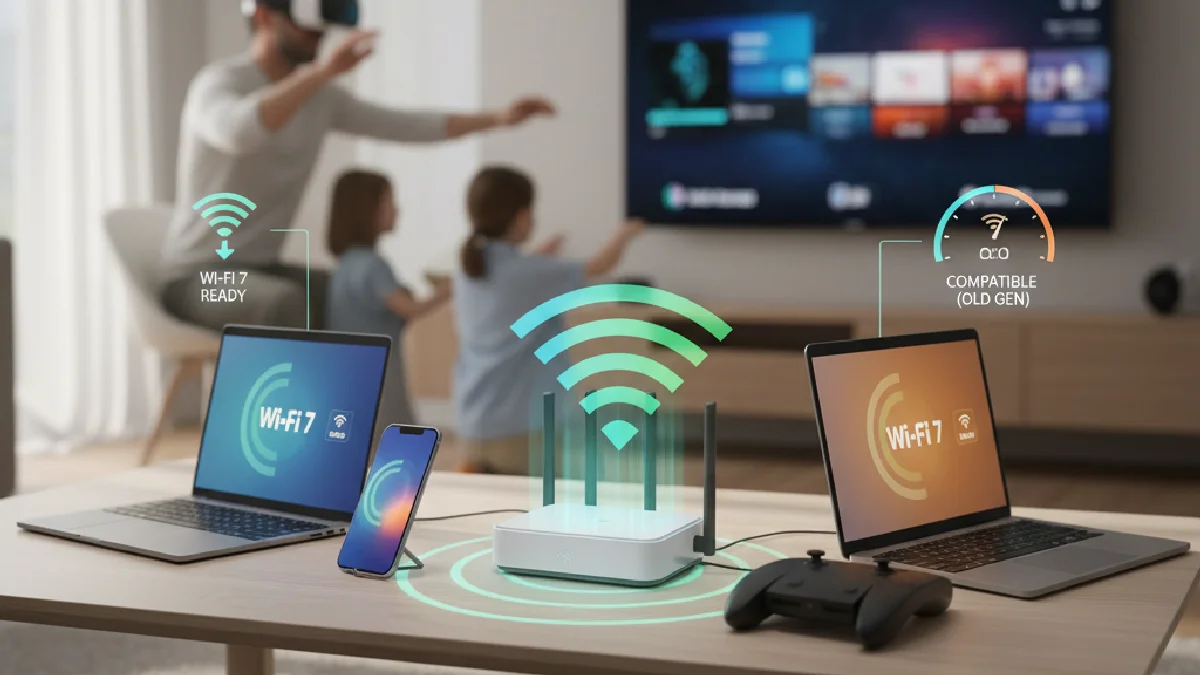
An often-overlooked aspect: final performance depends on the number of Wi-Fi 7 compatible devices in your home. Recent smartphones, 2024-2025 laptops, and new-generation consoles are starting to integrate this technology, but the transition remains gradual.
Non-Wi-Fi 7 compatible devices work perfectly thanks to backward compatibility, but obviously do not benefit from the improvements. This technological coexistence sometimes creates situations where the investment in a high-end mesh system only partially translates into noticeable gains.
For users of advanced streaming systems, this compatibility becomes crucial to fully exploit the capabilities of their equipment.
Comparison with Alternative Solutions
Facing the emergence of Wi-Fi 7 mesh, other solutions retain their relevance depending on usage contexts. Satellite connections like Starlink offer an interesting alternative for areas poorly covered by fiber, even if latency remains higher.
The choice between Wi-Fi 7 mesh and other technologies largely depends on your specific needs:
- Competitive gaming: Wi-Fi 7 mesh recommended for low latency
- Simultaneous 4K/8K streaming: excellent performance with new systems
- Intensive teleworking: constant stability and speed appreciated
- Smart home: improved management of multiple IoT devices
Installation and Configuration: Simplicity is Key
Paradoxically, despite their technical complexity, Wi-Fi 7 mesh systems simplify home installation. Manufacturers' mobile applications effectively guide the configuration process, making this advanced technology accessible.
Automatic channel configuration and intelligent bandwidth management significantly reduce manual interventions. A welcome evolution that contrasts with the complexity of settings on traditional routers.
This ease of use democratizes access to Wi-Fi 7 performance, even for less technical users. A decisive factor for the widespread adoption of this technology in homes.
Cost vs. Benefits: Justified Investment?
Wi-Fi 7 mesh systems represent a significant investment, generally two to three times more expensive than their Wi-Fi 6 equivalents. This price difference legitimately raises the question of return on investment.
For multi-device households with high bandwidth needs, the gains often justify the expense. However, for basic use – web browsing, occasional streaming, a few connected devices – Wi-Fi 6E may suffice for several more years.
Technological lifespan is another factor to consider. Investing in Wi-Fi 7 today ensures compatibility with future developments, avoiding premature replacement.
The progressive adoption of Wi-Fi 7 is gradually transforming the home network experience. While marketing promises require some nuance, the real gains in terms of speed, latency, and stability justify the growing interest in this technology. For demanding households, upgrading to Wi-Fi 7 mesh today represents a relevant future investment, provided expectations are adjusted to existing technical and infrastructural realities.