Wi-Fi 7 Mesh vs. Wi-Fi 8: The Adoption Dilemma Facing the Future
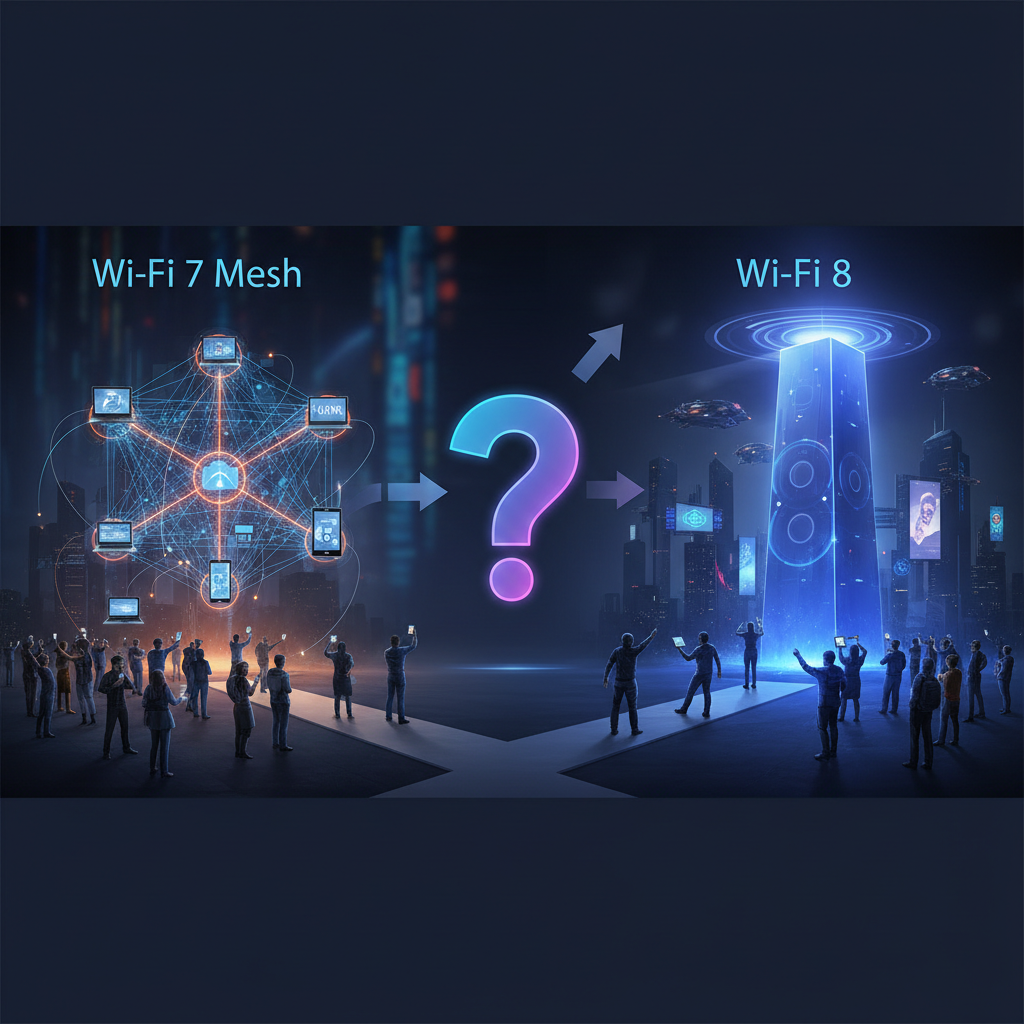
The Wi-Fi network market is undergoing an unprecedented period of transformation. While Wi-Fi 7 mesh systems are gaining popularity, with shipments increasing from 41.7 million units in 2024 to over 63 million projected in 2026, the announcement of Wi-Fi 8 is disrupting technological adoption strategies. This unprecedented situation presents consumers and businesses with a crucial dilemma: invest now in a mature technology or wait for the next revolution?
The Wi-Fi 7 Mesh Boom: Accelerating Adoption
Wi-Fi 7 has marked a decisive turning point in the home and professional networking industry. Wi-Fi 7 access points are expected to reach nearly 118 million annual shipments by 2026, reflecting massive enthusiasm for the 6 GHz band and increased throughput capabilities. For an in-depth understanding of Wi-Fi 7 capabilities, you can consult this white paper on Wi-Fi 7.
This spectacular growth is explained by several major technical factors. Wi-Fi 7 brings a maximum theoretical capacity of 46 Gbps, a substantial improvement over previous generations. The integration of the 6 GHz band offers a less congested spectrum, particularly crucial in dense environments where interference limits performance.
Mesh systems particularly benefit from these advances. Multi-Link Operation (MLO) technology allows devices to connect simultaneously across multiple frequency bands, automatically optimizing performance based on network load and distance. This intelligent coordination eliminates many of the dead zones traditionally problematic in large homes or offices.
Wi-Fi 8: Intelligence Trumps Raw Speed
Contrary to expectations, Wi-Fi 8 is not focused on a speed race. According to Light Reading experts, this new standard prioritizes reliability and connection intelligence over increasing maximum throughput.
Key Wi-Fi 8 innovations focus on multi-AP coordination with three revolutionary technologies:
- Co-TDMA (Coordinated Time Division Multiple Access): synchronizes spectrum access between multiple access points
- Co-SR (Coordinated Spatial Reuse): optimizes spatial frequency reuse
- Co-BF (Coordinated Beamforming): coordinates beamforming between devices
These technologies specifically aim to eliminate dead zones and improve latency in complex mesh deployments. The extension of the 6 GHz spectrum from 7.125 GHz to 7.25 GHz also adds a 320 MHz channel and a 180 MHz channel, valuable resources in saturated environments.
"The rudiments of name updates on speed and throughput are implemented in Wi-Fi 7. It's almost Wi-Fi 7.1." - Jeff Heynen, VP at Dell'Oro Group

Deployment Timing: A Decisive Factor
Deployment timing becomes a crucial strategic element. Wi-Fi 7 mesh systems benefit from immediate availability and extensive compatibility with current devices. The mature ecosystem allows users to fully enjoy the capabilities offered without waiting.
Conversely, the first commercial Wi-Fi 8 products are not expected until early 2028. This timeline reflects the technical complexity of multi-AP coordination features, requiring extensive development and testing phases.
Given that widespread adoption of a new Wi-Fi standard typically takes two to three years, users who invest in Wi-Fi 7 today will have relevant technology until the early 2030s. This amortization period largely justifies the investment for most use cases.
| Feature | Wi-Fi 7 | Wi-Fi 8 |
|---|---|---|
| Availability | Immediate | 2028 (commercial products) |
| Priority | Raw speed (46 Gbps) | Intelligence and reliability |
| Key Technologies | MLO (Multi-Link Operation) | Co-TDMA, Co-SR, Co-BF (multi-AP coordination) |
| Ecosystem Maturity | Established | In development |
Specialized Applications: Where Wi-Fi 8 Will Excel
Certain environments will particularly benefit from Wi-Fi 8 innovations. Businesses managing many simultaneous devices, university campuses, or high-density areas will see their network performance significantly improved.
MediaTek's research highlights that multi-AP coordination will fundamentally transform interference management and spectral resource optimization. This evolution will be particularly visible in large-scale mesh deployments.
Critical applications requiring ultra-low latency and maximum reliability will be the first use cases for Wi-Fi 8. Virtual reality systems, Industry 4.0, and dense IoT infrastructures represent niche markets where early investment could be justified. To learn more about this vision of Wi-Fi 8, consult DesignNews.
Investment Strategies: Navigating Between Present and Future
Investment decisions fundamentally depend on specific needs and time horizon. For immediate deployments requiring high performance, Wi-Fi 7 mesh is the optimal choice. Mature technology, a developed ecosystem, and extensive compatibility guarantee a rapid return on investment.
Organizations planning their infrastructure for the long term can consider a hybrid approach. Deploying Wi-Fi 7 for immediate needs while preparing a gradual migration to Wi-Fi 8 for critical areas allows for optimized investments.
This strategy is particularly relevant for companies whose infrastructures evolve gradually. Interoperability between generations facilitates staggered transitions according to operational and budgetary priorities.
The Industry Ecosystem Facing the Transition
The semiconductor industry is already anticipating this transition. Chip manufacturers are strengthening their Wi-Fi 8 platforms, while major operators are integrating the standard into their technological roadmaps. This industrial dynamic confirms the strategic importance of Wi-Fi 8 despite its distant deployment horizon.
As Popular Mechanics points out, Wi-Fi 8 represents a paradigm shift towards intelligence rather than raw performance. This evolution reflects the technological maturity of the sector and the changing user needs.
Telecommunications operators see these innovations as a means of competitive differentiation. Connectivity quality is becoming a major commercial argument, particularly with the democratization of very high-speed access.
Impact on Home Mesh Deployments
Home mesh networks are the flagship application of these technologies. Wi-Fi 7 already effectively meets the needs of most households, even the most connected ones. The available speeds far exceed the capabilities of current internet connections.
Wi-Fi 8 will find its relevance in the ultra-connected homes of the future, where dozens of IoT devices, advanced home automation systems, and augmented reality applications will coexist. Multi-AP coordination will eliminate resource conflicts and optimize the user experience.
For more information on the real performance of current systems, consult our detailed analysis of Wi-Fi 7 mesh performance.
Evolution Prospects: Towards a Convergent Ecosystem
The future of wireless networks is moving towards technological convergence. Wi-Fi 8 will naturally integrate into the 5G ecosystem and prepares for the arrival of pre-6G technologies. This synergy will fundamentally transform the approach to connectivity infrastructures.
Parallel developments in domestic pre-6G technologies confirm this trend towards interconnection and distributed intelligence. Wi-Fi mesh systems will form the backbone of these convergent ecosystems.
This evolution justifies a progressive investment approach, where each technological generation integrates harmoniously into an evolving global architecture.