WiFi 7 Mesh: Challenges of Democratization in 2025-2026

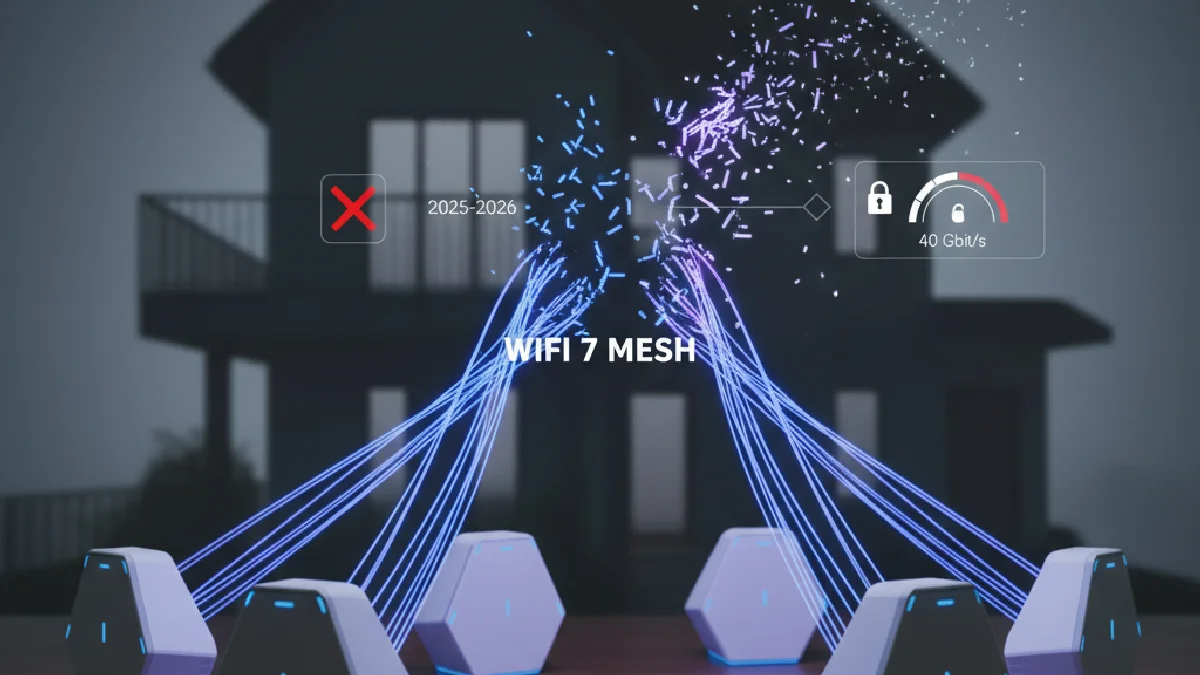
WiFi 7 routers promise revolutionary home connectivity, with theoretical speeds exceeding 40 Gbps and minimal latency. Yet, two years after the launch of the first equipment, the democratization of Mesh WiFi 7 remains a distant goal for most households. Between technological promises and market realities, what are the real obstacles to the massive adoption of this new standard?
A Prohibitive Entry Ticket for the General Public
The first major barrier to the adoption of WiFi 7 Mesh is undoubtedly its cost. Complete kits of two to three nodes generally range between 400 and 800 euros, an investment that far exceeds the average household budget accustomed to WiFi 5 or WiFi 6 solutions available for under 200 euros.
This price difference is explained by the technological complexity of the 802.11be standard: 320 MHz bandwidth, 4096-QAM modulation, MLO (Multi-Link Operation) technology allowing the aggregation of multiple bands simultaneously. These innovations come at a high price in electronic components and research & development.
For consumers, the calculation is simple: do the performance gains justify an investment three to four times higher? For the majority of current domestic uses – 4K streaming, video conferencing, web browsing – the answer often remains negative. WiFi 6, already largely capable of handling these needs, represents a sufficient technological step at a lower cost.
WiFi 7 mesh routers typically cost between €400 and €800 for a two-to-three node kit, which exceeds the average budget of households accustomed to WiFi 5/6 solutions under €200.
| WiFi Standard | Typical Cost (2-3 Node Kit) | Common Uses Handled | |---िजन|---|---| | WiFi 5 / 6 | < €200 | 4K streaming, video conferencing | | WiFi 7 | €400 - €800 | Future high-performance uses |
Installation Requires Technical Skills
Beyond the price, installation complexity is a major obstacle. Unlike a traditional router that is simply plugged in, a mesh system requires careful planning of the placement of different nodes to ensure optimal coverage and avoid dead zones.
Users must consider multiple parameters:- Wall thickness
- Building materials
- Electromagnetic interference
- Distance between access points
This diagnostic phase often involves using WiFi signal mapping applications or performing coverage surveys – tasks deemed too technical for most consumers.
Some manufacturers offer simplified installation assistants, but these do not fully replace the expertise required to optimize a large-scale mesh network. The promise of coverage up to 5,000 square meters, highlighted by operators like AT&T with their mesh technology, actually implies a careful configuration that few individuals can master without professional assistance.
The Device Compatibility Trap
The economic equation of WiFi 7 becomes even more complex when considering device compatibility. While the standard is technically backward compatible with previous generations, substantial gains in speed and latency are only truly realized on WiFi 7 compatible devices.
Concretely, this means that a household investing in a WiFi 7 mesh system will also need to consider progressively replacing its equipment:
- Recent smartphones (high-end ranges 2024-2025)
- Laptops equipped with compatible network cards
- Next-generation tablets, game consoles, and connected TVs
This cascade of replacements can quickly push the total cost of transition beyond a thousand euros, an investment difficult to justify for households whose current infrastructure is functioning satisfactorily. The installed base of WiFi 5 and WiFi 6 devices thus constitutes a structural impediment to rapid migration to the new standard.
Operator Offers Conditioned on Commitment
Faced with these financial barriers, some Internet service providers are trying to accelerate WiFi 7 adoption by offering upgrade programs. However, these initiatives remain largely conditioned on long-term commitments and subscription to very high-speed broadband plans.
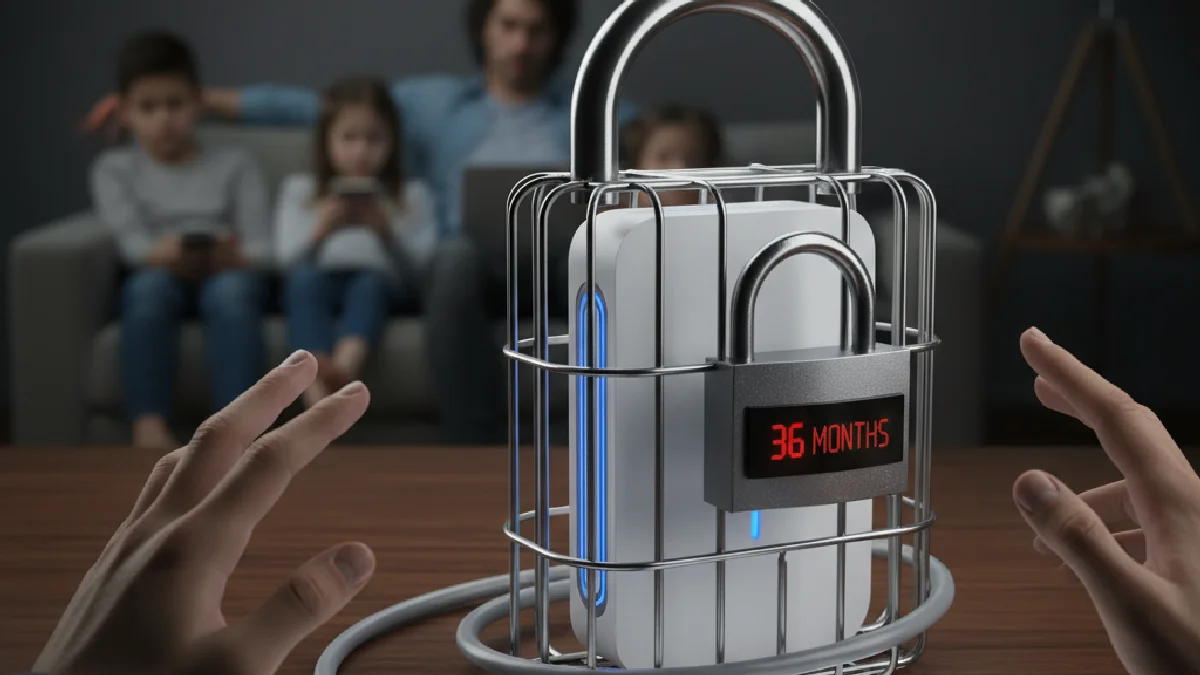
"Equipment Upgrade" type programs mentioned by some operators generally require service to be maintained for at least 12 months before eligibility for a free equipment replacement, with limitations to one upgrade every 36 months. These constraints reduce the attractiveness of offers for households with modest needs or seeking contractual flexibility.
Furthermore, access to WiFi 7 technologies often remains reserved for very high-speed plans (2 or 5 Gbps), whose monthly cost exceeds standard budgets. This market segmentation de facto confines WiFi 7 Mesh to a premium clientele, delaying its spread to mainstream segments.
Home network infrastructures, such as traditional WiFi systems, thus continue to dominate the residential market, offering a more accessible value proposition for the majority of users (see also Verizon - What is Wi-Fi?).
An Ecosystem Still Under Construction
The maturity of the WiFi 7 ecosystem is another point of friction. Unlike previous generations that benefited from progressive and coordinated development, WiFi 7 arrives in a fragmented market context and geopolitical tensions affecting semiconductor supply chains.
The shortage of advanced chips directly impacts the production of WiFi 7 routers, limiting available volumes and keeping prices at high levels. Chipset manufacturers – Qualcomm, Broadcom, MediaTek – are certainly increasing their production capacities, but ramping up takes time.
At the same time, the absence of uniform standards for certain advanced features (particularly intelligent mesh management protocols) creates fragmentation that complicates consumer choices. Each manufacturer offers its own control application, its own optimization algorithms, making objective comparison of performance difficult.
This immaturity of the ecosystem also translates into a lack of documented feedback. Early adopters are still testing the real limits of the technology in various home environments, and truly differentiating use cases – beyond marketing – remain to be concretely demonstrated. The U.S. government also has laws impacting technology, such as H.R.1 - 119th Congress.
Between Innovation and Pragmatism: What Horizon for 2026?
By 2026, the adoption of WiFi 7 Mesh will likely follow a diffusion curve comparable to previous generations: an initial phase reserved for tech-savvy early adopters and professionals, before progressive democratization conditioned by three key factors.
First, a significant drop in prices, made possible by increased production volumes and the arrival of new players in the market. Second, the enrichment of the compatible device park, notably through the natural renewal of smartphones and laptops. Finally, the emergence of truly bandwidth-intensive applications – high-resolution virtual reality, 8K streaming, demanding cloud gaming – likely to justify the investment.
Until then, for the majority of households, WiFi 6 and WiFi 6E solutions will continue to offer an excellent compromise between performance, reliability, and financial accessibility. Cloud infrastructure, such as that developed by industry giants, will continue to absorb some remote processing needs, reducing pressure on home networks.
The democratization of WiFi 7 Mesh will therefore not be a question of technical superiority – which is undeniable – but rather of convergence between economic accessibility, ease of use, and the emergence of uses truly justifying this firepower. A process which, as often in the history of consumer technologies, will take longer than manufacturers' initial forecasts (this is also taken into account in planning such as the Medium-Term Plan 2024-2028).