Optimizing Edge AI on IoT Microcontrollers: A Practical Guide

Edge AI on microcontrollers currently represents a major challenge for embedded system developers. How can artificial intelligence models run on devices constrained by their power consumption, while maintaining acceptable autonomy? The answer lies in a meticulous assembly of hardware choices, software optimizations, and power management strategies.
This guide details the concrete steps for deploying TinyML models on IoT microcontrollers, from MCU selection to implementing advanced sleep modes, including 8-bit quantification and energy profiling.
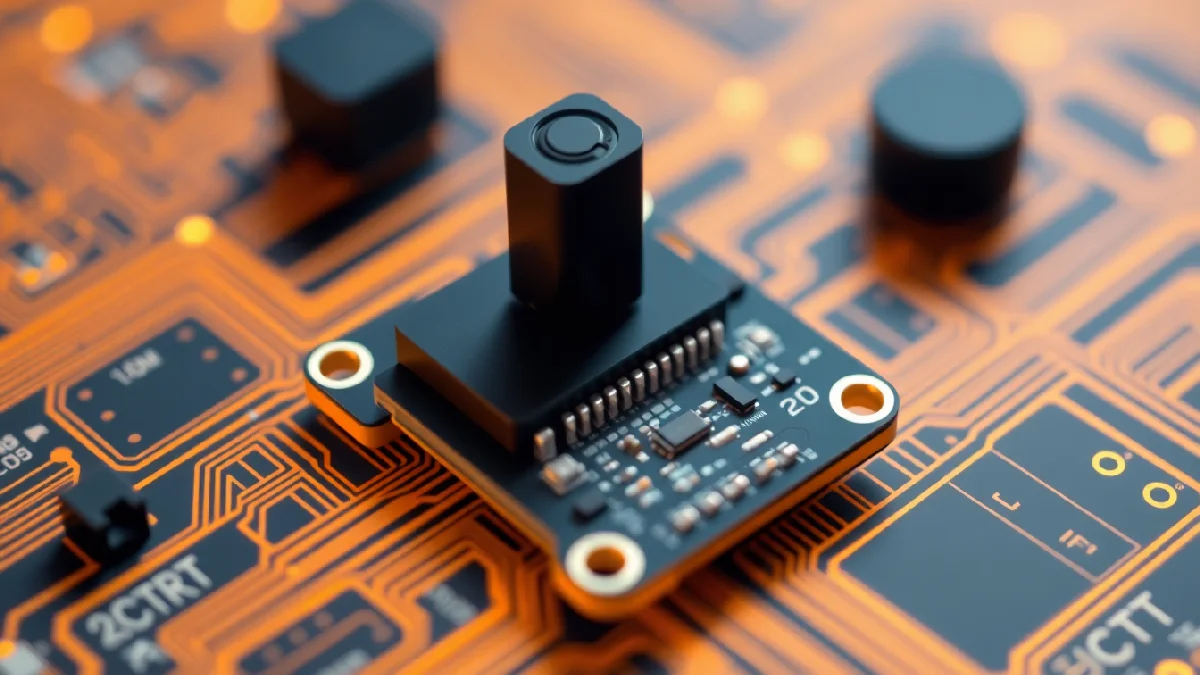
Choosing the Right Microcontroller for Edge AI
The foundation of any energy optimization begins with hardware selection. Modern microcontrollers designed for IoT now integrate acceleration capabilities dedicated to AI inference.
Recommended Architectures
MCUs based on ARM Cortex-M4 and Cortex-M33 dominate the low-power Edge AI market. These processors incorporate DSP (Digital Signal Processing) instructions that accelerate the matrix operations typical of neural networks. RISC-V alternatives like the ESP32-C3 are also gaining popularity due to their flexibility and reduced consumption.
Key to this is the presence of a hardware acceleration unit: NPU (Neural Processing Unit), extended DSP, or compatibility with TensorFlow Lite Micro. These components can reduce inference power consumption by several factors compared to purely software-based computation.
Dynamic Frequency Scaling
DVFS (Dynamic Voltage and Frequency Scaling) automatically adjusts voltage and clock frequency based on the load. During a light inference phase, the MCU can operate at 24 MHz instead of 120 MHz, drastically reducing instantaneous power consumption. Optimizing AI model performance necessarily involves this dynamic adaptation.
Preparing the AI Model for Embedded Systems
The model is the heart of the system. Without specific optimizations, even the most efficient microcontroller cannot maintain acceptable autonomy.
Adapted TinyML Architectures
MobileNet-V1 and V2, EfficientNet-B0, or custom architectures with a low number of parameters (< 500 KB) are the most suitable. These networks sacrifice a marginal amount of accuracy for a reduced memory footprint and computational complexity.
Reducing the number of convolutional filters, limiting network depth, and using separable convolutions decrease memory accesses — often more energy-intensive than the computations themselves.
8-bit Quantification and Pruning
Quantification converts floating-point weights (32 bits) to 8-bit integers, reducing model size by a factor of four and accelerating calculations on DSP units. This technique generally results in a precision loss of less than 2%, largely offset by the energy gain.
Pruning eliminates less influential neural connections. By removing up to 40% of weights without significantly degrading performance, CPU cycles and memory transfers are proportionally reduced.
"8-bit quantification and pruning can reduce inference power consumption by more than half while maintaining acceptable accuracy for most IoT applications."
Recompiling the model with CMSIS-NN or the manufacturer's acceleration libraries ensures optimal utilization of available hardware instructions.

Integrating a Lightweight and Efficient Runtime
The runtime transforms the optimized model into concrete execution. Choosing a framework adapted to embedded constraints is crucial.
TensorFlow Lite Micro and Alternatives
TensorFlow Lite Micro has established itself as the de facto standard for inference on MCUs. Its small footprint (a few tens of KB) and extensive compatibility make it a safe choice. ONNX Runtime Micro represents a credible alternative, especially for models from other frameworks.
These runtimes avoid dynamic memory allocation, utilize static buffers, and minimize system dependencies — all essential characteristics for stability and energy efficiency.
Duty-cycling and Sleep Modes
The real difference is made outside of inference. An MCU in deep-sleep mode consumes a few microamperes compared to several tens of milliamperes in active operation. The principle of duty-cycling involves keeping the system in deep sleep most of the time, waking it only for data collection or scheduled inferences.
Programming event-driven interruptions (motion detection via accelerometer, sound threshold exceedance, sensor variation) allows the core to wake up only when necessary. This "sleep-first" approach multiplies autonomy by a factor of 10 to 100 depending on the use case. To delve deeper, power management in battery-driven Edge AI devices details these strategies.
| Optimization Strategy | Description | Energy Impact |
|---|---|---|
| 8-bit Quantification | Conversion of floating-point weights to 8-bit integers. | ÷4 model size, calculation acceleration, precision loss <2% |
| Pruning | Elimination of less influential neural connections. | Reduces CPU cycles and memory transfers |
| Duty-cycling | Keeping the MCU in deep sleep, waking for specific tasks. | Multiplies autonomy by 10 to 100 |
Optimizing the Communication Layer
Radio transmission often represents the most power-hungry component of an IoT device. Minimizing its impact becomes a priority.
Low-Power Protocols
Bluetooth Low Energy 5.0, LoRaWAN, Thread, and Zigbee are designed for long-duration deployments. Unlike classic Wi-Fi, these protocols natively integrate power-saving mechanisms: reduced frames, periodic listening, coordinated sleep modes.
The choice depends on the required range and throughput: BLE for short-range, low-latency applications, LoRaWAN for spaced transmissions over several kilometers.
Compression and Transmission Limitation
Compressing payloads before transmission (adapted LZ77, DEFLATE algorithms) reduces airtime and thus power consumption. Limiting the transmission frequency — for example, grouping several inferences before transmission — divides radio consumption by the number of groupings.
Using "listen-before-talk" modes avoids collisions and costly retransmissions. Every millisecond of active airtime counts.
Fine-Grained Power Management at the Firmware Level
Software optimization doesn't stop at the model. The firmware controls every peripheral, every clock, every functional block of the MCU.
Selective Peripheral Activation
Activating only the clocks and buses necessary at a given moment is a golden rule. An ADC, a timer, or a serial interface consume power even when inactive if they remain powered. Systematically deactivating unused blocks between two measurement cycles reduces background consumption.
Power management strategies for Edge devices highlight the importance of this granular approach.
Battery Monitoring and Graceful Degradation
Periodically measuring battery voltage via an ADC allows anticipating depletion. When energy becomes critical, trigger graceful degradation strategies: reduce inference rate, deactivate non-critical functions, switch to reduced transmission mode.
This progressive degradation maintains essential service longer, preventing abrupt system shutdown.
Profiling and Iterating: The Key to Success
No optimization is complete without precise measurement. Energy profiling reveals invisible bottlenecks.
Energy Microscopy
Tools like high-resolution current analyzers (Otii Arc, PPK2) capture consumption with microampere precision. Identifying the consumption of each phase — wake-up, sensor acquisition, inference, transmission, return to sleep — allows targeting priority optimizations.
A poorly configured transmission phase can consume as much as ten optimized inferences. Without measurement, it's impossible to know.
OTA Updates and Continuous Adjustments
Planning for OTA (Over-The-Air) updates allows refining scaling, quantification, or duty-cycling parameters after deployment. Real-world usage conditions often reveal unexpected behaviors.
Maintaining a continuous improvement loop — measure, analyze, adjust, deploy — gradually maximizes autonomy while preserving service quality.
Considering the Complete Ecosystem
Optimizing Edge AI on MCUs is not limited to code and silicon. The development environment, debugging tools, and documentation play a decisive role.
- Development Platforms: Investing in well-supported platforms (STM32CubeIDE, ESP-IDF, Zephyr RTOS) accelerates development and reduces bugs.
- Cloud Integration: Cloud services for model training and deployment (Edge Impulse, TensorFlow Lite Model Maker) simplify the entire lifecycle.
- Security: Implement secure boot, communication encryption, and key management to prevent abnormal behaviors that impact autonomy.
This hybrid approach — cloud training, Edge inference — combines computational power and energy efficiency.
Finally, security considerations must not be overlooked. A compromised IoT device can become an attack vector or generate uncontrolled network traffic, directly impacting autonomy. Implementing secure boot, communication encryption, and key management mechanisms indirectly contributes to energy optimization by preventing abnormal behaviors.
Perspectives and Future Developments
Hardware and software advancements promise increasingly autonomous Edge AI devices. New MCUs integrate dedicated NPUs consuming less than 1 mW per inference. Extreme quantification techniques (4-bit, even binary) pave the way for even more compact models.
Federated Learning allows refining models directly on devices without centralizing data — a privacy-respecting approach that could become widespread. Combined with on-device fine-tuning techniques, it could transform MCUs into permanent adaptive systems.
Energy harvesting technologies — solar, thermal, piezoelectric — promise indefinitely autonomous devices. Combined with intelligent management strategies, they could eliminate battery constraints in many scenarios.
Edge AI on microcontrollers is still in its early stages. Mastering energy optimization techniques today prepares engineers for tomorrow's challenges, where embedded intelligence will become ubiquitous.
The article on the IBM and ARM alliance for datacenters shows how these optimizations also apply to larger infrastructures. Similarly, manufacturers' strategies in the face of the 2nm chip shortage illustrate the importance of energy efficiency at all levels.