Future of Digital Marketing Agencies: Automation and Expertise

The digital marketing sector is undergoing an unprecedented period of transformation. Between the rise of artificial intelligence and evolving client expectations, agencies must rethink their business model and services. This technological revolution raises a fundamental question: how can agencies leverage automation while preserving the added value of human expertise?
According to an Accenture study, AI could double French growth by 2035, radically transforming digital marketing professions [^1]. Agencies that can intelligently navigate between automation and human creativity will be the ones that thrive in this new competitive landscape [^2].
Automation Revolutionizes Marketing Operations
Marketing automation now represents much more than just optimizing repetitive tasks. Artificial intelligence platforms now enable dynamic audience segmentation, real-time content personalization, and automatic optimization of advertising campaigns.
Technology giants have developed sophisticated algorithms that handle predictive analytics, ad bidding management, and even content generation. This evolution allows agencies to process exponential volumes of data while maintaining unparalleled targeting precision.

McKinsey reveals that generative AI can automate up to 20% of marketing tasks, freeing up teams to focus on higher-value activities [^3]. Modern automation tools now integrate machine learning to continuously adapt to consumer behavior.
Applications of Automation
Automation transforms several key aspects of digital marketing:
- Ad campaign management: real-time budget and audience optimization
- Content marketing: automatic generation of creative variations and personalization
- Data analysis: instant metric processing and automated reporting
- Customer journey: automatic triggering of marketing actions based on behavior
This technological transformation allows agencies to significantly improve their operational efficiency while reducing production costs, creating a substantial competitive advantage.
Human Expertise: An Irreplaceable Value
Despite technological advancements, human expertise remains indispensable in several critical areas of digital marketing. Strategy, creativity, and understanding of cultural nuances remain exclusively human prerogatives.
Agencies that excel today are those that have successfully repositioned their teams on high-value missions: strategic consulting, creation of innovative concepts, and personalized client support. This evolution transforms the role of marketing professionals, who become true orchestrators of the digital ecosystem.
"Artificial intelligence automates processes, but it is human intelligence that defines direction and gives meaning to marketing actions." - Digitaweb 2025 Study [^2]
Mastering new SEO technologies also becomes crucial to maintain differentiating expertise in the face of increasing automation of marketing tools.
Irreplaceable Human Skills
Certain capabilities remain the preserve of human experts:
- Strategic vision: defining objectives and aligning with business strategy
- Conceptual creativity: developing original ideas and memorable campaigns
- Emotional intelligence: deep understanding of consumer motivations and emotions
- Adaptability: ability to quickly adjust to market changes
The Hybrid Model: The Future of Digital Agencies
High-performing agencies in 2025 are adopting a hybrid model that intelligently combines automation and human expertise. This approach optimizes operational efficiency while preserving the creative and strategic quality of deliverables.
This new paradigm transforms the internal organization of agencies. Teams specialize either in mastering technological tools or in creative and strategic missions. This complementarity generates synergy that multiplies the value provided to clients.
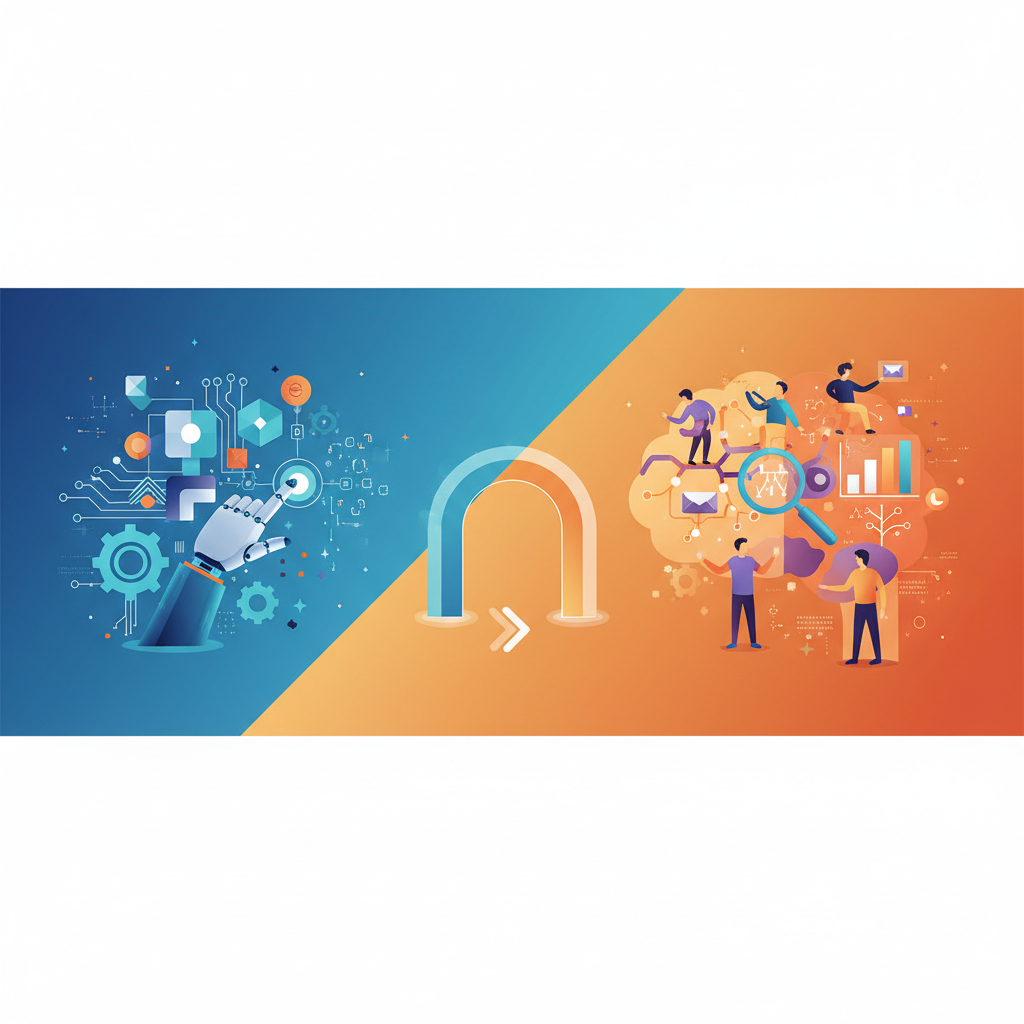
The evolution towards this hybrid model also requires a redesign of analysis and reporting processes, integrating automated data into a global strategic reflection.
New Platforms and Technologies
Agencies are progressively integrating emerging technologies that redefine the customer experience:
| Technology | Role for Digital Agencies |
|---|---|
| Artificial Intelligence (AI) | Task automation, predictive analysis, personalization [^4] |
| Marketing Automation | Dynamic segmentation, campaign optimization |
| Machine Learning | Continuous adaptation to consumer behavior |
| Web 3.0 / Metaverse | New territories for creative expression and client interaction [^5] |
The rise of Web 3.0 and the metaverse opens new territories for creative expression, requiring advanced technical expertise combined with an innovative artistic vision. Agencies are investing heavily in these new skills to support their clients in this digital transition.
Training and Team Adaptation
Continuous training is becoming a major strategic challenge for agencies. Professionals must constantly update their skills to master new automation tools while developing their creative and strategic capabilities.
Training programs now focus on understanding AI algorithms, interpreting automated data, and optimizing hybrid workflows. This upskilling allows teams to fully leverage available technologies.
The most advanced agencies create personalized training paths, enabling each employee to develop specialized expertise while maintaining a global vision of marketing challenges. This approach fosters innovation and creativity within teams.
The Importance of Organizational Agility
Rapid adaptation to new technologies requires an agile and flexible organization. Agencies are rethinking their hierarchical structures to encourage experimentation and continuous innovation. This organizational agility becomes a key success factor in a constantly evolving environment.
Redefined Added Value
Technological evolution fundamentally redefines the value proposition of digital marketing agencies. Rather than focusing solely on technical execution, they become strategic partners who orchestrate their clients' entire digital ecosystem.
This transformation implies a more consultative approach, where the agency supports the client in their global strategic thinking. Automation of operational tasks frees up time to deepen understanding of business issues and develop tailor-made solutions.
Agencies that successfully make this transition are those that can demonstrate their direct impact on their clients' business results. They develop sophisticated performance indicators that measure not only campaign effectiveness but also their contribution to the company's overall growth.
Personalization becomes the keyword of this new approach. Each client benefits from a unique strategy, adapted to their specific industry and particular objectives. This advanced personalization, made possible by the automation of standardized tasks, constitutes a sustainable competitive advantage.
Conclusion
The future of digital marketing agencies is shaped by a subtle balance between intelligent automation and human expertise. This transformation is not a threat but an opportunity to redefine added value and position themselves as indispensable strategic partners.
Agencies that will thrive are those that can leverage AI to optimize their operations while developing their creative and consultative capabilities. This evolution requires significant investment in training and technology, but it opens up considerable growth prospects.
Automation unleashes the creative potential of teams and allows them to focus on what truly makes a difference: strategy, innovation, and client relationships. In this new paradigm, humans remain at the heart of success, but their role evolves towards nobler and more impactful missions.
[^1]: What future for digital marketing agencies? [^2]: The future of digital agencies: what evolutions for ... [^3]: Latest Advances in Digital Marketing and AI [^4]: Digital Marketing Quebec [^5]: 5 marketing trends that will redefine your strategy in 2025