AI Copilots for Developers: Impact on Software Architecture
GitHub Copilot and its competitors are quietly transforming how developers design their systems. This shift, affecting both application architecture and working methods, is redefining modern software development standards.
Development teams integrating these intelligent assistants are observing profound changes in their architectural approaches. Far from being mere code generators, these tools directly influence structural decisions and encourage the adoption of new collaborative practices.

Towards More Modular and Decentralized Architectures
AI copilots naturally foster the emergence of modular architectures. This trend is explained by these tools' ability to efficiently generate isolated and well-defined components, encouraging developers to favor structures broken down into independent services.
Microservices and serverless functions find a particularly fertile ground in this approach. Each component can be generated, tested, and iterated almost instantly thanks to the AI's contextual suggestions. This execution speed pushes teams to rethink their traditional monolithic architectures.
Dependency Injection as a Standard
Dependency injection becomes almost essential in an AI-assisted environment. Clearly defined interface patterns and contractual APIs emerge as essential practices for maintaining the interoperability of generated code fragments.
This contractual approach also significantly reduces the risks of duplication and technical debt, recurring problems when different developers use copilots on the same project.
The Emergence of "AI-first" Development
The development paradigm is evolving towards an "AI-first" model where artificial intelligence is integrated directly into development pipelines. This transformation goes beyond simple code generation to encompass the entire software lifecycle.
"Automation boosts productivity and improves employee satisfaction by streamlining tasks, fostering better collaboration, and freeing up time for more strategic work." - Microsoft
Workflow automation tools become central to this approach, as highlighted by Microsoft. Linting, code review, and unit tests are now automated by generative models that create test cases and documentation in real-time.
Integration into CI/CD Pipelines
Copilots integrate into CI/CD pipelines via validation hooks and intelligent review bots. These systems can detect potential hallucinations or flag security violations even before deployment.
However, this integration requires new technical skills and a redesign of existing processes to fully leverage these capabilities.
| Feature | Description |
|---|---|
| Architectures | More modular and decentralized (microservices, serverless) |
| Methods | "AI-first" development, increased automation |
| Practices | Dependency injection, contractual APIs |
| Integration | CI/CD pipelines with intelligent hooks and bots |
New Disciplines and AI Governance
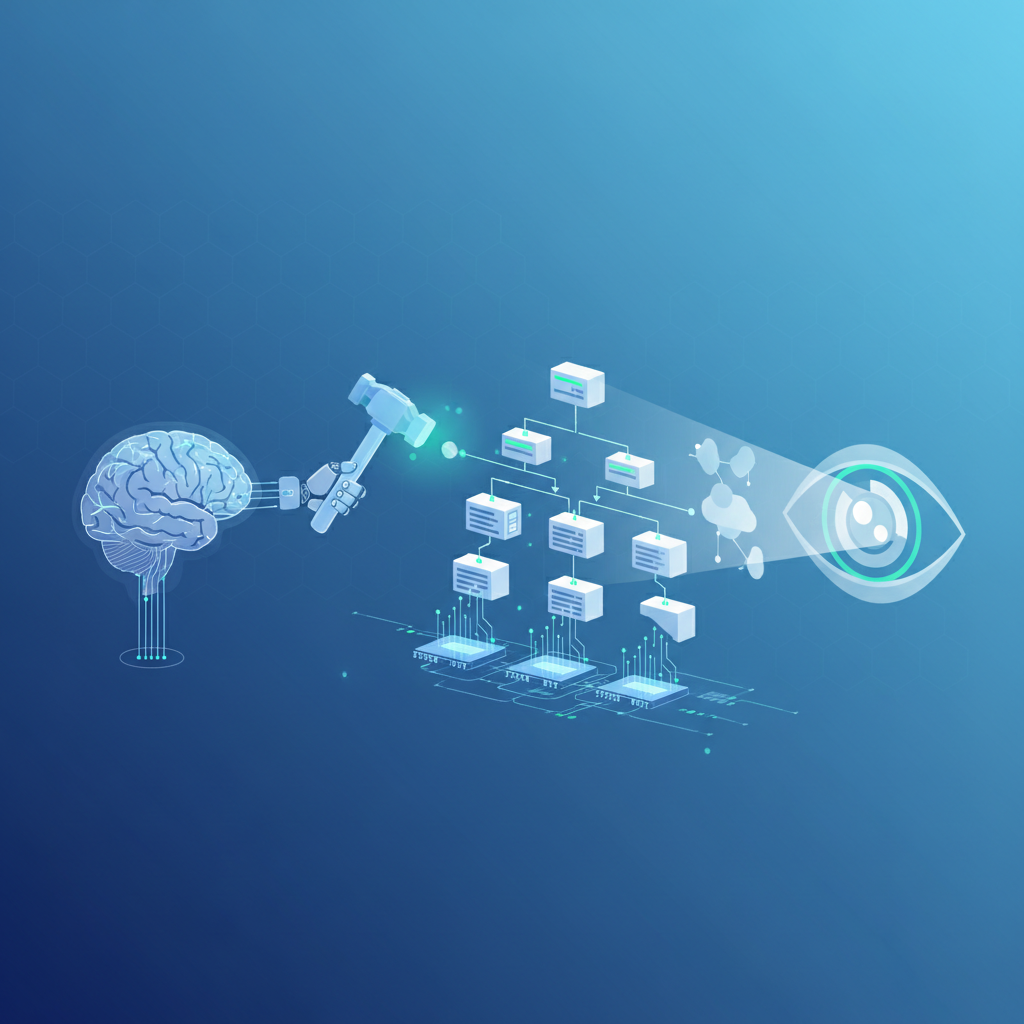
The adoption of copilots necessitates the emergence of new technical disciplines specific to managing artificial intelligence in development. These practices cover several critical aspects of modern software production.
Prompt management becomes a skill in its own right, requiring a structured approach to optimize interactions with AI models. Model versioning and fine-tuning on company-specific data require rigorous and documented processes.
Compliance and Security Controls
Confidentiality and security issues take on a particular dimension with AI copilots. Teams must establish systematic human reviews and model audits to prevent the injection of malicious code or the leakage of sensitive information.
AI governance policies become essential to regulate the use of these tools, particularly in environments where regulatory compliance is critical.
As Obvia experts highlight in their analysis, these ethical and practical considerations require in-depth reflection on the responsible integration of generative AI.
Impact on Development Culture
AI copilots foster a more iterative development culture centered on continuous feedback. This cultural evolution transforms team dynamics and collaboration methods.
Developers report a significant acceleration of development cycles, but also a change in the very nature of their work. The focus shifts from writing code to architectural design and business logic validation.
Human-Machine Collaboration
Human-machine collaboration becomes central to new development processes. Developers learn to formulate their intentions clearly and structuredly to optimize copilot results.
This interaction requires developing new communication skills and a fine understanding of the capabilities and limitations of the AI models used.
Challenges and Future Prospects
The integration of AI copilots raises several technical and organizational challenges that require adapted responses. The maintenance of hybrid systems (human code + generated code) represents a major issue for project sustainability.
Team training is another significant challenge. Developers must acquire new skills while maintaining their traditional technical expertise. This dual requirement necessitates significant investments in continuous training.
Questions of intellectual property and legal responsibility for generated code remain largely unresolved, creating uncertainty for companies that widely adopt these tools.
Despite these challenges, the evolution towards AI-assisted software architectures seems irreversible. Organizations that can adapt their processes and train their teams will gain a lasting competitive advantage in this transforming market. This evolution is part of a broader dynamic of digital transformation of human resources, where AI redefines roles and skills.
AI copilots will continue to evolve into more sophisticated assistants, capable of understanding complex business contexts and proposing complete architectural solutions. This evolution could lead to the emergence of autonomous AI assistants capable of managing entire segments of software development.
The main challenges to overcome are:- Maintaining hybrid systems (human and generated code).
- Continuous training for development teams.
- Uncertainties related to intellectual property and legal responsibility for code.
- The need for new technical and organizational skills.
The future of software development is thus shaped around enhanced collaboration between human and artificial intelligence, where emerging architectures will reflect this unique synergy. Teams that master this hybrid collaboration will define industry standards for years to come.
FAQ (JSON format - translate question and answer fields only):