Automation and AI: The Future of WEEE Sorting in 2026

Imagine a center where hundreds of tons of used smartphones, computers, and screens pass daily on conveyor belts. Once sorted by hand under difficult conditions, these devices now pass before intelligent cameras that instantly recognize each type of plastic, each circuit board, each trace of precious metal. Robotic arms precisely pick up valuable parts, while algorithms optimize processing flows in real-time.
This reality is no longer science fiction. In 2026, artificial intelligence (see also Artificial Intelligence - Shaping tomorrow), advanced robotics, and automation converge to radically transform the sector of sorting and recovery of Waste Electrical and Electronic Equipment (WEEE). Between environmental challenges, economic opportunities, and technological innovations, the recycling industry is undergoing a profound transformation that is reshaping the contours of the circular economy.
Industrial Vision for Material Recognition
The core of this transformation relies on industrial vision systems powered by neural networks capable of identifying over 150 types of electronic components in real-time. These devices analyze the shape, color, texture, and even the chemical composition of objects passing on the sorting lines.
Innovation centers like the one inaugurated by DHL in Troisdorf, Germany, are already integrating these cutting-edge technologies. Multi-spectral cameras coupled with multi-modal classification algorithms instantly distinguish a copper cable from an aluminum cable, an ABS casing from a polycarbonate casing, or a capacitor containing hazardous substances.
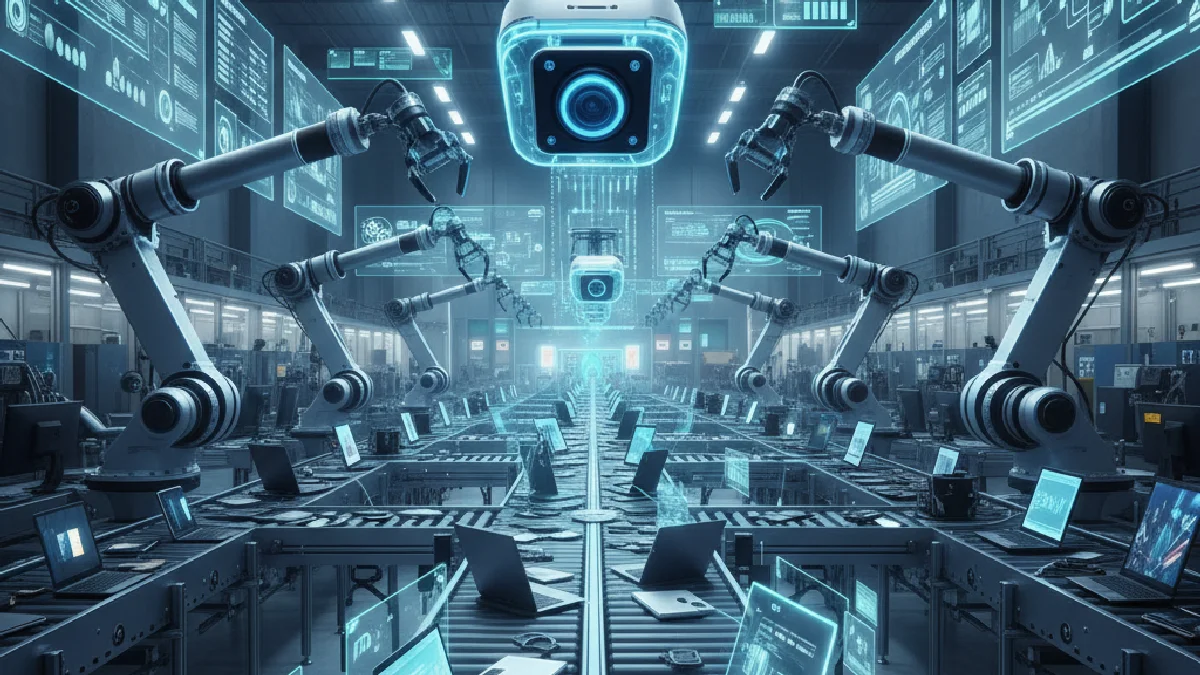
This ultra-fast analytical capability far exceeds human performance. Where an experienced operator can process a few dozen pieces per minute with a significant error rate, automated systems analyze several hundred objects in the same amount of time, with constant precision. The stakes are not just quantitative: it's also about identifying dangerous components (mercury, lead, cadmium) to isolate them before they contaminate recycling streams.
"Artificial Intelligence is no longer just 'selling' us things; it's becoming an ally for more thoughtful and sustainable practices."
Adaptive Robotics: Smart Grippers for All Components
Once materials are identified, they still need to be handled. This is where robotic arms equipped with adaptive grippers come in, capable of grasping a rigid motherboard as well as a flexible cable or a fragile battery.
Developed as part of research programs such as the Demeter 2026 call for projects and supported by Horizon-Europe funding, these robots integrate force, pressure, and temperature sensors that continuously adjust the grip to avoid damaging components or releasing toxic substances.
X-ray fluorescence spectrometry (X-RF) embedded in some grippers even allows for the analysis of a piece's exact composition at the moment of grasping. This ability to automatically extract precious metals (gold, copper, palladium) and isolate hazardous substances radically transforms the economic and environmental efficiency of the process.
Pilot projects launched in early 2026 show impressive results: the purity rates of recovered copper now exceed 98%, compared to 85-90% in traditional facilities. This improvement directly translates into commercial value, as pure copper trades at a significantly higher price on international markets.
Digital Platforms and Logistics Flow Optimization
Innovation is not limited to sorting facilities. Upstream, connected digital platforms orchestrate the entire value chain, from collection to the reintegration of materials into the productive circuit.
These systems use machine learning to predict the quality of incoming batches based on their origin (professional devices, consumer electronics, industrial equipment), optimize collection routes in real-time, and even anticipate fluctuations in raw material prices to maximize the profitability of recovery.
According to the Global E-waste Monitor 2024 Report, processing costs could be significantly reduced by 2030 thanks to this logistical rationalization. At the same time, the total value recovered through metal extraction and material reintegration into the circular economy could reach several tens of billions of dollars globally.

This predictive dimension also transforms the management of recycled material stocks. Operators can now anticipate demand from electronics manufacturers and adjust their processing volumes accordingly, thereby reducing storage costs and improving the fluidity of the entire chain.
Drastic Reduction in Residual Waste
One of the most tangible environmental benefits of these innovations lies in the reduction of residual waste – materials that, due to lack of proper identification or separation, end up landfilled or incinerated without recovery.
Latest-generation automated facilities show a 30% decrease in this residual waste compared to traditional sorting centers. Every component, every gram of metal, every fragment of plastic now finds an appropriate recovery path.
This performance is explained by the combination of several complementary technologies:
- Granulometric sorting optimized by 3D vision to separate fragments by size
- Magnetic and eddy current separation guided by AI to extract ferrous and non-ferrous metals
- Multi-spectral optical sorting to distinguish different families of plastics
The stakes go beyond mere technical performance. At a time when environmental regulations are tightening and material traceability is becoming a legal requirement in several countries, these systems offer a guarantee of compliance and an automatic documentation capability for the entire treatment process.
Comparison: WEEE Sorting - Traditional vs. Automated (2026)
| Characteristic | Traditional Installation | Automated Installation (2026) |
|---|---|---|
| Error Rate | Significant | Consistent and precise |
| Processing Speed | Low (dozens/min) | High (hundreds/min) |
| Residual Waste Reduction | Limited | 30% improvement |
| Recovered Copper Purity | 85-90% | >98% |
Towards Industrial Scalability
The question of scalability – that is, the ability to deploy these innovations on a large scale – is a major challenge for the sector. Pilot projects in 2026 demonstrate that the technologies are mature, but their widespread adoption requires significant investment and adaptation to local contexts.
Some industry players, as mentioned in logistics news from 2025, are betting on hybrid models combining full automation for high-volume flows and targeted human interventions for complex or rare equipment. This approach optimizes the cost-effectiveness ratio while preserving skilled employment in the sector.
Operator training is also a key issue. Sorting jobs are evolving: less repetitive handling, more supervision of automated systems, predictive maintenance, and data analysis. This upskilling requires adapted training programs, integrating robotics, artificial intelligence, and material knowledge.
At the same time, the standardization of electronic equipment would greatly facilitate the work of sorting systems. Adopting design standards that favor disassembly and material separation (eco-design) would create a virtuous circle between manufacturers and recyclers, as illustrated by some initiatives related to audio-visual multimodality and augmented human interaction.
Circular Economy and Resource Sovereignty
Beyond environmental performance, this transformation of WEEE sorting addresses a strategic imperative: securing raw material supply. In a context of geopolitical tensions and geographical concentration of mineral extraction, the recovery of electronic waste becomes a secondary source of critical metals.
Gold, palladium, neodymium, and tantalum present in electronic equipment represent significant deposits. Their efficient recovery reduces import dependence and decreases the ecological footprint associated with primary mineral extraction. AI technologies optimize this recovery with unprecedented precision.
This logic fully aligns with the objectives of the circular economy: keeping materials in the productive cycle for as long as possible, minimizing the extraction of virgin resources, and transforming waste into resources. Automated sorting systems are not an end in themselves, but an essential link in this systemic transformation.
Some innovations, such as those developed in the field of RAG in business for knowledge automation, could also apply to the documentary and regulatory management of the recycling sector, facilitating traceability and compliance (see also Materialities - Eduscol).
Challenges and Future Developments
Despite these advances, several obstacles still hinder the massive deployment of these technologies. The initial investment cost remains high, particularly for small and medium-sized recycling structures. Innovative financing models, including equipment leasing and shared value creation, are emerging to overcome this barrier.
The reliability and maintenance of robotic systems in demanding industrial environments (dust, vibrations, variable climatic conditions) also pose a technical challenge. Manufacturers are working on more robust designs and predictive maintenance protocols based on continuous data analysis.
Finally, the social acceptability of automation in a sector traditionally providing low-skilled jobs raises legitimate questions. The transition must be accompanied by public policies that promote retraining and upskilling, so that productivity gains benefit society as a whole.
Towards an Intelligent and Sustainable Recycling Industry
2026 marks a decisive turning point for the electronic waste sorting sector. Innovations in artificial intelligence, robotics, and automation are no longer experimental: they are being concretely deployed in industrial centers worldwide, transforming a sector long considered marginal into a strategic pillar of the circular economy. These technologies offer much more than operational efficiency gains. They redefine our relationship with resources, transforming waste into valuable deposits and paving the way for industrial sovereignty based on recycling rather than primary extraction. Record purity rates, drastic reduction of residual waste, and optimization of logistics flows outline an industry capable of reconciling economic performance and environmental responsibility. Challenges remain numerous – investments, training, social acceptability – but the momentum has begun. As technologies mature and economic models are structured, automated WEEE sorting could become the norm rather than the exception, foreshadowing a similar transformation in other recycling sectors. Artificial intelligence, far from being limited to consumer applications like creative AI in digital art, proves its ability here to solve concrete industrial problems in service of a more sustainable future.