Gemini vs. AI Personalization: Professional Hyper-Specialization

The AI assistant is no longer content with just answering questions: it must now understand the user, remember their preferences, and adapt to their professional context. With the deployment of Personal Intelligence, Google is taking a decisive step in personalizing Gemini. But can this generalist approach compete with the ultra-specialized solutions that dominate certain sectors?
This question goes to the heart of a strategic debate for organizations: should they favor a versatile model capable of covering a wide range of uses, or invest in highly targeted tools that excel in a specific domain?
Personal Intelligence: When Gemini Leverages the Google Ecosystem
Gemini's strength now lies in its ability to reason across multiple data sources simultaneously. Thanks to Personal Intelligence, the assistant accesses – with explicit user authorization – the entire Google portfolio: Gmail, Calendar, Drive, Photos, YouTube, Search, Maps, and many others.
Concretely, this means a professional can ask Gemini to synthesize project discussions scattered across their email, cross-reference this information with their calendar to identify available slots, and then generate a structured report in Google Docs. All without leaving the assistant's interface.
Google highlights this approach as an aid "designed specifically for you," where the user retains total control: they can view, modify, or delete stored information at any time. This transparency meets a growing demand from professionals for data governance.
Multimodal capabilities also play a central role. Gemini natively processes text, images, audio, video, and code, with a context window that can reach one million tokens. This technical breadth allows for solving complex problems involving multiple data formats – a financial analysis integrating graphs, Excel spreadsheets, and audio comments, for example.
Three Models, Three Scales of Specialization
Google offers Gemini in three main versions – Ultra, Pro, and Nano – to cover various computational requirements and use cases. This segmentation is reminiscent of AI copilots competing in the developer market, each seeking its optimal positioning.
Gemini Ultra targets the most demanding tasks: in-depth reasoning, complex multimodal analysis, sophisticated code generation. Gemini Pro offers a balance between performance and accessibility, suitable for most daily professional uses. Gemini Nano, lighter, integrates directly into mobile devices for fast local processing.
For businesses, Google offers Gemini Code Assist Enterprise, an enhanced version that leverages the organization's private code repositories. This tool ensures that suggestions adhere to internal best practices and the specific structure of existing code – a crucial differentiation from generic models.
Integration with Google Cloud reinforces this adaptive logic: Apigee, Application Integration, Gemini Cloud Assist create an "agent-first" environment capable of automating business workflows, controlling terminals, or performing Deep Research on vast documentary corpuses.
Gemini is no longer limited to generating content: it becomes a true orchestrator capable of navigating complex systems and executing end-to-end tasks.
| Gemini Model | Primary Use Case | Key Features |
|---|---|---|
| Ultra | Demanding tasks | In-depth reasoning, multimodal analysis |
| Pro | Daily professional uses | Performance and accessibility balance |
| Nano | Mobile devices | Fast local processing, lightweight |
Niche Solutions Retain Their Sectoral Advantage
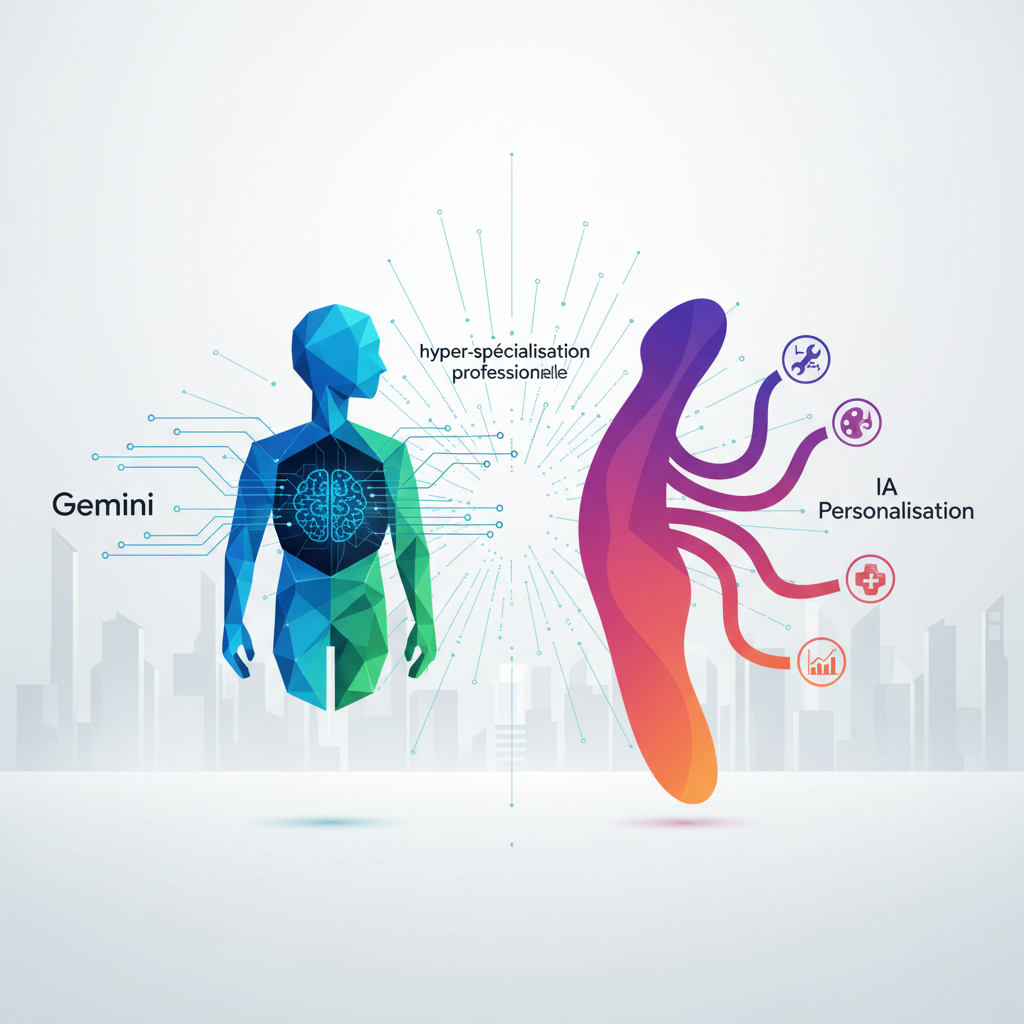
Despite this adaptive power, Gemini remains a general-purpose model. However, certain professional domains require a depth of expertise that only ultra-specialized tools can offer.
Let's take three concrete examples:
- Legal drafting: Solutions like Harvey or LegalMation rely on specifically annotated corpuses of case law and regulatory texts, with compliance verification and citability features that Gemini does not natively provide.
- Electronic circuit design: Platforms like Synopsys.ai or Cadence rely on models trained exclusively on technical schematics, simulations, and manufacturing data, with tight integration into industry CAD tools.
- Advanced financial modeling: Assistants like Bloomberg GPT or proprietary solutions from investment banks leverage highly structured historical datasets and adhere to strict compliance standards (Basel III, MiFID II, etc.).
These tools offer not only superior precision in their field but also adapted business interfaces and regulatory compliance guarantees that general-purpose models struggle to match.
As feedback from integrating GPT in enterprises highlights, the choice of a model depends as much on raw performance as on its suitability for existing business processes and regulatory requirements.
Broad Personalization vs. Sectoral Depth: Which Strategy to Adopt?
Faced with this dual landscape, organizations must arbitrate between two logics:
- The "Swiss Army knife" approach: Deploy Gemini as a unified platform for the majority of professional needs – writing, data analysis, project management, code generation. This strategy reduces technical complexity and training costs, while benefiting from native integration with the Google Workspace ecosystem.
- The "best-of-breed" approach: Select the most performant solutions for each critical function. This logic prioritizes sectoral excellence but requires managing multiple interfaces, licenses, and data governance policies.
A third path is emerging: strategic hybridization. This involves using Gemini as a generalist foundation for cross-functional tasks, while deploying niche solutions for high-value activities or those subject to strict regulatory constraints. This architecture optimizes the performance/cost ratio while maintaining necessary flexibility.
Some sectors, such as audiovisual production and animation, are already experimenting with this logic by combining generalist tools for scripting and project management with specialized solutions for 3D rendering or post-production.
The Challenges of Context Window and Persistent Memory
A technical element profoundly differentiates generalist models from niche solutions: persistent memory and long-term context management.
With Personal Intelligence, Gemini can now remember user-expressed preferences – their industry, ongoing projects, business constraints – and leverage them in future interactions. According to Blog du Modérateur, this feature allows for "picking up a conversation" weeks later, without having to re-state the entire context.
However, this capability remains cross-functional: it works well for generic tasks (writing, research, planning) but does not replace the in-depth business knowledge possessed by specialized solutions. A model trained on years of medical records or financial market data retains a lead in recommendation precision.
Gemini's one-million-token context window is nevertheless a considerable advantage for massive document analyses: contract review, regulatory report synthesis, complex project mapping. In these scenarios, breadth takes precedence over depth.
Governance and Transparency: The New Frontiers of Personalization
Advanced personalization raises governance questions that become critical in a professional environment. Organizations must reconcile three imperatives:
1. Algorithmic transparency: understanding how AI uses personal data to personalize its responses 2. Access control: precisely defining which Google services Gemini can leverage, and for which users 3. Decision traceability: documenting AI recommendations to meet audit and compliance requirements
Google partially addresses these issues by allowing users to view, modify, or delete stored information. With one of Google's most capable AI models, it's important to pay attention to new regulations that may emerge. But in a B2B context, IT and legal departments often demand stricter contractual guarantees – data localization, retention period, deletion procedures.
Niche solutions, on the other hand, frequently offer on-premise environments or private clouds that provide total control over sensitive data. This is a decisive argument in regulated sectors (finance, health, defense).
Evolution of Skills and Continuous Training
The adoption of Gemini or specialized solutions directly impacts the training needs of teams. A professional using a generalist assistant must develop a cross-functional "prompt engineering" skill – knowing how to formulate precise requests, structure interactions, and verify results.
Conversely, adopting an ultra-specialized tool requires in-depth business training but reduces the technical learning curve: the interface is designed for the sector, functionalities are pre-configured, and results are immediately usable.
This distinction influences HR strategy: organizations that rely on Gemini invest in generalist upskilling programs, while those that favor niche solutions recruit or train sectoral experts capable of leveraging advanced functionalities.
Towards a Convergence of Approaches?
In the medium term, the boundary between generalist models and niche solutions could blur. Google is working on facilitated fine-tuning mechanisms that would allow companies to enrich Gemini with their own business data, thereby creating "semi-specialized" versions without losing the advantages of native integration.
Conversely, some niche solutions are developing APIs to integrate into generalist platforms, creating hybrid ecosystems where each component brings its specificity. This "business plugin" logic is reminiscent of the evolution of ERP and CRM, which progressively opened their architectures to accommodate sectoral modules.
AI today is constantly evolving. The challenge for organizations remains to manage this complexity: define a coherent AI architecture, avoid the proliferation of redundant tools, and ensure system interoperability. This is a mission that goes beyond simple technical evaluation and touches on overall digital strategy.
FAQ (JSON format - translate question and answer fields only):