OpenAI and Edge AI: The Consumer Device Bet

Artificial intelligence is moving out of data centers. While large language models have long captured attention, OpenAI is now directing its investments towards a more discreet but strategic target: consumer devices capable of processing AI locally. This ambition is supported by major partnerships with NVIDIA, Amazon, and SoftBank, securing $110 billion to develop a new generation of Edge AI infrastructure. The goal? To make artificial intelligence instantaneous, confidential, and energy-efficient on augmented reality, mixed reality devices, and everyday connected objects.
Edge AI: Decentralizing for Better Service
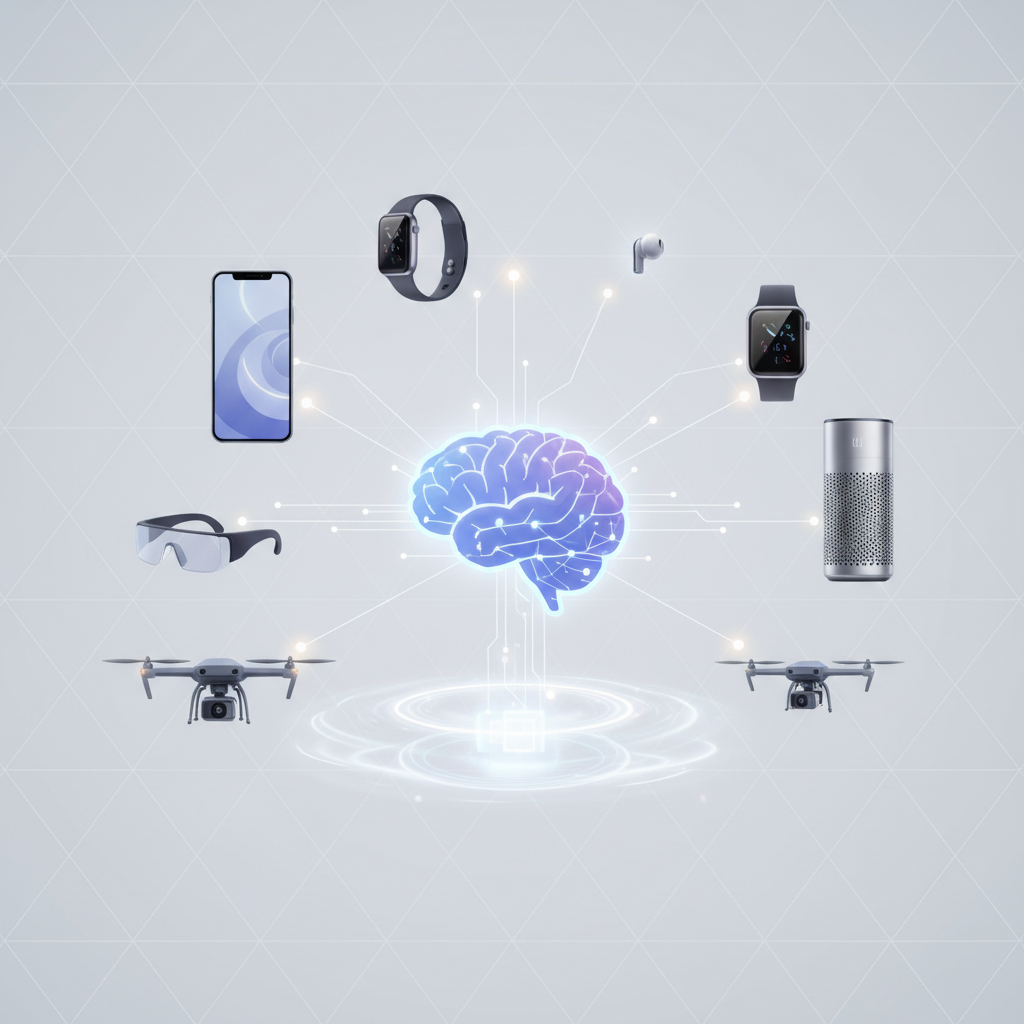
Edge AI refers to the processing of artificial intelligence models directly on devices, without systematically relying on the cloud. This approach transforms sensors, smart glasses, smartwatches, or home assistants into autonomous systems capable of real-time inference of complex decisions.
The benefits are tangible: drastic reduction in latency, improved data confidentiality – as data remains local – and decreased energy consumption related to network exchanges. As The Conversation points out, edge computing enables faster and more secure calculations by avoiding round trips to remote servers.

To achieve this, OpenAI and its partners are investing heavily in model compression and specialized architectures: dedicated integrated circuits (ASICs), field-programmable gate arrays (FPGAs), new-generation non-volatile memories (RRAM, FeRAM). These technologies reduce model size while preserving performance, making it possible to integrate multimodal assistants into compact formats.
Augmented and Mixed Reality: Instant Experiences
Augmented Reality (AR) and Mixed Reality (MR) devices directly benefit from this dynamic. Local processing of video, audio, and sensory streams opens the door to fluid, contextual interactions with no perceptible delay. Indoor navigation, instant translation of signs, real-time health monitoring, or hands-free professional assistance finally become viable.
This approach addresses a critical requirement: latency. In an AR/MR environment, any processing delay breaks immersion and harms the user experience. Edge AI eliminates this bottleneck by allowing smart glasses or headsets to calculate their responses in milliseconds, directly on-device.
“Edge computing enables faster and more secure calculations, avoiding systematic reliance on the cloud.”
However, this performance comes at a technical cost: computing power remains limited by the physical constraints of devices (size, weight, heat dissipation). OpenAI's teams and their partners are therefore relying on compressed models and algorithmic optimizations to make inference compatible with these constrained environments.
IoT: Towards Smart Connected Objects
The number of IoT devices is expected to exceed 75 billion by 2025. Home sensors, health wearables, autonomous vehicles, industrial equipment: all generate massive data streams. Integrating Edge AI into these devices transforms their role, shifting from simple data collectors to true autonomous decision-making agents.
Concretely, a home sensor equipped with Edge AI can analyze air quality, detect anomalies, and automatically adjust ventilation, without waiting for feedback from a remote server. A health wearable can identify an abnormal heart rhythm and immediately alert the user or their doctor, while ensuring that biometric data never leaves the wrist.
This decentralization improves resilience: even without a network connection, devices continue to function. It also addresses growing concerns about privacy, as regulations – GDPR in Europe, data sovereignty laws in Asia – tighten labeling and transparency requirements.
Strategic Partnerships: NVIDIA, Amazon, SoftBank
OpenAI announced an investment of $110 billion, including $30 billion from SoftBank, $30 billion from NVIDIA, and $50 billion from Amazon. These partnerships aim to secure the computing resources necessary for next-generation inference on Edge devices.
NVIDIA brings its specialized chips and expertise in GPU processing optimized for embedded AI. Amazon, via AWS, provides a hybrid cloud infrastructure allowing for remote model synchronization and training before local deployment. SoftBank, finally, expands geographical reach and facilitates integration into Asian IoT ecosystems.
This strategic alliance strengthens OpenAI's balance sheet and allows it to invest in technologies that go beyond large language models. The goal: to democratize AI by making it accessible on billions of consumer devices, without compromising performance or confidentiality.
Technical Challenges: Power, Heat, Compression
Despite advances, several obstacles remain. The computing power of Edge devices is still limited. Models must be aggressively compressed, which requires trade-offs between precision and size. Quantization, distillation, and pruning techniques reduce the weights of neural networks, but they require fine-tuning to avoid performance degradation.
Thermal management is another challenge. Intensive calculations generate heat; in a compact format (glasses, watch), dissipating this heat without a fan remains complex. ASIC architectures and non-volatile memories, which are more energy-efficient, offer a promising path but require heavy R&D investments.
Finally, compatibility between models and hardware varies. Each manufacturer develops its own chips, creating fragmentation that complicates large-scale deployment. Open standards and unified frameworks – TensorFlow Lite, ONNX Runtime – attempt to overcome this dispersion, but interoperability remains an ongoing project.
| Technical Challenge | Description |
|---|---|
| Computing Power | Intrinsic limitation of Edge devices, requires model compression. |
| Thermal Management | Heat dissipation in compact formats without active ventilation. |
| Compatibility | Fragmentation due to proprietary chips and lack of unified standards. |
Regulations and Transparency: A Framework Under Construction
The rise of Edge AI raises unprecedented regulatory questions. If data remains local, how can the transparency of decisions made by AI be guaranteed? How can an embedded model, inaccessible without disassembling the device, be audited? European and North American regulators are exploring labeling and certification mechanisms, requiring manufacturers to document the capabilities and limitations of their models.
Data sovereignty is also becoming a strategic issue. Governments require certain categories of data – health, defense, critical infrastructure – to be processed within national territory, which favors Edge AI. But this requirement also imposes logistical and legal constraints on companies operating internationally.
Finally, liability in the event of a malfunction remains unclear. If an AR assistant makes an identification error causing an accident, who is responsible: the hardware manufacturer, the AI model publisher, or the user? Current legal frameworks, designed for cloud software, struggle to adapt to this new distributed reality.
Concrete Applications: From Health to Industry
The use cases for Edge AI are multiplying.
- In the healthcare sector, wearables continuously analyze physiological signals, detect cardiac arrhythmias or falls, and trigger automatic alerts. This personalized monitoring improves preventive care while reducing the burden on hospital systems.
- In industry, sensors equipped with Edge AI monitor machine status, predict failures, and optimize maintenance cycles. This approach, called predictive maintenance, reduces downtime and operational costs, while extending equipment lifespan.
- Smart cities deploy cameras and sensors capable of streamlining traffic, detecting incidents in real-time, and adjusting public lighting according to attendance. These autonomous and resilient systems function even in the event of a network outage, ensuring the continuity of public services.
As Studi explains in its article on Edge AI, this technology transforms IoT and industry by enabling local, instant, and secure decisions.
Towards Ubiquitous and Invisible AI
OpenAI's ambition goes beyond simply improving language models. By investing heavily in Edge AI, the company anticipates a future where artificial intelligence becomes ubiquitous but invisible, integrated into every everyday object without imposing latency, network dependence, or privacy compromises.
This vision relies on a hybrid infrastructure: model training in the cloud, deployment and inference at the edge. Consumer devices thus benefit from the latest algorithmic advances while maintaining autonomy and responsiveness. For users, the experience becomes fluid, personalized, and secure.
The success of this strategy will depend on OpenAI's and its partners' ability to overcome technical, regulatory, and economic challenges. But the announced investments, strategic partnerships, and hardware advancements suggest rapid acceleration in the coming months. Edge AI is no longer a distant promise: it is redefining the contours of consumer AI.
To delve deeper into these transformations, discover how multimodal RAG integrates image and audio to enrich user experiences, or explore the autonomous AI agents redefining professions in 2026.