
Bootstrapping vs. VC Funding: Profitability and Control in 2026
The debate between self-funding and venture capital is not just a matter of money. It's a strategic decision that redefines a company's governance, growth pace, and long-term vision. In 2026, as the startup ecosystem reinvents itself after several years of turbulence, founders face a crucial choice: prioritize autonomy and progressive profitability, or bet on accelerated growth funded by external investors.
This decision influences everything: from capital structure to daily trade-offs, including the ability to pivot or maintain a long-term strategic direction.

Bootstrapping: Total Control and Financial Discipline
Bootstrapped startups build their trajectory using their own resources. No funding rounds, no endless negotiations with investment funds, but organic growth dictated by generated revenue.
Equity Retention and Decision-Making Power
One of the most obvious advantages of bootstrapping lies in capital preservation. Founders retain almost all of their shares — often 90% or more after several years of operation. This shareholding structure gives them total control over strategic decisions: product pivots, recruitment, partnerships, and potential exit timelines.
There's no external pressure to meet artificial milestones or prepare for an exit within an imposed timeframe. The long-term vision takes precedence, and decisions are made based on the economic model's viability, not the demands of an investor-composed board of directors.
Profitability from the Start
Self-funded companies have no choice but to become profitable quickly. This constraint fosters remarkable operational discipline: every euro spent must be justified, every hire weighed, every marketing investment evaluated for its actual return.
According to available data, bootstrapped startups have a 25-30% probability of becoming profitable, with a five-year survival rate between 35% and 40%. These figures, though seemingly modest, reflect a reality: those that pass the initial hurdle build solid foundations.
“Bootstrapping forces you to focus on what truly matters: real customers, real revenue, and sustainable growth.” — Founder of a profitable SaaS company
The Limits of Organic Growth
The main drawback of bootstrapping remains the speed of growth. Without external capital, it's difficult to invest heavily in marketing, quickly recruit a large team, or fund ambitious product development. Growth strictly depends on generated cash flow, which can slow down market share acquisition in highly competitive sectors.
Self-funded startups excel in niches where customer proximity and business expertise outweigh deployment speed. But in markets where “winner takes all” dominates, this approach can be risky.
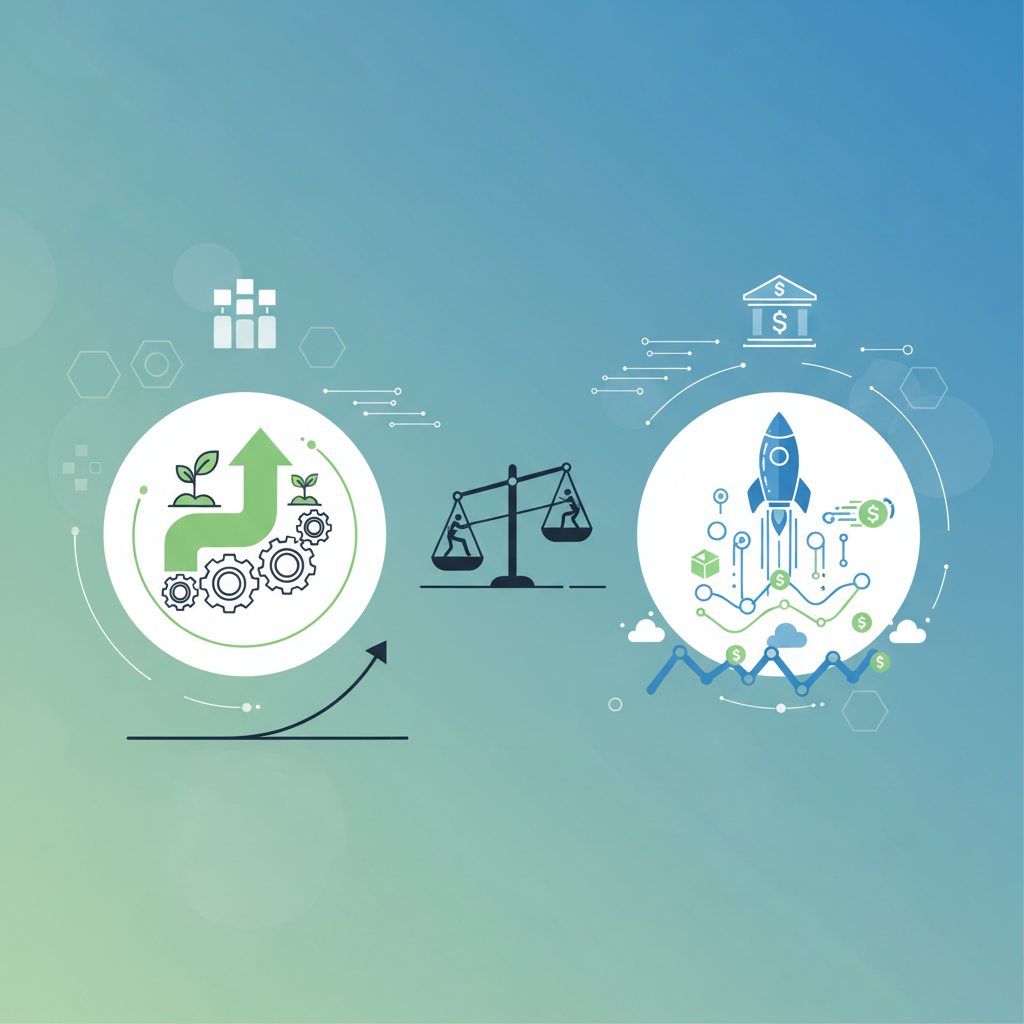
VC Funding: Acceleration and Dilution
Conversely, companies that raise funds from venture capitalists embark on a race for growth. Capital injection allows for rapid recruitment, multiplication of commercial initiatives, and accelerated product development. But this choice implies major structural compromises.
Rapid Dilution and Loss of Control
Share dilution begins with the first funding round. After one or two rounds (seed and Series A), founders typically hold only 20-30% of the capital. With each new round, this share further decreases, benefiting investors who take seats on the board of directors and influence strategic decisions.
This loss of control is not merely symbolic. Venture capitalists often impose strict performance targets, aggressive growth indicators, and an exit trajectory — usually via acquisition or IPO — within 5 to 7 years.
Founders thus find themselves managing not only their company but also the expectations and pressures of an investor ecosystem whose interests are not always aligned with a long-term vision.
High Burn Rate and Performance Pressure
VC-funded startups often operate with a high burn rate: they spend more than they earn, betting on sufficiently rapid growth to justify successive valuations. This model imposes constant pressure: each quarter must demonstrate tangible progress, otherwise, difficulties will arise in subsequent rounds.
Figures are telling: only 5-10% of venture-backed companies achieve profitability, and their five-year survival rate ranges between 10% and 15%. The majority fail or stagnate, unable to justify the expectations created by their initial valuations.
The Leverage Effect: Scaling and High Valuations
Despite these risks, venture capital remains the preferred path for startups aiming for rapid scaling. Access to millions of euros or dollars allows for testing multiple hypotheses simultaneously, investing heavily in customer acquisition, and recruiting top talent before the competition.
Successful companies achieve spectacular valuations and generate significant returns for their founders, even after dilution. But this success remains the exception, reserved for those who manage to execute in very high-growth markets.
To delve deeper into the challenges of restructuring and strategic adaptation during uncertain times, consult our article on IT restructuring and anticipating post-crisis layoffs.
Structural Comparison: Two Growth Philosophies
Beyond the numbers, bootstrapping and venture capital embody two radically different philosophies.
| Criterion | Bootstrapping | Venture Capital |
|---|---|---|
| Founder Equity | ≥ 90% after several years | 20-30% after 1-2 rounds |
| Strategic Control | Total | Shared with investors |
| Exit Horizon | Flexible, no constraints | 5-7 years (exit pressure) |
| Profitability | Priority from the start | Secondary (focus on growth) |
| Survival Rate (5 years) | 35-40% | 10-15% |
Bootstrapping suits founders who prioritize sustainability, control, and a customer-centric approach. It works particularly well in B2B SaaS sectors, niche services, or high-margin models where customer loyalty generates strong recurring revenue.
Venture capital, on the other hand, is essential in rapidly expanding markets where speed of conquest determines leadership. It remains indispensable for companies requiring heavy investments in R&D, infrastructure, or marketing before generating their first significant revenues.
Hybrid Models: A Third Way in 2026
Facing the limitations of these two pure approaches, a third path is emerging: hybrid funding. Some startups begin by bootstrapping their first few years to validate their business model, then selectively raise funds to accelerate in specific segments (geographical expansion, strategic product development).
This approach allows for preserving a significant portion of equity while benefiting from occasional leverage. However, it requires rigorous execution: founders must demonstrate clear traction before raising, negotiate favorable terms, and remain vigilant about dilution.
Revenue-based financing funds and other non-dilutive debt instruments are also gaining popularity. They offer an alternative to traditional funding rounds, allowing profitable companies to borrow based on their recurring revenue, without giving up equity.
To understand how certain economic models withstand crises through adapted structures, discover our analysis on social entrepreneurship and economic resilience.
Choosing Based on Your Market and Vision
The choice between bootstrapping and venture capital is neither good nor bad in absolute terms. It depends on several factors: the nature of the market, the founders' profile, the ability to generate revenue quickly, and growth ambition.
When to Prioritize Bootstrapping?
- You operate in a niche market with moderate competition
- Your business model quickly generates recurring revenue
- You want to maintain total control of your company
- You prioritize profitability over growth speed
- You have an aversion to the risk associated with dilution and investor demands
When to Opt for Venture Capital?
- Your market is rapidly expanding and requires quick conquest
- The business model requires heavy investments before profitability
- You aim for market leadership with a strong network effect
- You accept dilution in exchange for accelerated growth
- You are ready to manage the pressure and expectations of an investor ecosystem
In both cases, it is essential to understand the long-term implications. Decisions made during the seed phase condition the entire trajectory of the company, from governance to organizational culture.
To optimize your customer relationship and intelligently automate your sales processes, consult our guide on CRM automation and hyper-personalization in 2026.
Outlook for Founders in 2026
The startup ecosystem is evolving. After years of exuberance where fundraising was perceived as validation in itself, the market is returning to more solid fundamentals. Investors now prioritize healthy unit economics, profitable models, and teams capable of executing with discipline.
In this context, bootstrapping is regaining its prestige. Many recent success stories show that building a sustainable, profitable company controlled by its founders is not only possible but often preferable to a frantic race for valuation.
This does not mean that venture capital has lost its relevance. On the contrary, it remains essential for certain categories of businesses. But it is no longer the only legitimate path. Founders today have a choice, and this choice must be informed, strategic, and aligned with their long-term vision.
Whether you opt for self-funding, venture capital, or a hybrid model, the key lies in the consistency between your funding strategy and your business model. A well-funded company is, above all, a company whose capital structure supports its ambitions without constraining them.
---