
Social Entrepreneurship: How Economic Models Resist Crises

When the COVID-19 pandemic disrupted the global economy in 2020, many traditional businesses faltered. However, one category of organizations not only resisted but sometimes grew stronger: social enterprises. How do these structures, which combine a social mission with economic viability, manage to navigate the storm of successive crises?
The answer lies in three words: absorption, adaptation, transformation. These capabilities form the foundation of economic resilience that goes beyond mere survival to aim for lasting impact, even in times of turbulence.

Shock Absorption: Building Strategic Reserves
The first line of defense for a social enterprise facing a crisis is to absorb shocks without compromising its fundamental mission. This capacity relies on prudent financial management and diversification of funding sources.
Contrary to popular belief, social economy organizations are not limited to public subsidies. They develop a hybrid funding ecosystem that combines several levers: sales of products and services, contractual services for businesses or institutions, social impact bonds, impact investment funds, and solidarity finance mechanisms.
This diversification reduces dependence on a single source of income. When one channel dries up during a crisis, others take over. According to a World Economic Forum report on the social economy, this multi-channel approach is one of the key factors in organizational resilience to economic disruptions.
The establishment of financial reserves also plays a crucial role. Even modest, these precautionary funds provide a safety cushion, allowing essential operations to be maintained during the first months of a crisis, giving time to activate other adaptation levers.
Adaptation: Participatory Governance as a Strategic Asset
While shock absorption is a passive defense, rapid adaptation represents the offensive capability of social enterprises in the face of crises. And their secret weapon lies in their governance model.
Democratic and participatory governance, characteristic of many social economy structures like SCOPs (Cooperative and Participatory Societies) or SCICs (Collective Interest Cooperative Societies), fosters decentralized and reactive decision-making. Employees, beneficiaries, and stakeholders participate in strategic choices, generating valuable collective intelligence in times of uncertainty.
This proximity to the field allows social enterprises to quickly detect weak signals and adjust their offerings in real-time. During the pandemic, some structures developed remarkable resilience mechanisms thanks to this organizational agility: shifting to remote work, reorienting services to emerging needs, mobilizing local solidarity networks.
"An organization's ability to adapt relies less on its financial resources than on its capacity to mobilize collective intelligence and make quick decisions as close to the ground as possible."
Operational flexibility is also evident in the hybrid models adopted by social enterprises. Remote work, flexible hours, team versatility: these practices, often experimented with before they became necessary, allowed for remarkable business continuity.
Transformation: Turning Crisis into an Opportunity for Innovation
Beyond absorption and adaptation, the most resilient social enterprises undertake a true transformation of their economic model. They don't just weather the crisis; they emerge stronger.
This transformation begins with a strategic reorientation of their offerings towards services with high social or environmental value. Crises often reveal new societal needs: isolation of vulnerable people, food insecurity, digital divide, ecological transition. Successful social enterprises are those that identify these emerging needs and provide innovative solutions.
Strengthening local partner networks is another pillar of this transformation. Crises demonstrate the importance of short supply chains and local embeddedness. Some social enterprises even develop local currencies or proximity exchange systems that create economic resilience at the community level.
Digital innovation also plays a central role. Digital platforms allow reaching new beneficiaries, maintaining connections during lockdown periods, and optimizing operations. This digitalization does not replace the human contact central to the social economy but complements and amplifies it.
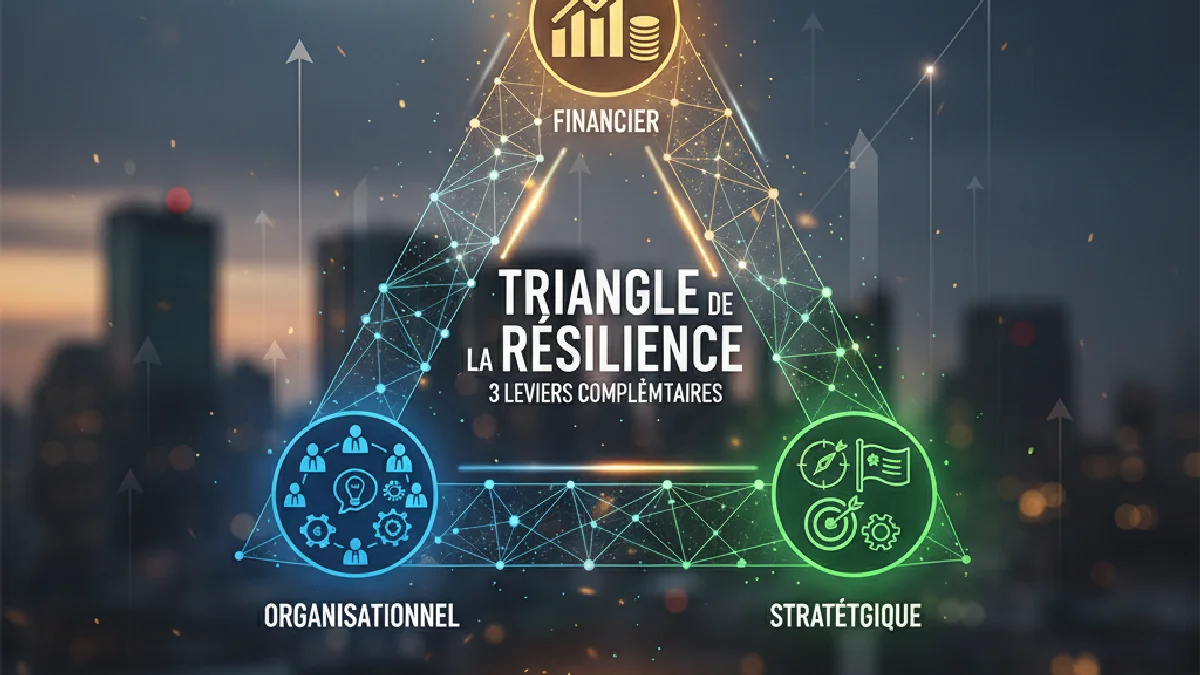
The Resilience Triangle: Three Complementary Levers
The resilience of social enterprises does not rely on a single factor but on the interaction of three complementary levers: financial, organizational, and strategic.
The financial lever combines revenue diversification, reserve building, and access to innovative financing like impact bonds. Without financial solidity, even the best strategy remains fragile.
The organizational lever mobilizes participatory governance, operational flexibility, and collective learning capacity. Structures that involve their stakeholders in decisions develop superior systemic resilience.
The strategic lever is based on the clarity of the social mission, the capacity for innovation, and local embeddedness. Social enterprises that stay true to their purpose while adapting their methods are those that best weather storms.
These three levers articulate like the sides of a triangle: the weakness of one weakens the whole, but their mutual reinforcement creates a remarkably solid structure.
| Lever | Key Components | Role in Resilience |
|---|---|---|
| Financial | Revenue diversification, reserves, innovative financing | Ensures stability and operational continuity |
| Organizational | Participatory governance, flexibility, collective intelligence | Facilitates rapid adaptation and informed decisions |
| Strategic | Clear social mission, innovation, local embeddedness | Enables transformation and identification of new opportunities |
Economic Uncertainty: A Persistent Context
Crises are no longer exceptional events but a new normal. Geopolitical tensions, climate change, rapid technological shifts: sources of disruption are multiplying and accelerating.
In this context, resilience strategies are no longer a luxury but an existential necessity. SMEs and startups can draw inspiration from social economy practices, particularly in terms of revenue diversification and participatory governance.
Economic uncertainty also demands increased vigilance on performance indicators. For growing structures, tracking metrics like the burn multiple allows anticipating cash flow difficulties and quickly adjusting trajectory.
Some social enterprises even develop antifragility capabilities, a concept that goes beyond simple resilience. Rather than merely resisting shocks, they benefit from them to grow stronger, like a muscle that develops under effort. To learn more, consult this article on antifragility in the face of crises.
Concrete Tools to Strengthen Resilience
How can a social enterprise concretely develop its resilience capacity? Several operational practices have proven effective:
- Regularly conduct financial stress tests: simulate different crisis scenarios (30% drop in revenue, loss of a major client, etc.) to identify vulnerabilities
- Build a strategic reserve fund equivalent to 3-6 months of fixed costs, even gradually
- Diversify revenue sources by developing at least three distinct funding channels
At the organizational level, establishing spaces for regular dialogue with stakeholders helps maintain active collective intelligence. Formats can vary: participatory assemblies, thematic working groups, field information feedback mechanisms.
Investing in digital skills is also a priority. Not to replace humans, but to increase the organization's capacity for action and adaptation. A social enterprise capable of quickly shifting to online services has valuable flexibility.
Finally, developing strategic partnerships with other social economy actors creates network effects and mutualization. Sharing resources, exchanging best practices, supporting each other: these organized solidarities strengthen collective resilience.
Towards a More Resilient and Inclusive Economy
The experience of social enterprises in recent crises offers valuable lessons for the entire entrepreneurial ecosystem. Their ability to preserve their mission while ensuring their economic viability demonstrates that it is possible to reconcile impact and performance, even in adversity.
This resilience does not result from a magic recipe, but from a combination of proven practices: participatory governance, financial diversification, local embeddedness, social innovation, and above all, clarity on the "why" that guides action even in the storm.
For entrepreneurs and leaders seeking to build sustainable organizations, the social entrepreneurship model offers a valuable compass. It reminds us that economic resilience is not built solely on financial statements, but also on the quality of human relationships, the strength of solidarity networks, and the collective ability to find meaning in challenges. For inspiration, you can also discover Fairphone's resilience model.
Crises will continue to occur. But organizations that have integrated these principles of resilience will be better equipped to navigate them, and perhaps even turn them into opportunities for inclusive and sustainable growth.