Web3 vs Web2: Comparison of Economic Models 2026

The internet is undergoing a profound transformation. On one side, Web2 giants – Google, Meta, Amazon – are refining their proven models, based on data monetization and premium services. On the other, decentralized applications (dApps) powered by blockchain promise to give users back control over their digital assets and identity. But beyond the rhetoric, what concrete differences separate these two architectures in terms of value creation, innovation, and governance?
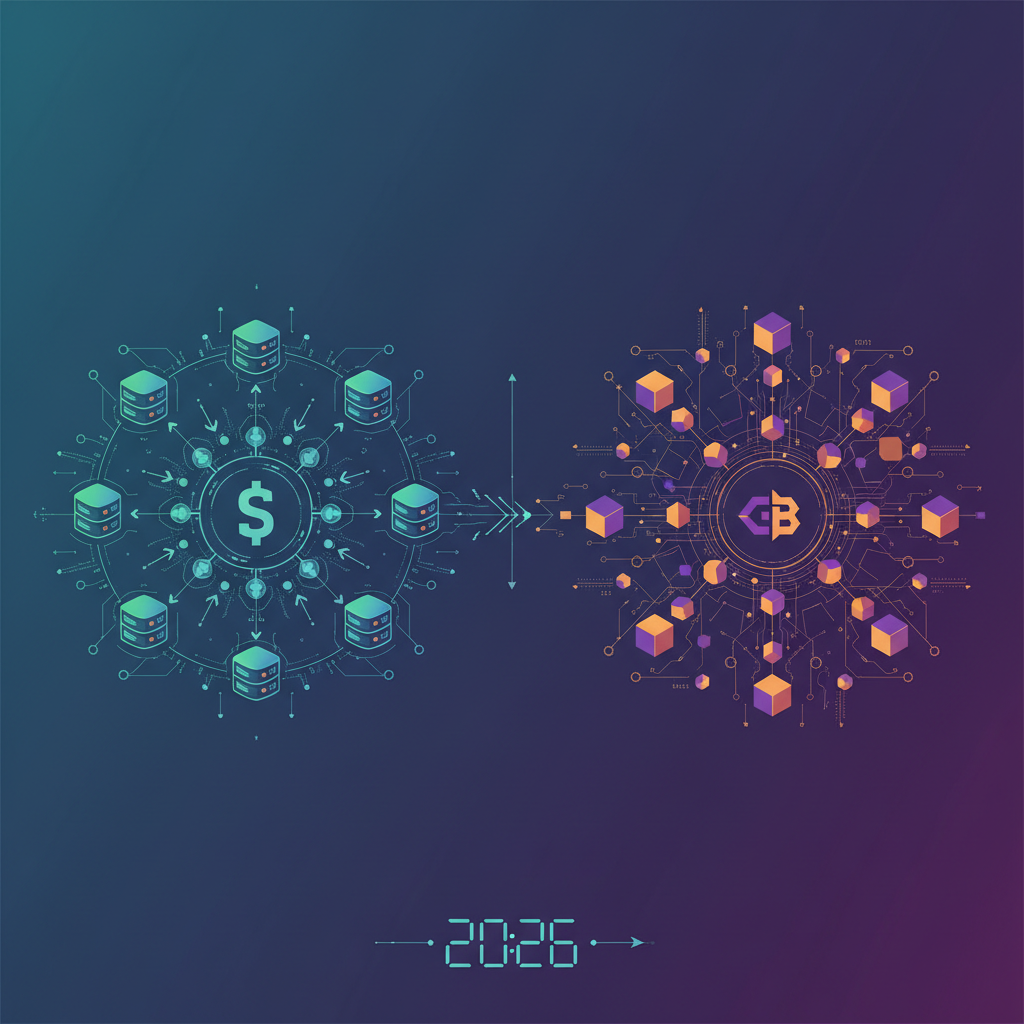
Monetization Models: Centralization vs. Tokenization
Web2: Profitability Through Data
Web2 platforms operate on a centralized economic logic. Their proprietary infrastructure – servers, databases, algorithms – allows them to massively capture and exploit user data. Targeted advertising is the primary monetization lever: every interaction, search, or click feeds behavioral profiles sold to advertisers.
Next come subscription models (Netflix, Spotify, LinkedIn Premium) which convert access to content or features into recurring revenue. Finally, transaction fees – common practice for Amazon, Uber, or Airbnb – allow platforms to take their share of each commercial exchange.
This concentration of value at the top of the pyramid creates powerful network effects but limits redistribution to content creators and contributors.
Web3: Redistribution via Tokens and NFTs
Conversely, Web3 dApps rely on public blockchains (Ethereum, Solana, Polygon) where ownership of digital assets is cryptographically attested. Users hold their data in non-custodial wallets, and value circulates via native tokens rather than centralized commissions.
Several innovative mechanisms are emerging:
- Staking and liquidity mining: holders lock their tokens to secure the network or provide liquidity, in exchange for automatic rewards.
- NFTs and royalties: creators receive recurring revenue from each resale of their digital works, directly coded into smart contracts.
- Distributed transaction fees: a portion of gas fees can be returned to validators or active protocol contributors.
This model encourages active participation and aligns economic incentives between the platform, developers, and users, according to analyses from Web3FuturePro.
Innovation: Closed Cycles vs. Open Iterations
Proprietary R&D and Strategic Acquisitions
In the Web2 ecosystem, innovation relies on massive investments in research and development conducted by internal teams. Patents protect technological advancements, creating barriers to entry and strengthening dominant positions.
Tech giants also employ a strategy of targeted acquisitions: buying promising startups (Instagram by Facebook, YouTube by Google) to quickly integrate new features and neutralize competition. This model favors rapid execution but concentrates decision-making power and limits external experimentation.
Open-Source Development and DAOs
Web3 adopts a radically different approach. Most protocols are open-source, allowing any developer to audit the code, propose improvements, or fork a project to create their own version.
Decentralized Autonomous Organizations (DAOs) embody this collaborative logic: token holders vote on protocol directions, resource allocation, and funding for new features. As Ethereum.org highlights, this participatory governance stimulates iterative and community-driven innovation, though sometimes slower.
"In Web3, anyone can participate without monetizing their personal data. Control is decentralized, making censorship almost impossible."
Crowdfunding mechanisms – IDO (Initial DEX Offering), grant programs, crypto venture capital – replace traditional fundraising and allow projects to raise funds directly from their community.

Governance and Control: Centralized Authority vs. Distributed Consensus
Vertical Decision-Making
Web2 applications operate on a classic hierarchy. Executives and boards of directors define product strategies, content moderation policies, and terms of use. Users are subject to these decisions, even when they directly affect their experience or revenue.
This centralized governance offers responsiveness and consistency in execution but generates risks of censorship, arbitrary changes (algorithm modifications, feature removal), and conflicts of interest between profitability and user interests.
On-Chain Governance and Decentralized Voting
Web3 establishes transparent governance via smart contracts and on-chain voting mechanisms. Each improvement proposal (governance proposal) is submitted to token holders, who vote proportionally to their stake in the protocol.
This decentralization reduces the risks of censorship and unilateral manipulation. According to Ethereum documentation, Web3 servers cannot be arbitrarily "shut down" as they rely on a decentralized network of thousands of nodes.
However, this model also presents challenges: slow decision-making processes, concentration of voting power among "whales" (large holders), and technical complexity that can exclude less expert users.
| Characteristic | Web2 (Centralized) | Web3 (Decentralized) |
|---|---|---|
| Decision-Making | Vertical (management, board of directors) | Horizontal (DAOs, on-chain token holder voting) |
| Risks | Censorship, arbitrary changes, conflicts of interest | Slowness, vote concentration, technical complexity |
| Primary Objective | Profitability and platform control | Distributed consensus and incentive alignment |
Data Ownership and Control: The Core of the Debate
One of the fundamental differences between Web2 and Web3 concerns data ownership. In the current internet, platforms collect, store, and exploit personal information without true user control. Terms and conditions, rarely read, de facto transfer ownership of content and metadata to the operator.
Conversely, Web3 relies on decentralized identities (DIDs) and cryptographic wallets where the user retains the private key. Personal data is never hosted on a central server but remains under the exclusive control of its owner. Applications only access information with explicit authorization, via granular consent protocols.
This architecture strengthens digital sovereignty but also implies increased responsibility: the loss of a private key means the definitive loss of access to assets, with no centralized recourse possible. To learn more about security challenges, consult our article on Solana facing the quantum threat.
Resilience, Scalability, and Costs: Technical Trade-offs
Centralized Infrastructure: Performance and Fragility
Web2 architectures rely on centralized servers and content delivery networks (CDNs) optimized for speed and latency. This centralization ensures high performance, a smooth user experience, and rapid scalability.
However, it introduces single points of failure: a server outage, a cyberattack, or a political decision can render a platform inaccessible. Furthermore, the geographical concentration of infrastructure raises questions of digital sovereignty and dependence on cloud giants (AWS, Azure, Google Cloud).
Decentralization: Resilience and Transaction Costs
Blockchain networks disperse data across thousands of independent nodes, ensuring high availability and resistance to censorship. No single authority can arbitrarily shut down or modify a decentralized dApp.
Nevertheless, this architecture distributes costs differently: each transaction generates gas fees (especially on Ethereum), the amount of which varies depending on network congestion. Performance remains lower than centralized databases, and scalability challenges persist despite layer 2 solutions (Polygon, Optimism, Arbitrum).
The balance between decentralization, security, and speed – known as the "blockchain trilemma" – remains at the heart of technical debates.
Acquisition and Retention Strategies: Platforms vs. Communities
User acquisition dynamics differ radically. Web2 invests heavily in digital marketing, conversion optimization, and proprietary loyalty programs. Platforms maintain full control over customer data and orchestrate personalized campaigns on a large scale.
Web3 focuses on community engagement: token distribution to early adopters, ambassador programs, "play-to-earn" or "learn-to-earn" mechanisms. Loyalty is based on aligning economic interests rather than algorithmic dependency loops.
Token airdrops, exclusive NFTs, and participatory governance systems transform users into active stakeholders, creating organic but sometimes volatile loyalty when economic incentives fluctuate.
Regulatory Framework and Compliance: Asymmetrical Uncertainties
The regulatory environment is a decisive factor. Web2 platforms operate within established legal frameworks (GDPR in Europe, consumer protection laws), even if they are regularly subject to antitrust disputes and sanctions for abuse of dominant position.
Web3 navigates a complex regulatory vacuum. Global financial authorities struggle to classify tokens (financial assets, utilities, securities?) and define responsibilities in systems without a central entity. The recent initiative by the US SEC regarding a crypto Safe Harbor illustrates attempts at clarification.
This uncertainty hinders institutional adoption but also offers a space for regulatory experimentation. Pro-crypto jurisdictions (Singapore, Switzerland, United Arab Emirates) attract Web3 projects, creating a geographical fragmentation of digital governance.
Convergence and Hybrid Models: The Future of the Internet
Rather than a binary opposition, the evolution of the internet seems to be moving towards hybrid models combining the strengths of each paradigm. Embedded wallets integrate the fluid Web2 experience with Web3 crypto ownership. Progressive governance protocols gradually decentralize control as the network matures.
Platforms like Discord or Reddit are experimenting with community tokens, while dApps adopt Web2 interfaces to reduce onboarding friction. Layer 2 solutions and account abstraction bring blockchain performance closer to that of centralized databases.
This convergence does not mean the disappearance of pure models, but the emergence of a spectrum of solutions where each project chooses the degree of decentralization adapted to its constraints. Liquid staking mechanisms illustrate this trend, as detailed in our 2026 platform comparison.
Outlook: Reinvention or Coexistence?
The internet's transformation is not just a technological choice. It raises fundamental questions about the distribution of power, value capture, and individual autonomy in the digital space.
Web2 will likely continue to dominate mainstream usage in the short term, thanks to its accessibility, performance, and mature ecosystems. But Web3 carves an alternative path for applications requiring transparency, censorship resistance, and verifiable ownership – decentralized finance, sovereign digital identity, creator markets.
The future may be neither entirely centralized nor entirely decentralized, but contextual: each use case will find its optimal balance between control, performance, and sovereignty. Organizations that can navigate these paradigms, combining Web2 agility and Web3 resilience, will build the digital infrastructures of the next decade.