Buy-Back vs. Refurbishment: Which Strategy for the Circular Economy?
The electronics industry generates millions of tons of waste each year, while the demand for new equipment continues to grow. In this context, two circular economy models are emerging as sustainable solutions: buy-back (repurchase of used equipment) and refurbishment. But which offers the best economic and environmental potential?
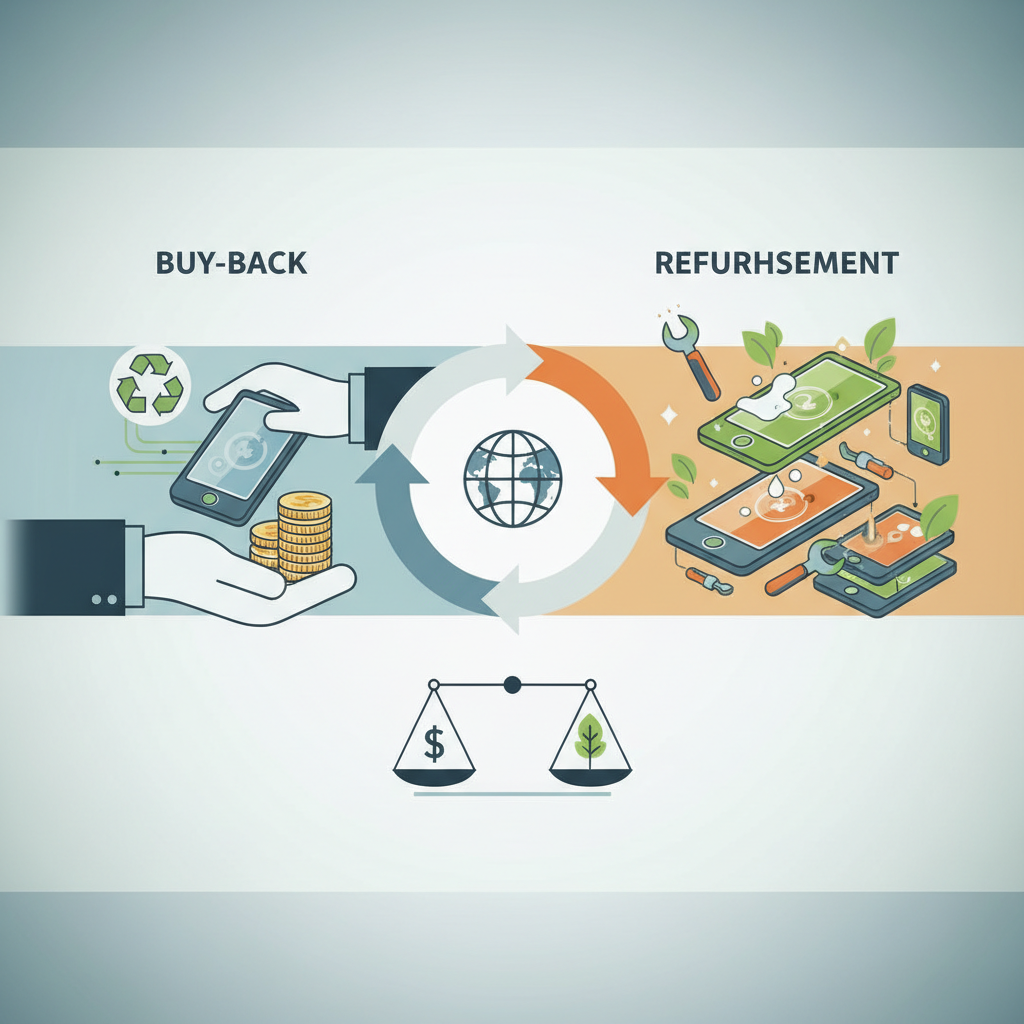
The Fundamentals of the Buy-Back Model
The buy-back model involves systematically collecting end-of-life equipment directly from consumers and businesses. This approach secures a constant supply of used material, creating a controlled source for reuse or recycling activities.
Companies specializing in buy-back invest heavily in collection logistics and rapid equipment evaluation. Econocom, a European leader in digital services, has developed a network of collection centers capable of processing several hundred thousand devices annually, according to their 2022 annual report.
Strategic Advantages of Buy-Back
- Supply Security: ensures a regular flow of quality used material
- Strengthened Customer Relationships: builds customer loyalty through attractive trade-in services
- Value Chain Control: complete mastery of the process from collection
Buy-back prices vary considerably depending on the condition and age of the equipment, but generally represent 15% to 40% of the initial purchase value for devices less than three years old.
Refurbishment: The Art of a Second Life
Refurbishment involves an in-depth technical process: disassembly, inspection, repair, re-manufacturing, and reassembly of components. This approach literally transforms used equipment into “like-new” products with a commercial warranty.
Savings generated by refurbishment range from 34% to 70% of production costs, according to industry studies. This performance is explained by the reuse of expensive components (processors, memory, screens) that retain their technical value despite use.
"Refurbishment can reduce the selling price by 20% while decreasing the carbon footprint by 50% when it extends a device's life by 2 to 4 years."
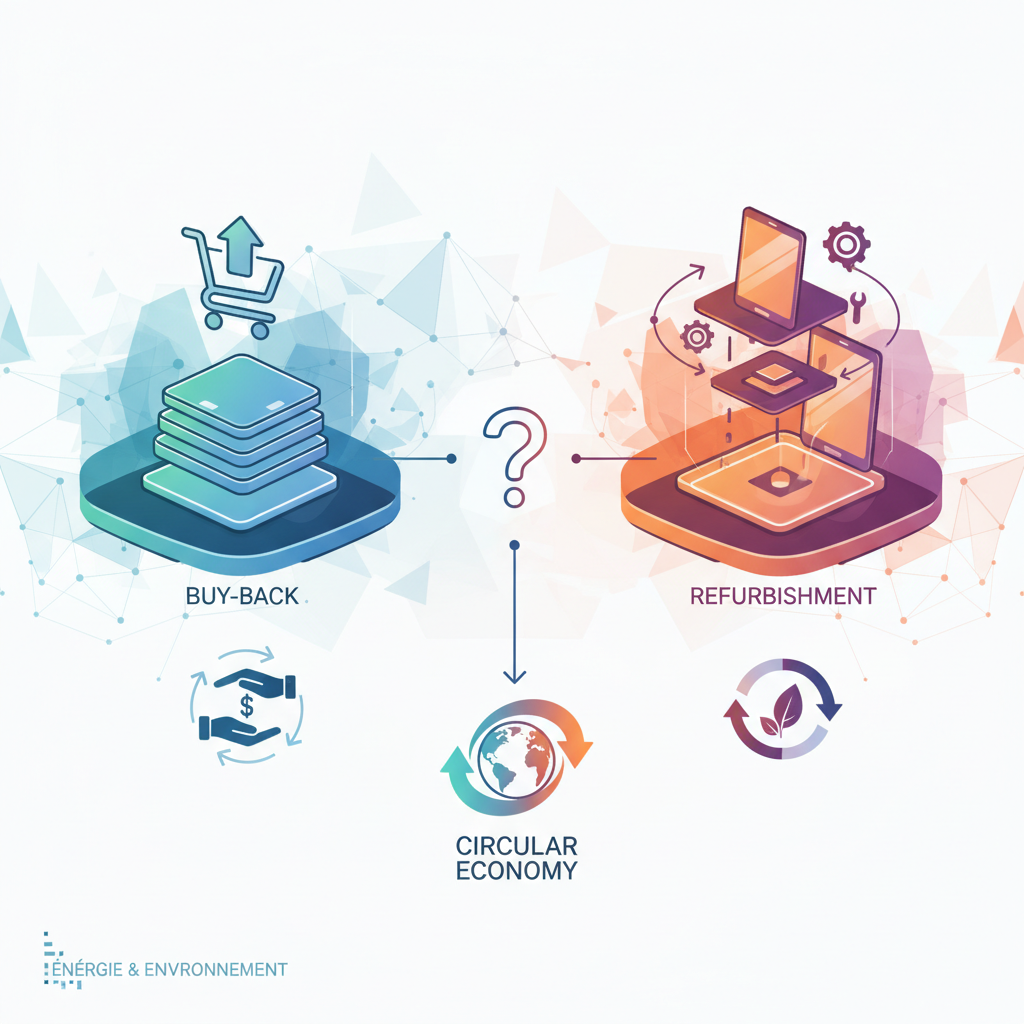
Environmental Impact of Refurbishment
The IT refurbishment sector generates substantial environmental benefits:
- 50% reduction in CO2 emissions compared to new production
- Saving critical raw materials: rare earths, precious metals
- Extension of equipment lifespan by an additional 2 to 4 years
Life cycle analysis reveals that refurbishment avoids the manufacturing phase, which is responsible for 70% to 80% of the total environmental impact of electronic equipment.
Economic Comparison: Profitability and Risks
Buy-Back Model: Investments and Challenges
The buy-back model requires significant initial investments in logistical infrastructure and skilled personnel. Companies must also manage the volatility of raw material prices and international competition for quality sources.
Operational costs include:- Sourcing and equipment evaluation
- Transportation and storage
- Specialized technical personnel
- Dedicated information systems
Refurbishment: Stability and Job Creation
Refurbishment benefits from cost stability due to the use of recovered components. This sector also creates specialized, non-relocatable jobs, contributing to local economic development.
Operational margins for refurbishment generally range between 25% and 45%, higher than those for new products (15-25%) due to raw material savings.
| Characteristic | Buy-back | Refurbishment |
|---|---|---|
| Initial Investments | High (logistics, personnel) | Lower (focused on technical processes) |
| Cost Volatility | Sensitive to raw material prices | Stable (recovered components) |
| Operational Margins | Variable | 25% to 45% (higher than new) |
| Job Creation | Logistics, evaluation | Specialized, non-relocatable |
Regulatory Framework and Public Policies
European and national policies actively support both models through several levers:
Support Measures
- Extension of legal warranties up to 2 years for refurbished products
- Mandatory availability of spare parts for 7 to 10 years
- Tax incentives for companies practicing trade-ins
The European ecodesign directive now imposes repairability and upgradability criteria on manufacturers, facilitating refurbishment activities. This regulation is gradually transforming the market in favor of the circular economy.
As shown by the study on the circular economy in Quebec, these policies generate significant economic benefits: over $200 million in added value and 1,147 supported jobs.
Operational Challenges and Future Prospects
Limitations of Buy-Back
The buy-back model remains sensitive to economic cycles and fluctuations in raw material prices. International competition, particularly from Asia, exerts constant pressure on trade-in prices, reducing operational margins.
Rapid and reliable evaluation of equipment represents a major technical challenge, requiring costly expertise tools and continuous team training.
Challenges of Refurbishment
Refurbishment faces challenges of scalability and standardization. Each equipment model requires specific processes, limiting economies of scale.
Consumer perception also acts as a barrier: despite warranties, refurbished products still suffer from a "second-hand" image that hinders massive adoption.
Nevertheless, these challenges are finding innovative solutions, as illustrated by projects to optimize circular supply chains that integrate Artificial Intelligence and Industry 4.0 to automate processes.
Hybrid Models and Strategic Convergence
The future likely belongs to hybrid models that combine buy-back and refurbishment in an integrated approach. Market leaders are developing complete ecosystems where collection directly feeds refurbishment units.
This convergence allows for optimization of:- Complete traceability of equipment
- Maximum valorization of each component
- Cost reduction through infrastructure pooling
Companies that master this vertical integration have a decisive competitive advantage, as demonstrated by the success of players specialized in the circular economy.
The emergence of digital platforms also facilitates this convergence by directly connecting equipment holders to refurbishers, optimizing flows and reducing intermediaries.
This transformation is part of a broader logic of energy transition, where companies seek to reduce their carbon footprint by adopting sustainable solutions, similar to initiatives developed in the carbon capture technologies sector.
Outlook 2026-2030: Towards Industrial Maturity
The buy-back and refurbishment market is expected to experience sustained growth of 15% to 20% annually until 2030. This expansion is based on the convergence of several factors: strengthening regulations, environmental awareness, and economic optimization.
Investments in R&D are focused on automating evaluation and refurbishment processes, reducing labor costs and improving standardization. Artificial intelligence now allows for automatic diagnosis of component status, significantly accelerating processing cycles.
This industrial maturation positions the circular economy as a strategic sector, on par with emerging climate regulations that redefine companies' environmental obligations.