European EV Market 2026: Sales Rebound Despite Uncertainty
After a turbulent period marked by the energy crisis and political uncertainties, the European electric vehicle market is returning to growth in 2026. With at least 4 million units expected, this recovery is nonetheless accompanied by new regulatory and geopolitical challenges that question the sustainability of this positive dynamic. Detailed forecasts on this growth are available through specialized sources such as Research Nester and Fortune Business Insights.
Germany, the engine of European rebound
Germany confirms its status as the leading European market with nearly 800,000 electric vehicles sold in 2026, representing approximately 15% of new registrations. This performance is due to several converging factors: the gradual decrease in battery costs, the expansion of the offer with diversified models (sedans, SUVs, city cars), and the deployment of an increasingly dense public charging network.
The overall European market is expected to reach 15.2 million new vehicles in 2026, the highest level since 2020, although it remains below the 17.7 million recorded in 2019. This progression reflects a gradual normalization after the disruptions of previous years.
European manufacturers are also benefiting from a diversification of their electric range. Tesla is no longer alone in the premium segment, while traditional brands now offer credible alternatives in all price categories.
Subsidies on borrowed time: the sword of Damocles
One of the main factors of uncertainty concerns the evolution of public incentives. Purchase subsidies, tax exemptions, and parking benefits that have supported the market are to be gradually phased out or revised by the end of 2026. This prospect creates a climate of anticipation among consumers and corporate fleets.
“Most national incentives will have to be gradually phased out or revised by the end of 2026, creating a climate of uncertainty among consumers and fleets.”
In Germany, the ecological bonus has already been reduced, falling from 9,000 euros to 4,500 euros for the cheapest vehicles. This progressive reduction aims to prepare the market for financial autonomy, but it worries professionals who fear a slowdown in sales.
The stakes are high: how to maintain the attractiveness of electric vehicles without massive public support? The answer probably lies in the continued reduction of production costs and the improvement of the overall value proposition.
European regulations: between easing and confusion
The European regulatory framework is going through a period of instability that complicates manufacturers' planning. Low-emission zones (LEZs) are regularly challenged or suspended in several European cities, creating a difficult-to-navigate mosaic of local rules.
More significantly, the European Commission recently eased its legislation aiming to ban internal combustion vehicles in 2035. The new objective now sets a 90% reduction in tailpipe emissions, with the remaining 10% potentially offset by the use of low-carbon steel or synthetic fuels.
This increased flexibility, although welcomed by some manufacturers, introduces legal uncertainty that fuels political debates. Research and development investments are affected, with industrialists hesitating on which technologies to prioritize in the long term.
Geopolitical challenges weigh on the industry
Geopolitical tensions represent a major challenge for the consolidation of the European EV market. Several factors combine to create cost volatility:
- Fluctuations in energy prices: variations in oil and gas directly impact the relative competitiveness of electric vehicles
- Dependence on raw materials: Europe remains largely dependent on Asian supplies for battery components
- Trade disputes: tensions with China over automotive tariffs complicate trade
This strategic dependence pushes Europe to develop its own value chain. European "gigafactory" projects are multiplying, but their ramp-up will take several years. In the meantime, vulnerability to geopolitical hazards persists.
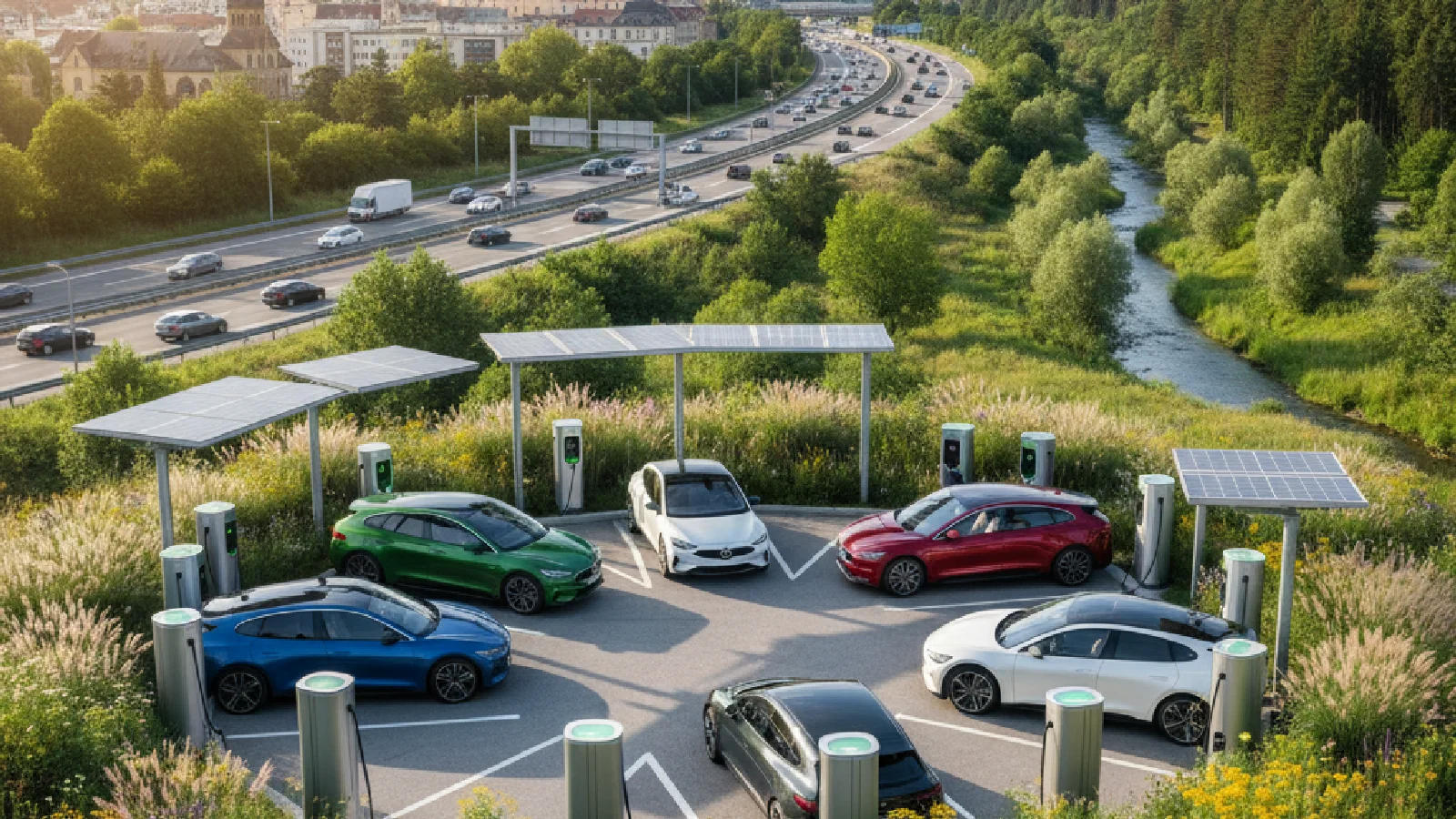
The European automotive industry is also relying on charging infrastructure to secure its transition. The deployment of fast charging stations is accelerating, but remains uneven across territories.
Technological prospects: beyond lithium-ion
2026 could mark a technological turning point with the emergence of new storage solutions. Lithium-sulfur batteries are attracting increasing interest due to their superior energy density and potentially reduced cost.
These innovations, if they materialize, could solve two major challenges of electric vehicles: range and price. Several European manufacturers are investing heavily in these disruptive technologies, hoping to regain an advantage over Asian competition.
Hydrogen also remains in the equation for heavy vehicles and professional fleets, even if its development for private individuals seems less of a priority in the short term.
An ecosystem in transformation
The rebound of the European EV market in 2026 is part of a broader transformation of the automotive ecosystem. Traditional manufacturers are accelerating their transformation, investing massively in electrification and connected services.
This evolution is accompanied by a recomposition of the value chain, with the emergence of new players specialized in batteries, software, or charging services. Partnerships are multiplying, creating a more complex but potentially more resilient ecosystem.
Integration with AgriTech technologies also opens new opportunities for electric vehicles in the agricultural and industrial sectors, expanding the market beyond private individuals.
Towards market consolidation?
Despite the challenges, the signals for 2026 remain generally positive. The improvement of the offer, the decrease in costs, and the extension of infrastructure create the conditions for sustainable growth of the European electric vehicle market. Comprehensive analyses are available, notably the Transport Dashboard - Q3 2025 from IFP Énergies nouvelles.
| Factor | Impact on the EV Market in 2026 |
|---|---|
| Sales rebound | 4 million units expected, 9% of new car fleet |
| German market | 800,000 EVs sold, 15% of new registrations |
| Public subsidies | Gradual phasing out creating uncertainty among consumers and fleets |
| European regulations | Easing of the 2035 ban and vagueness around LEZs, leading to legal uncertainty |
| Geopolitical challenges | Cost volatility due to dependence on raw materials and trade disputes |
| Technological innovations | Emergence of lithium-sulfur batteries for range and price |
The key to success will lie in the European industry's ability to navigate between regulatory uncertainties and competitive pressures. Predictions for the electric car market in 2026 suggest an acceleration of these trends, as do the detailed expectations by Automobile Propre.
The stakes go beyond simple technological adoption: it is about building a viable economic model that reconciles climate ambitions, industrial competitiveness, and social acceptability. 2026 will be a decisive test for this complex equation.