Lithium-Sulfur vs. Lithium-Ion Batteries: An Energy Revolution
The race for innovation in energy storage is reaching a decisive turning point in 2026. While lithium-ion batteries still dominate the market with their proven reliability, a new generation is emerging: lithium-sulfur batteries. This technology promises to revolutionize the range of electric vehicles and the efficiency of stationary storage, but at what cost?
The stakes go beyond mere technical improvement. It's about determining which technology will support the global energy transition in the coming decades.
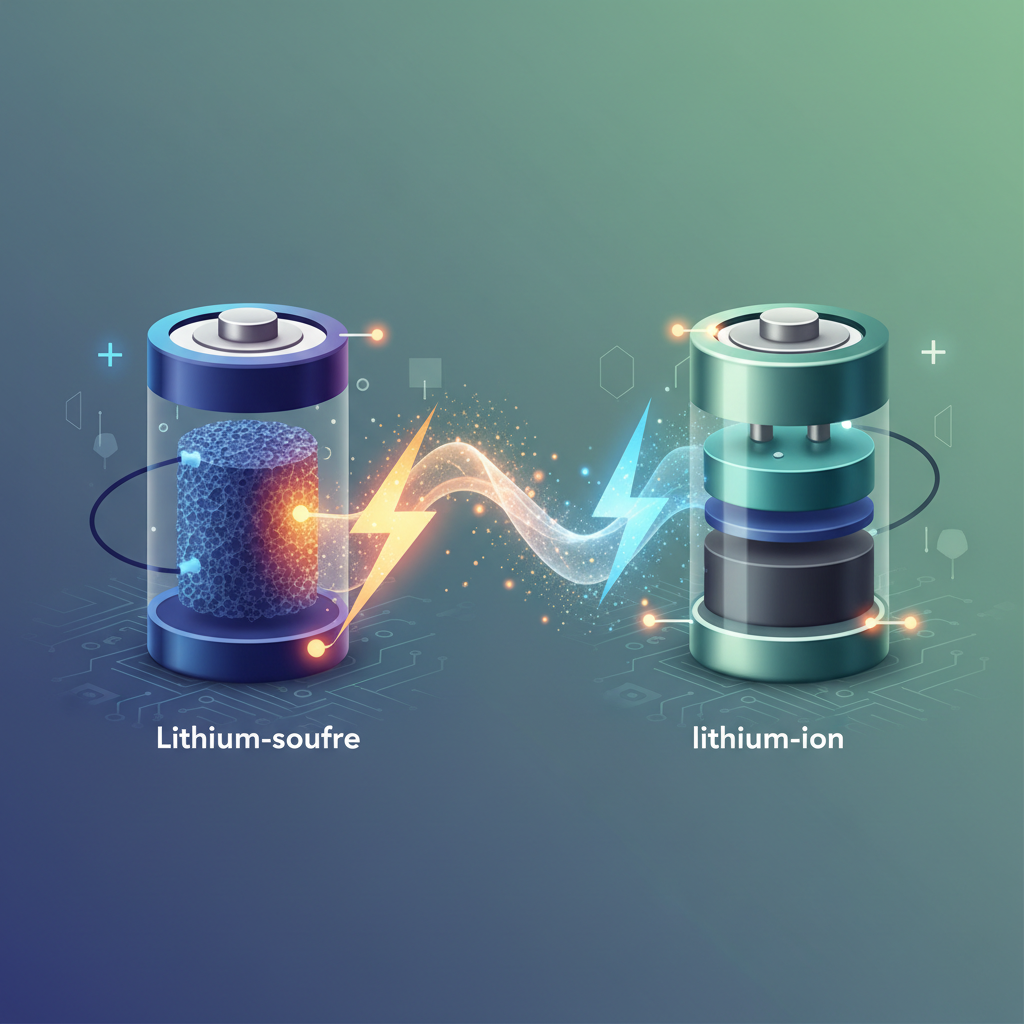
Energy Density: The Decisive Advantage of Lithium-Sulfur
Lithium-sulfur batteries show an impressive theoretical potential of 500 Wh/kg, two to three times higher than traditional lithium-ion batteries, which cap at between 150 and 250 Wh/kg. The most performant NMC/NCA cells currently exceed 200 Wh/kg, while LFP reach approximately 160 Wh/kg.
This fundamental difference is based on sulfur chemistry. Unlike the complex metal oxides in lithium-ion batteries, sulfur offers a theoretical capacity of 1675 mAh/g, significantly higher than graphite (372 mAh/g) used as an anode in Li-ion.
Concretely, this energy superiority translates into:- Lighter electric vehicles with equivalent range
- Aeronautical applications revolutionized by weight reduction
- More compact and efficient stationary storage
Recent demonstrations have validated lithium-sulfur cells reaching 450 Wh/kg with recharge times under 10 minutes, confirming the potential of this technology.
Durability and Cycling: The Achilles' Heel of Li-S
Despite their energetic promises, lithium-sulfur batteries face a major obstacle: their limited lifespan. They typically withstand 1000 cycles before significant degradation, compared to over 2000 cycles for mature lithium-ion batteries.
This limitation stems from the "polysulfide shuttle" phenomenon, where sulfur compounds dissolve in the electrolyte and migrate between electrodes, causing a gradual loss of active material. This parasitic mechanism progressively reduces the battery's capacity.
"Lithium-ion batteries benefit from high capacity stability over 2000 cycles, a crucial advantage for applications requiring long-term reliability."Engineers are exploring various solutions to counter this phenomenon:
- Encapsulation of sulfur in carbon matrices
- Development of more stable ether-based electrolytes
- Addition of additives to block polysulfide migration

| Characteristic | Lithium-Ion Batteries | Lithium-Sulfur Batteries |
|---|---|---|
| Energy Density | 150-250 Wh/kg | Up to 500 Wh/kg |
| Lifespan (Cycles) | > 2000 cycles | ~1000 cycles |
| Cost (Raw Material) | Cobalt, Nickel, Graphite | Sulfur (low cost) |
Economics and Costs: Sulfur, a Promising Raw Material
The economics of lithium-sulfur batteries are based on a fundamental advantage: the abundance and low cost of sulfur. This raw material, widely available as a byproduct of the petroleum industry, contrasts with the critical metals in lithium-ion batteries.
Lithium-ion batteries are highly dependent on cobalt, nickel, and graphite, whose prices fluctuate according to geopolitical tensions. Their average cost is currently around 200 USD/kWh and could stagnate due to resource scarcity.
According to analyses by GYCX Solar, sulfur promises cheaper batteries, but manufacturing processes and protection systems against undesirable reactions still keep production costs high.
The large-scale industrialization of Li-S requires:- Development of optimized manufacturing processes
- Investment in new supply chains
- Training of specialized technicians in this technology
Sectoral Applications: Programmed Revolution or Gradual Transition?
Electric Vehicles: Range vs. Durability
In the automotive sector, lithium-ion batteries maintain their dominance thanks to their industrial maturity and established safety. Manufacturers prioritize reliability over 8 to 15 years of use, a criterion where Li-ion excels.
However, lithium-sulfur batteries could revolutionize the sector with their range potential. A vehicle equipped with Li-S could theoretically travel 800 to 1000 km with a lighter battery pack, transforming the user experience.
As Energy Bases explains, this transition will depend on resolving the cyclability and safety challenges of lithium-sulfur batteries.
Stationary Storage: Reliability vs. Density
For grid storage, lithium-ion batteries currently dominate due to their proven reliability. Large-scale projects prioritize predictable performance over 20 years of operation.
Lithium-sulfur batteries could establish themselves in specific applications requiring very high energy density, provided their thermal management and lifespan are significantly improved.
Technological Challenges and Innovation Prospects
Improving lithium-sulfur batteries focuses on several priority research areas. Laboratories are developing solid electrolytes to eliminate the shuttle phenomenon, while electrode-electrolyte interface engineering is progressing rapidly.
Improvement strategies include:- Nano-structuring of electrodes to optimize reactions
- Development of gelled or solid electrolytes
- Advanced thermal management systems
French academic research is advancing on aging prediction and charge cycle optimization, key elements for industrial adoption.
In parallel, integration with other emerging technologies like SMR for industrial integration opens new perspectives for decarbonized energy storage.
Safety and Standardization: Regulatory Challenges
Safety is a major challenge for lithium-sulfur batteries. Unlike Li-ion, whose safety protocols are standardized, Li-S require the development of new industrial standards.
Specific risks include managing gases released during reactions and the thermal stability of new electrolytes. The industry must establish appropriate certifications before mass commercialization.
This issue aligns with broader energy transition challenges, particularly in integrating CCS strategies that are revolutionizing industry.
The Future of Energy Storage in Perspective
The opposition between lithium-sulfur and lithium-ion batteries actually conceals an emerging complementarity. Each technology will find its optimal applications according to priority performance criteria.
Li-ion will continue to dominate applications requiring long-term reliability and durability, while Li-S will enter sectors where energy density takes precedence over longevity.
The decade 2025-2035 will be decisive. It will determine whether lithium-sulfur batteries transition from a promising technology to a mature industrial solution, capable of transforming our energy storage and transport methods.
This evolution is part of a broader movement of energy diversification, including the rise of vertical vs. precision agriculture, both requiring adapted storage solutions.