SMR: Practical Guide for Industrial Integration 2026

Small Modular Reactors (SMRs) represent a major energy revolution for French industry. With over 63 reactors under construction worldwide and a hundred projects in development, 2026 is set to be a pivotal year for their industrial deployment. This guide details the critical steps for successful SMR implementation, from strategic design to operational commissioning. For a more in-depth analysis of prospects in France, the SFEN has published a detailed report.
The stakes are considerable: SMRs can provide industrial heat up to 700°C for heavy industrial processes, while generating decarbonized electricity. This versatility makes them particularly well-suited solutions for the decarbonization needs of French industry, which still largely consumes fossil fuels for its thermal requirements. The revival of nuclear energy underscores this trend.

Define the Strategic Vision and Select the Technology
The first step is to precisely analyze the energy needs of the industrial site. SMRs offer different capacities depending on their technology: Pressurized Water Reactors (PWRs) deliver heat up to 300°C, ideal for agri-food or pharmaceutical industries, while High-Temperature Reactors (HTRs) reach 700°C for steelmaking or petrochemicals.
Technological choice should prioritize designs already certified by the IAEA and national authorities. In 2025, several technologies achieved major regulatory milestones, significantly reducing approval times. Module standardization also allows for economies of scale and a mature supply chain.
The evaluation must include the integration capacity into the site's existing energy system: electrical grid, heat distribution, cogeneration systems, and storage capabilities. This analysis determines the final architecture of the project and its profitability potential.
Navigate the Regulatory Framework
The authorization process is the most critical step of the project. In France, the Energy Regulatory Commission (CRE) published its report on the integration of SMRs into energy systems in September 2025, establishing an adapted regulatory framework.
The Authorization Request File (DDA) must include:
- A complete safety assessment with risk analysis
- Cybersecurity of control-command systems
- Environmental impact and compensatory measures
- Radioactive waste management plan
- Physical security strategy for facilities
In Canada, the Canadian Nuclear Safety Commission (CNSC) has developed a specific approach for SMRs, including public hearing processes and phased reviews. This methodology now inspires European practices, and the Clean Electricity Regulations further strengthen this framework.
"SMR authorization requires an integrated approach combining nuclear safety, cybersecurity, and social acceptability" - IAEA, Nuclear Safety Report 2025
| Regulatory Aspect | Required in France (CRE) | Canadian Example (CNSC) |
|---|---|---|
| File | Safety, cybersecurity, environmental impact, waste management, physical security | Public hearing process, phased reviews |
| Objective | Adapted regulatory framework for SMR integration | Specific approach for SMRs |
Structure Funding and Partnerships
Funding represents a major challenge, with investment costs estimated between 3 and 6 billion euros for a complete industrial project. The financial strategy must combine public and private funds in a project finance approach.
France 2030 programs allocate specific envelopes to SMRs, with subsidies that can cover up to 40% of development costs. The Belgian Federal Energy and Climate Plan also provides financial support for cross-border SMR projects.
On the private funding side, long-term power purchase agreements (PPAs) secure project profitability. Large industrial consumers are actively seeking guaranteed decarbonized energy sources, creating a buoyant market for SMRs. Partnerships with energy companies allow for sharing technical and commercial risks.
Secure the Industrial Supply Chain
The supply chain is the backbone of successful deployment. Critical components – pressure vessels, pumping systems, heat exchangers – require specific industrial qualifications and manufacturing lead times of 18 to 24 months.
The enriched uranium sector must be operational, orchestrated by players like Orano, who are developing specific capabilities for SMRs. Series agreements help secure supply and benefit from decreasing prices on standardized modules.
A consortium of manufacturers must be established, including:- Module manufacturers (factory production)
- Modular assembly specialists
- Logistics providers for heavy component transport
- System integrators for energy interfaces
Qualification of high-temperature materials and instrumentation systems requires specific certifications. Critical welds must meet the most demanding nuclear codes, implying an upskilling of manufacturing teams.
Site Preparation and Logistics Optimization
Site preparation begins with an in-depth geotechnical study, evaluating soil bearing capacity and seismic risks. Electrical infrastructure must be sized for power evacuation and safety auxiliaries, with redundant grid connections.
Connection to the existing industrial heat network often represents the most technically complex part. High-temperature heat exchangers require special materials and sophisticated control systems to adapt to variations in industrial demand.
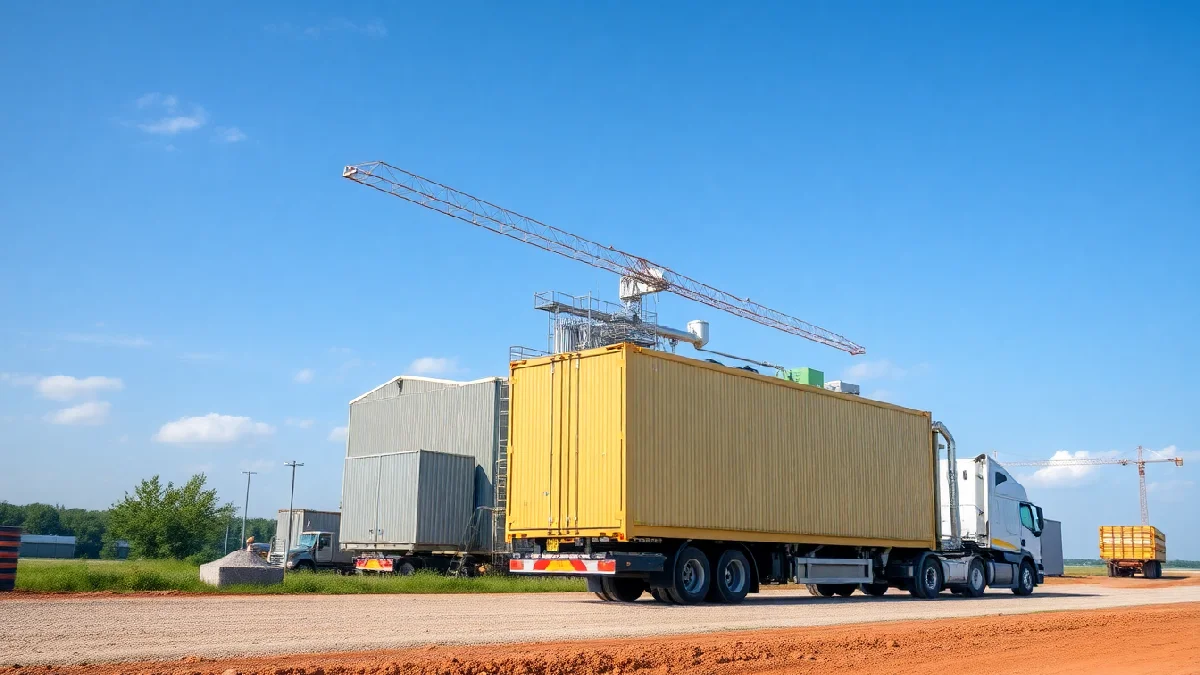
Logistics for transporting SMR modules imposes particular constraints: unit weight up to 500 tons, oversized dimensions, multimodal road-rail-river transport. Logistics planning must integrate exceptional transport authorizations and coordination with infrastructure managers.
Installation and Progressive Commissioning
The installation of SMR containers follows a precise sequence: module positioning, primary and secondary circuit connection, control-command system installation. Each step is subject to rigorous quality controls according to nuclear procedures.
Pressure tests and cold startup validate circuit integrity before the first fuel loading. These tests span 3 to 6 months depending on the installation's complexity, with progressive system validation stages.
Operator training is a critical issue. Operators must master the specificities of SMRs, which differ from conventional reactors. Training simulators are deployed upstream to prepare teams for normal and accidental procedures.
Integration into the Energy Ecosystem
Once operational, the SMR must integrate seamlessly into the industrial site's overall energy system. Optimizing dispatch between electricity production, industrial heat, and energy storage requires sophisticated algorithms and real-time supervision.
Fuel cycle management includes initial loading, periodic refueling operations, and irradiated assembly management. SMRs offer the advantage of longer cycles (up to 7 years), reducing intervention frequency.
The long-term waste management strategy must be defined from the design stage, including temporary on-site storage and transfer to reprocessing facilities. The IAEA is developing specific recommendations to optimize this management.
Predictive maintenance based on artificial intelligence and online monitoring optimizes SMR availability. IoT sensors continuously collect operational data to anticipate maintenance needs and maximize the load factor.
Optimize Performance and Profitability
The dashboard integrates key performance indicators: technical availability, load factor, production costs, avoided emissions. These metrics allow for fine-tuned management of the installation and identification of optimization areas.
Integration with electric company fleets creates energy synergies. The SMR can power fast-charging stations while providing industrial heat, optimizing the use of decarbonized energy.
System services offered to the grid operator (frequency regulation, spinning reserve) generate additional revenue, valuing the flexibility of SMRs. This multi-valorization significantly improves project profitability.
Conclusion
The implementation of an SMR in 2026 requires a systemic approach integrating technical, regulatory, and economic dimensions. Feedback from early projects shows that success relies on meticulous preparation and close coordination among all stakeholders.
The future of SMRs looks promising with the development of new green hydrogen production technologies coupled with high-temperature reactors. This technological convergence opens new perspectives for industrial decarbonization.
France has all the assets to become a global leader in SMRs: nuclear expertise, a developed industrial fabric, and an excellent research ecosystem. The challenge now is to transform these advantages into concrete industrial successes, positioning France as a global benchmark for this energy revolution.