Green Hydrogen: Beyond Electrolysis, Alternative Pathways
Green hydrogen represents one of the pillars of the global energy transition. While water electrolysis powered by renewable energy remains the benchmark technology, other production methods are emerging and deserve particular attention. Biomass and heterogeneous catalysis are establishing themselves as credible alternatives, each with its specific advantages and economic challenges.
While global hydrogen production reached 97 million tons in 2023, according to the International Energy Agency, the race for decarbonization is pushing industries and researchers to explore all available avenues. Could these alternative technologies revolutionize the green hydrogen market and offer more competitive solutions than electrolysis?
Biomass Gasification: Valuing Organic Waste
Hydrogen production from biomass primarily relies on two processes: gasification and thermolysis. These techniques convert organic residues – agricultural, forestry, or industrial waste – into syngas, and then into pure hydrogen.
The gasification process involves heating biomass to high temperatures (800-1000°C) in the presence of a limited amount of oxygen. This reaction produces a gaseous mixture mainly composed of carbon monoxide and hydrogen. An additional steam reforming step increases the proportion of hydrogen and captures CO₂.
Pilot facilities, such as the one in Vitry-le-François, aim for a production cost of around €4/kg of hydrogen. This price is competitive compared to current electrolysis costs, estimated between €5 and €6/kg. However, this competitiveness is highly dependent on the price and availability of raw materials.
“Biomass offers the advantage of using existing waste while producing decarbonized hydrogen, thus creating a virtuous circular economy,” explain experts from the Institute for Catalysis and Environment Research in Lyon.
Heterogeneous Catalysis: Innovation for Efficiency
Heterogeneous catalysis opens new perspectives for green hydrogen production. This approach uses solid catalysts to accelerate water splitting or methane reforming reactions, without carbon emissions. For more information, one can refer to studies on heterogeneous catalysis for new energies.
Three main pathways stand out in this field:
- Photocatalysis: harnessing solar energy to split water molecules
- Thermochemical catalysis: low-temperature processes reducing energy requirements
- Electrocatalysis on solid supports: improving electrolysis yields
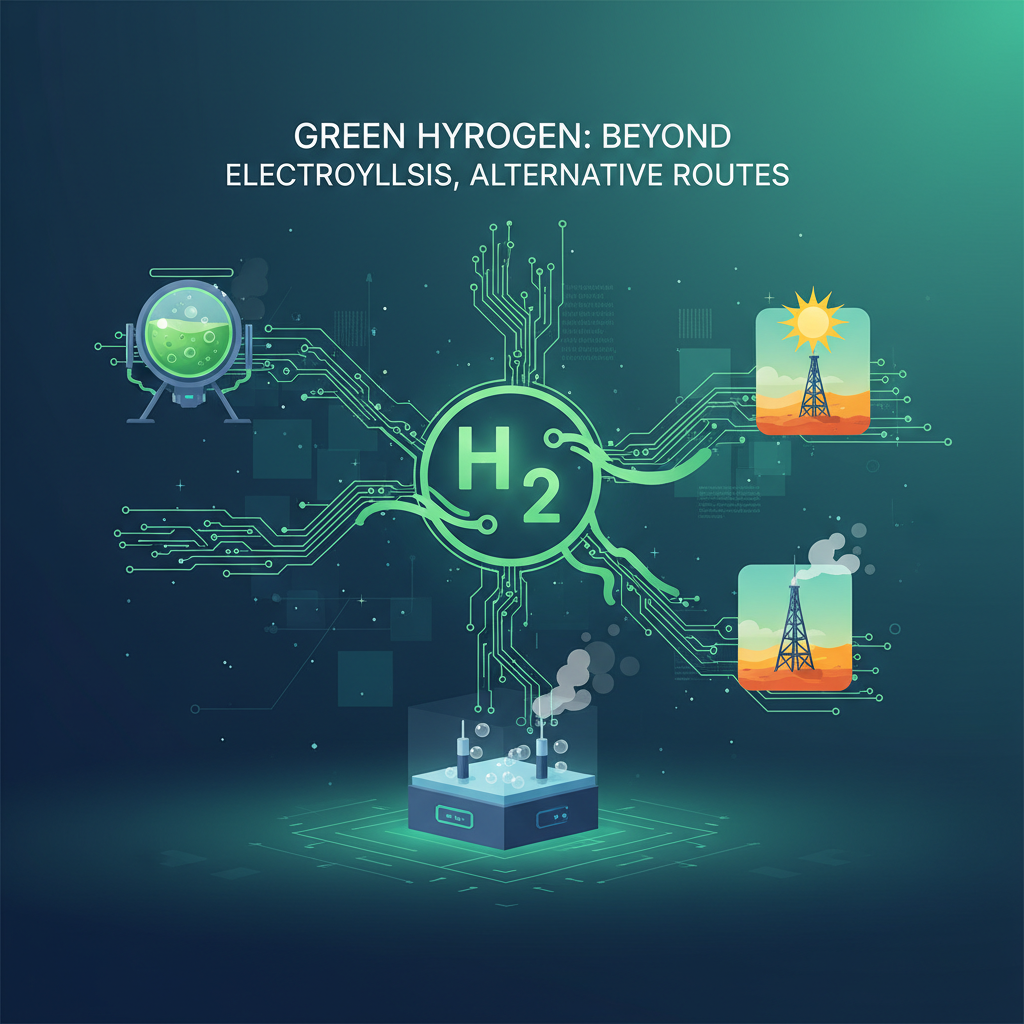
These revolutionary technologies in the energy sector promise higher theoretical yields and reduced operational costs. Photocatalysis, in particular, could enable hydrogen production directly powered by solar radiation, without the intermediate step of electricity generation.
Economic Challenges and Technological Maturity
Despite their potential, these alternative pathways face significant obstacles. Heterogeneous catalysis largely remains at the fundamental research stage, with still modest yields and high investment costs for industrial facilities.
Economic analysis reveals significant differences between technologies. According to industry data, electrolysis benefits from a favorable learning curve, with a 20-30% cost reduction expected by 2030. Alternative technologies must therefore accelerate their development to remain competitive. For more detailed information on hydrogen production, specialized resources can be consulted.
Biomass production offers interesting economic viability in specific niches where organic waste is abundant and inexpensive. Agricultural or forestry regions have a natural advantage for developing this sector. However, the seasonality of certain resources and collection costs can impact overall profitability.

Future Prospects and Competitive Positioning
The future of these technologies will largely depend on investments in research and development. The 280 billion dollars planned by 2030 in the hydrogen sector could accelerate the emergence of viable alternative solutions. The potential of green hydrogen as a catalyst for the energy transition is highlighted by numerous reports, such as those from Mirova.
Heterogeneous catalysis could experience a major breakthrough if the challenges of catalyst yield and durability are resolved. Recent advances in renewable energy technologies suggest promising synergies for the integration of these processes.
Electrolysis nevertheless retains its advantage of technological maturity and industrial deployment. This proven technology benefits from significant economies of scale and an already established production infrastructure. Electrolyzer manufacturers are investing heavily to reduce costs and improve efficiency.
Niche Markets and Specialized Applications
Each technology finds its relevance in specific contexts. Biomass is particularly suitable for rural areas with abundant and inexpensive organic resources. This local approach reduces transport costs and fits into a logic of territorial circular economy.
Catalytic processes could establish themselves in applications requiring decentralized or intermittent production. Their ability to operate at lower temperatures opens up prospects for integration into distributed energy systems. The potential for green hydrogen adoption in transport is a concrete example of these applications.
Comparative analysis of alternative energy solutions shows the importance of adapting technology to the local context. Regional green hydrogen strategies will need to take these specificities into account to optimize investments.
Conclusion
Green hydrogen now has a diverse technological array to meet the challenges of decarbonization. While electrolysis remains the most mature pathway, biomass and heterogeneous catalysis offer promising alternatives with specific advantages.
Biomass production can achieve interesting economic competitiveness in favorable contexts, particularly when raw materials are locally available at low cost. This sector fits perfectly into a circular economy approach.
Heterogeneous catalysis, although still under development, could revolutionize the sector in the longer term. Its potential for reducing energy needs and improving yields makes it a future technology to watch closely.
The future of green hydrogen will likely be shaped by the complementarity of these approaches rather than the dominance of a single technology. Each region, each application will thus be able to benefit from the solution best suited to its local and economic specificities.
Comparison of Green Hydrogen Production Technologies
| Technology | Estimated Production Cost | Advantages | Challenges |
|---|---|---|---|
| Electrolysis | €5-6/kg (current) | Maturity, industrial deployment | Energy cost, initial investment |
| Biomass Gasification | ~€4/kg (pilot) | Waste valorization, circular economy | Biomass availability, seasonality |
| Heterogeneous Catalysis | Not specified (R&D) | High theoretical yields | R&D stage, costs, catalyst durability |