Floating Offshore Wind: A Guide to Sustainable Installation
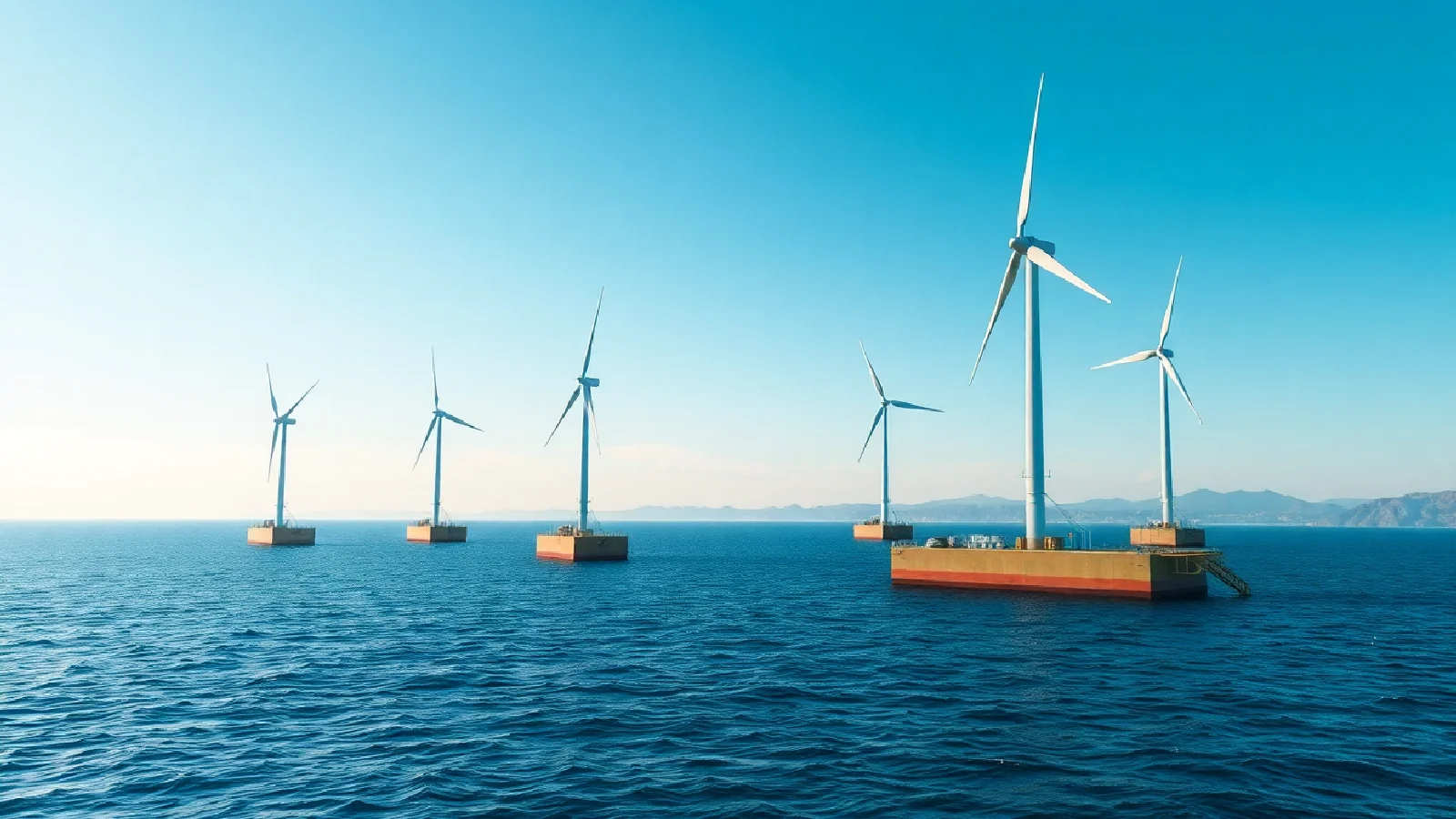
The energy transition demands new solutions for harnessing offshore wind. When depths exceed 50 meters, fixed-bottom wind turbines become economically unfeasible. It is under these conditions that floating offshore wind emerges as a strategic alternative, opening access to previously unexploited areas.
Mounting giant turbines on floating platforms, anchoring them with light lines, and maintaining their stability against storms: the challenge seems immense. Yet, several pilot projects are already demonstrating the technical feasibility of this approach. The remaining tasks are to industrialize processes, reduce costs, and reconcile energy production with the preservation of marine ecosystems.
Major Technical Challenges of Floating Wind
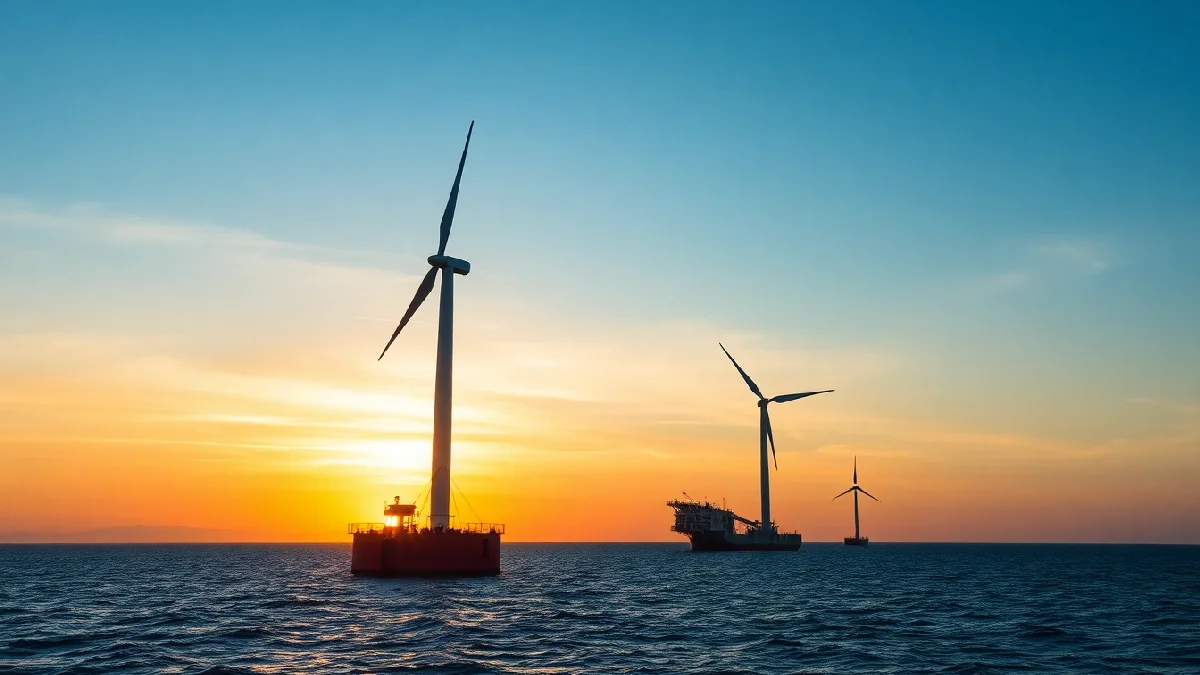
Floating turbines operate in a particularly hostile environment. Unlike fixed-bottom wind turbines, they must simultaneously manage wave movements, wind loads, and anchoring constraints. This triple stress requires innovation on several fronts.
The design of anchoring systems represents one of the central challenges. Anchors must withstand cyclonic loads while minimizing sediment abrasion to preserve the seabed. Engineers are developing low-impact anchors capable of adapting to different types of underwater soils without disturbing benthic habitats. Additional information can be found in the report of the study mission on marine renewable energies.
Automatic ballast control is another technical feat. To maintain platform stability despite pitching and rolling, systems adjust mass distribution in real-time. This dynamic management ensures turbine efficiency while extending the lifespan of mechanical components.
Remote maintenance also poses questions. Intervening on a platform located several tens of kilometers from the coast, often in difficult weather conditions, requires rigorous planning and rethought intervention protocols.
Making turbines reliable in hostile environments is a major technological hurdle before the large-scale deployment of floating wind.
Innovative Solutions Under Development
Faced with these constraints, innovation is unfolding in several areas. Onshore pre-assembly significantly simplifies offshore operations. Rather than assembling floating structures at sea, manufacturers carry out most of the assembly in suitable ports before towing the complete unit to its operating site.
This approach drastically reduces installation times and limits the exposure of teams to difficult marine conditions. It also allows for better quality control of assemblies.
Highly recyclable materials are part of a circular economy approach. Studies indicate that approximately 98% of components, excluding blades, can be recovered at the end of their life. Research is currently focused on fully recyclable blades to eliminate this last environmental weakness.
The use of artificial intelligence and IoT sensors is transforming maintenance. Autonomous drones regularly inspect installations, detect anomalies, and transmit data in real-time. This predictive monitoring reduces human interventions and optimizes maintenance cycles.
As WEAMEC highlights in its technical dossier, research and development play a crucial role in overcoming the technological and economic barriers of this sector.
Three Competing Floater Architectures
Floating wind relies on different platform designs, each offering specific advantages depending on site conditions.
| Platform Type | Key Characteristics | Advantages | Ideal Conditions |
|---|---|---|---|
| Semi-submersibles | Immersed columns connected by pontoons, stable buoyancy | Adaptability to different depths, relatively easy installation | Moderate swell |
| SPAR Floaters | Vertical configuration, significant ballast at the bottom | Excellent stability | Depths > 100 meters |
| Tensioned Leg Platforms | Structure held by pre-tensioned cables anchored to the seabed | Remarkable stability | Less sensitive to seabed conditions |
Semi-submersible platforms rely on several immersed columns connected by pontoons, forming a stable structure through buoyancy. Their advantage lies in their adaptability to different depths and their relative ease of installation. They are particularly suitable for sites exposed to moderate swell.
SPAR (Single Point Anchor Reservoir) floaters adopt a vertical configuration with significant ballast at the bottom. This geometry ensures excellent stability but requires significant depths, generally greater than 100 meters, for installation. Technical details can be found in an IFM Méditerranée article on floating offshore wind.
Tensioned Leg Platforms maintain the structure with pre-tensioned cables anchored to the seabed. This solution offers remarkable stability but involves higher anchoring constraints and increased sensitivity to seabed conditions.
Each technology is undergoing real-world testing to validate its performance and identify the most relevant usage contexts. Just as solid-state batteries represent a breakthrough in energy storage, these floater innovations are redefining the possibilities of offshore wind.
Environmental Recommendations for Responsible Deployment
The social and ecological acceptability of floating wind directly depends on considering environmental impacts from the design phase. Environmental organizations, including Surfrider, emphasize the need for rigorous maritime spatial planning that integrates biodiversity as a primary criterion. WWF France has also issued an official position on offshore wind.
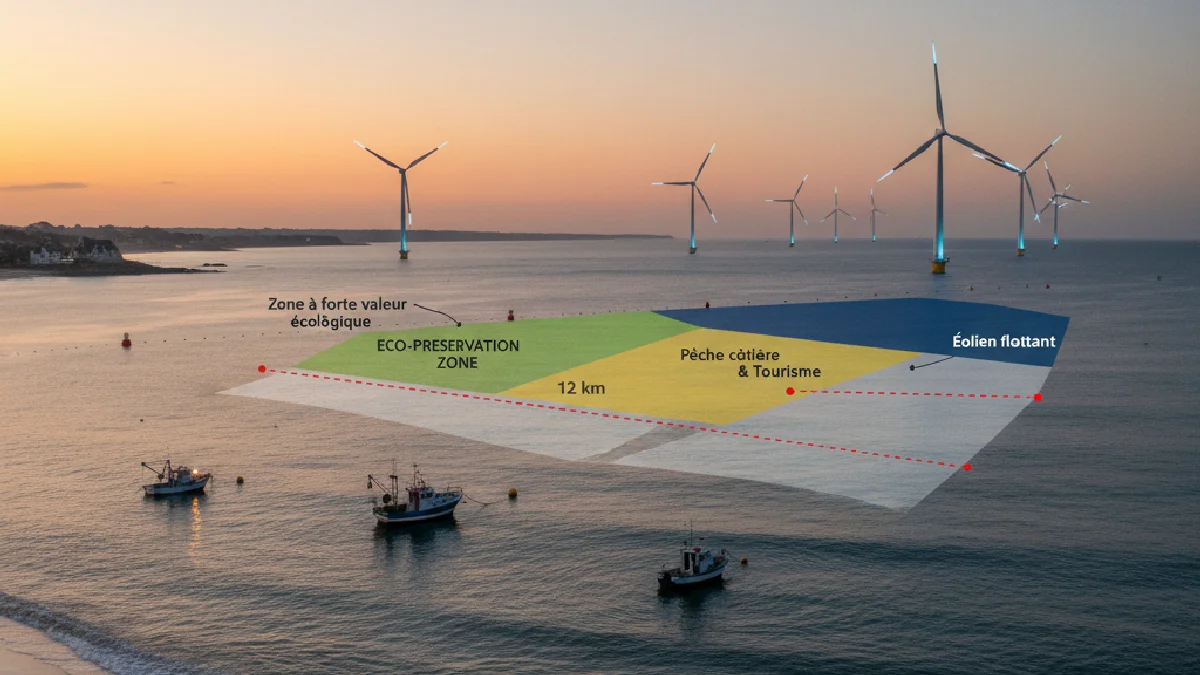
Site selection is a decisive parameter. Recommendations advocate for installation more than 12 kilometers from the coast to avoid areas of high ecological value, limit visual impact from the shore, and reduce conflicts of use with coastal fishing and tourism.
Environmental monitoring programs must begin during preliminary studies to establish a precise baseline. This monitoring specifically covers:
- Seabird populations and their migratory corridors
- Marine mammals and the risk of entanglement in cables
- Benthic habitats and their resilience capacity after installation
Eco-design of components integrates solutions to minimize nuisances: optimized cable geometry to avoid traps, anti-collision systems for birds, coatings limiting colonization by invasive species.
Circular decommissioning anticipates the end-of-life of installations. Unlike fixed concrete foundations, which are difficult to remove, floating structures can be fully recovered, then reconditioned or recycled. This approach is part of an extended responsibility logic.
Maritime Spatial Planning: Key to Coexistence of Uses
The ocean already concentrates numerous activities: fishing, commercial navigation, military zones, tourism, marine protected areas. The introduction of floating wind farms requires rigorous coordination of uses to avoid conflicts and optimize maritime space occupation.
The French methodology, tested notably for projects in the Mediterranean, relies on public debates involving all stakeholders from the outset. These consultations help identify the least sensitive areas and define accompanying measures for affected sectors.
Fishing professionals, who are particularly concerned, participate in the development of co-use protocols. Some parks can become fish repopulation zones, creating an “artificial reef” effect favorable to biodiversity. Others host complementary aquaculture activities.
The tourism sector is also subject to specific impact studies. International feedback shows that the perception of wind farms varies greatly depending on their distance from the coast, their visibility, and the communication carried out beforehand.
Early involvement of local communities ensures the territorial anchoring of projects and facilitates social acceptance. This participatory dimension is as crucial as purely technical aspects.
French Objectives and Industrial Dynamics
France has considerable potential for floating wind, particularly in the Mediterranean where depths drop rapidly. National objectives aim for the installation of nearly 5 GW of floating wind in the Mediterranean by 2040, with a first phase of commercial deployment already underway. Detailed presentations can be consulted on sites like EOLIENNES EN MER.
Nine competitive bidding procedures have been launched over the past decade, totaling more than 10 GW of power for fixed-bottom and floating farms. The first commercial floating farms – Golfe de Fos and Narbonnaise – are currently in the study phase and preparing authorization dossiers.
This dynamic is supported by a structured research ecosystem around platforms like WEAMEC, which coordinates academic and industrial work. Collaborations between laboratories, design offices, and industrialists accelerate the transfer of innovations to operational applications.
The industrialization of the sector generates significant regional benefits: creation of dedicated ports, development of specialized skills, establishment of component manufacturing plants. Optimizing local value chains simultaneously reduces the carbon footprint of transport and production costs.
This integrated approach, combining energy ambition and environmental vigilance, aligns with the concerns raised by ESG 2026 criteria, which require rigorous measurement of the actual impacts of industrial projects.
Towards a Mature and Competitive Sector
Floating offshore wind is gradually moving from experimentation to industrialization. Technical barriers are diminishing thanks to material and digital innovations. Feedback from initial deployments fuels the continuous improvement of processes.
Economic competitiveness is also progressing. Production costs decrease as volumes increase and supply chains become structured. Projections indicate a gradual convergence with fixed-bottom wind costs, and even advantages in certain sites where wind conditions are particularly favorable.
Systematic integration of environmental criteria from design ensures the long-term sustainability of this sector. Evaluation methods are being refined, incorporating not only the direct impact of installations but also their overall carbon footprint, from manufacturing to decommissioning.
The success of floating wind will depend on the ability to maintain this balance between energy performance, economic viability, and ecological responsibility. Current projects serve as full-scale laboratories to validate these principles and prepare for large-scale deployment.
The example of agrivoltaics shows that it is possible to reconcile renewable energy production with the preservation of existing activities. Floating wind follows a similar trajectory, seeking to integrate harmoniously into the marine ecosystem.