Solid-State Batteries: Doubling EV Range by 2030

While current electric vehicles offer ranges between 300 and 500 kilometers, a new generation of solid-state batteries promises to exceed the symbolic 1,000 km mark. This technological shift, driven by solid electrolytes replacing the flammable liquids of traditional lithium-ion cells, is now the focus of investments from dozens of laboratories and car manufacturers. The stakes are considerable: doubling energy density while eliminating thermal risks that still hinder the mass adoption of electric mobility.
Energy Density Reaching New Levels
Lithium-ion batteries that power most electric vehicles today typically achieve 250 Wh/kg for NMC (nickel-manganese-cobalt) ternary chemistries and approximately 180 Wh/kg for LFP (lithium-iron-phosphate). These performances, although constantly improving, are hitting physical limits imposed by liquid electrolytes and graphite electrodes.
Solid electrolyte batteries are revolutionizing this equation. Chinese laboratories are already reporting prototypes reaching 800 Wh/kg, while industrial players like Farasis are announcing cells at 400-500 Wh/kg ready for production. This spectacular increase in power comes from three converging innovations:
- The use of pure lithium metal anodes, which replace graphite and multiply storage capacity
- The integration of sulfide, oxide, or polymer-based electrolytes allowing high ionic conductivity
- The elimination of inert materials necessary for the safety of liquid cells, thereby freeing up more space for active materials
According to the Swiss Federal Office of Energy, this progress radically transforms pack architecture: at equivalent density, solid batteries make it possible to envision lighter vehicles or double the range for the same volume.
Enhanced Safety: The End of Thermal Risks
One of the major obstacles to the adoption of electric vehicles remains the fear of thermal runaway. The liquid electrolytes of conventional lithium-ion batteries, composed of flammable organic solvents, can ignite in the event of an internal short circuit, overcharge, or perforation.
Solid electrolytes structurally eliminate this risk. Whether ceramic (oxides or sulfides) or polymer-based, these materials contain no volatile or combustible compounds. Perforation, crushing, or overcharge tests conducted by manufacturers show that solid cells do not ignite and do not release toxic gases. This intrinsic safety also drastically reduces cooling systems and mechanical protections for packs, reducing weight and overall cost.
“The solid electrolyte eliminates the main vector of heat propagation and blocks the formation of lithium dendrites, metallic crystals that cause internal short circuits.”
For users and insurers alike, this improvement in passive safety represents a decisive argument, especially in professional fleets or public charging infrastructures.
Industrial Challenges of Scaling Up
Despite these promises, the transition from laboratory prototypes to mass production remains fraught with obstacles. Three major challenges dominate industrial roadmaps:
The electrode-electrolyte interface is the primary bottleneck. Solid electrolytes, rigid by nature, struggle to maintain intimate contact with electrodes that expand and contract with each charge cycle. This loss of contact degrades performance and reduces lifespan. Researchers are exploring nanometric coatings and hybrid compositions to improve this critical interface.
Manufacturing cost remains prohibitive. High-purity materials (lithium sulfides, rare earth oxides) cost several times more than conventional components. Deposition processes, under controlled atmosphere and high temperature, require specialized equipment. As long as global production remains below 2 GWh annually, economies of scale are slow to materialize.
Charge and discharge power remains limited. The best prototypes still struggle to match the rapid charging speed of advanced liquid batteries, due to the lower ionic conductivity of solid electrolytes at room temperature. Innovative architectures, such as semi-solid cells combining solid electrolyte and polymer gel, are emerging to overcome this hurdle.
As highlighted in a report by the Federal Office of Energy, the transition to production capacities of several tens of GWh annually will still require several years of development and massive investments in industrial equipment.
Ranges Exceeding 1,000 Kilometers
The first vehicles incorporating solid electrolyte batteries are validating the announced laboratory gains in real-world conditions. The Nio ET9, a high-end Chinese electric sedan, boasts a certified range exceeding 1,000 kilometers thanks to a 150 kWh pack utilizing a density of 360 Wh/kg. Other manufacturers, such as Toyota and BMW, plan commercial launches between 2027 and 2030.
This increase in range transforms usage. Long-distance journeys become feasible without intermediate charging, bringing the electric experience closer to that of internal combustion vehicles. For professional fleets, delivery drivers, or taxis, reduced downtime improves profitability. For individuals, it dispels range anxiety that still deters many potential buyers.
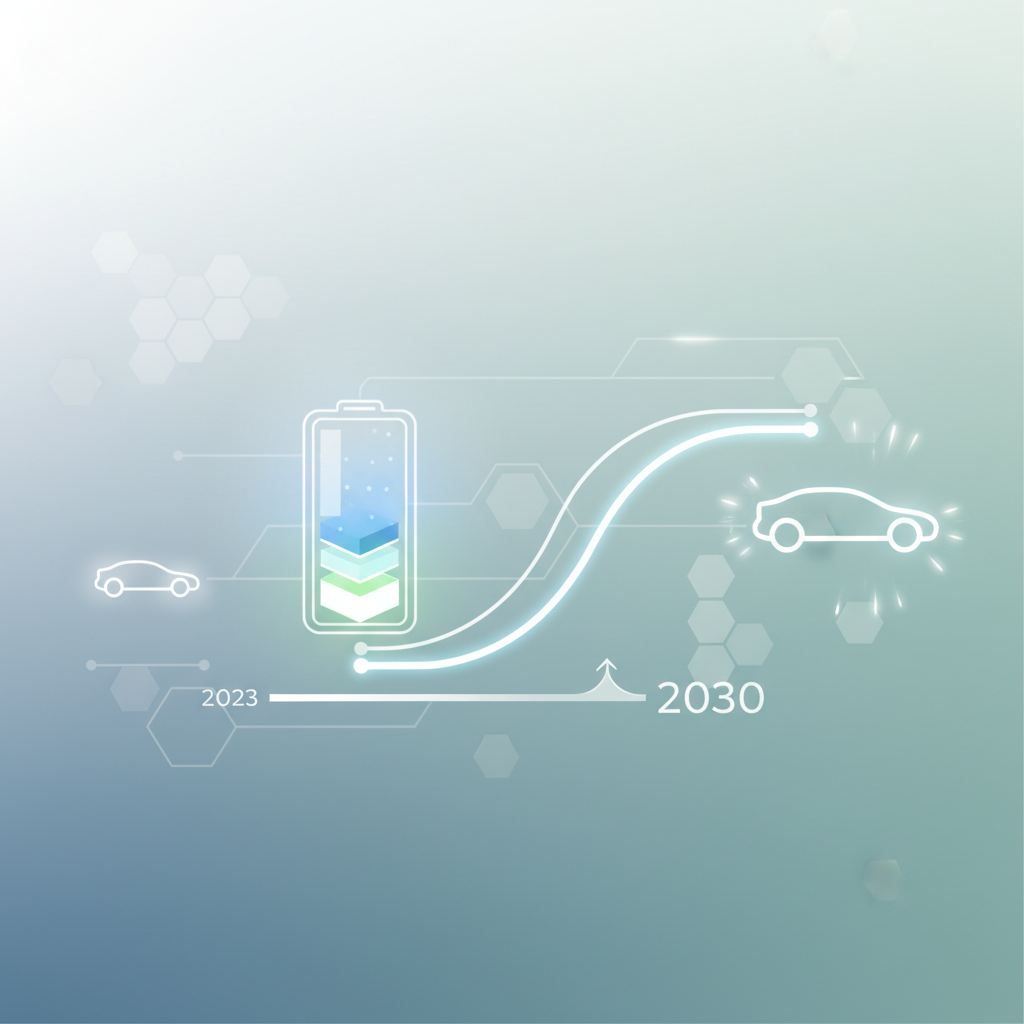
Experts anticipate that an average density of 500 Wh/kg will be commercially accessible by 2030, roughly double that of current lithium-ion batteries. At constant pack volume, this means twice the range; at equivalent range, a significantly lighter and more efficient vehicle.
This evolution also aligns with the transition towards critical raw materials whose availability and extraction condition the energy sovereignty of nations.
The Ecosystem in Full Structure
The technological race mobilizes a heterogeneous ecosystem. Automotive manufacturers are integrating these developments into their strategic roadmaps: Toyota aims for mass commercialization as early as 2027, while Volkswagen and Stellantis are multiplying partnerships with specialists like QuantumScape or Solid Power.
Specialized chemists play a key role. Arkema, a French specialty materials company, is developing solutions covering the entire value chain, from polymer electrolytes to structural adhesives for module assembly. These innovations aim to optimize not only the cell but also the complete module and pack, reducing weight, cost, and manufacturing time.
Governments support this transition through funding programs. The European Union has included solid-state batteries among the critical technologies of its Green Deal, while the United States and China are increasing subsidies for research and pilot plants. The stakes extend beyond the automotive market: stationary storage for renewable energies constitutes a major medium-term outlet, as demonstrated by the rise of agrivoltaics which requires high-performance storage solutions.
Outlook and Deployment Schedule
While laboratory prototypes are impressive, commercial deployment will follow a gradual timeline. IDTechEx analysts, who closely follow the evolution of the solid-state battery market, anticipate three distinct phases:
2025-2027: The first limited series. Premium models and pilot fleets will integrate semi-solid or solid-state batteries, at prices still high but acceptable for high-end or demanding professional segments.
2028-2030: Scaling up. Production capacities will reach several tens of GWh, allowing for a gradual decrease in costs. Mid-range vehicles will begin to adopt this technology, with standard ranges exceeding 700 km.
After 2030: Generalization. Solid-state batteries will become competitive against advanced lithium-ion batteries, gradually equipping the majority of new electric vehicles. Stationary storage and aeronautical applications will emerge as growth drivers.
This trajectory, however, assumes the resolution of the technical challenges mentioned and a stabilization of critical material supply chains. Geopolitical tensions around lithium, cobalt, or rare earths could slow down or accelerate this transition, depending on whether regions manage to secure their supply chains.