Heat Pumps in Belgium: Accelerating Decarbonization
In a context of climate emergency, Belgium is committed to carbon neutrality by 2050, an objective highlighted in Belgium's Long-Term Strategy. To achieve this, the country's three regions have identified heat pumps as the main lever for decarbonizing the tertiary sector. However, despite stated ambitions, deployment remains slow. Between political promises and on-the-ground reality, how can this crucial energy transition be accelerated?
The colossal challenges of tertiary decarbonization
The building sector represents a major challenge for Belgium. According to official Belgian Energy Outlooks, tertiary buildings must imperatively reduce their greenhouse gas emissions to meet European climate objectives. This transformation implies a gradual abandonment of natural gas heating systems, responsible for a significant portion of direct emissions.
Heat pumps are therefore an essential solution. Their ability to draw energy from the air, ground, or water to efficiently heat spaces makes them a decarbonized heating system particularly suited to the Belgian climate. But this mature technology still faces many obstacles that slow down its widespread adoption.
The electrification of heating also represents a systemic challenge in many countries. As the analysis of building decarbonization challenges highlights, this transition requires a coordinated approach between improving energy efficiency and transforming heating systems.
Persistent obstacles despite incentives
Financial obstacle, the primary identified barrier
The initial investment cost of heat pumps is the primary obstacle to their widespread adoption. For owners of tertiary buildings, the economic equation remains complex: although operating costs are lower in the long term, the initial investment can reach several tens of thousands of euros depending on the size and configuration of the building.
This financial issue is often accompanied by the need to strengthen the thermal insulation of existing buildings. Heat pumps, to function optimally, indeed require high-performance envelopes. This double requirement – replacing the heating system and improving insulation – can discourage investors.
The challenge of technical skills
The lack of skilled installers represents a critical bottleneck. Installing a heat pump requires specific knowledge in thermodynamics, sizing, and integration into existing systems. This limited technical expertise not only slows down deployment but can also affect the performance of poorly designed installations.
Training professionals in the sector therefore becomes a priority. Training centers must adapt their programs to meet the growing needs of the market and ensure the quality of installations.
Regional strategies to overcome obstacles
Brussels: the Rénolution strategy in action
The Brussels-Capital Region has developed an ambitious approach with its Rénolution strategy. This plan includes specific grants for the installation of heat pumps, gradually replacing support for gas boilers since 2023. These financial incentives aim to offset a significant part of the initial additional cost.
"The heat pump is declared the spearhead of the energy transition" in the Brussels strategy.
At the same time, the Region imposes energy performance obligations in renovation, creating a regulatory framework favorable to the deployment of decarbonized technologies.
Wallonia and Flanders: complementary approaches
The other two Belgian regions have also introduced aid schemes. Walloon subsidies and PACE (Air-Climate-Energy Plan) aid are part of a targeted financial support logic. These mechanisms particularly support major renovations that will become mandatory from 2030.

The regional approach allows strategies to be adapted to local specificities: urban density in Brussels, different energy mixes depending on the regions, or specific characteristics of the tertiary building stock.
| Region | Key Strategy | Incentives | Obligations |
|---|---|---|---|
| Brussels | Rénolution | Specific grants | Energy Performance Obligations in renovation |
| Wallonia | Subsidies | Targeted financial aid | Major renovations mandatory 2030 |
| Flanders | PACE aid | Targeted financial aid | Major renovations mandatory 2030 |
The challenge of electrical infrastructure
The capacity of the electrical grid to absorb the additional demand generated by the electrification of heating constitutes a major challenge. This often underestimated concern requires significant investments in infrastructure reinforcement.
The integration of renewable electricity therefore becomes crucial to guarantee a truly low-carbon energy source for heat pumps. Without this component, the environmental benefit of these systems could be questioned.
Grid operators are also developing innovative solutions such as zoned heating networks, allowing needs to be pooled and energy efficiency optimized at the scale of entire neighborhoods.
Towards accelerated growth: levers for action
Strengthening vocational training
The development of technical skills is an indispensable prerequisite. The regions are investing in strengthening vocational training, creating new specialized courses in the installation and maintenance of heat pumps.
This upskilling is accompanied by awareness-raising actions among building professionals, aiming to democratize these technologies still perceived as complex.
Ambitious goals and long-term planning
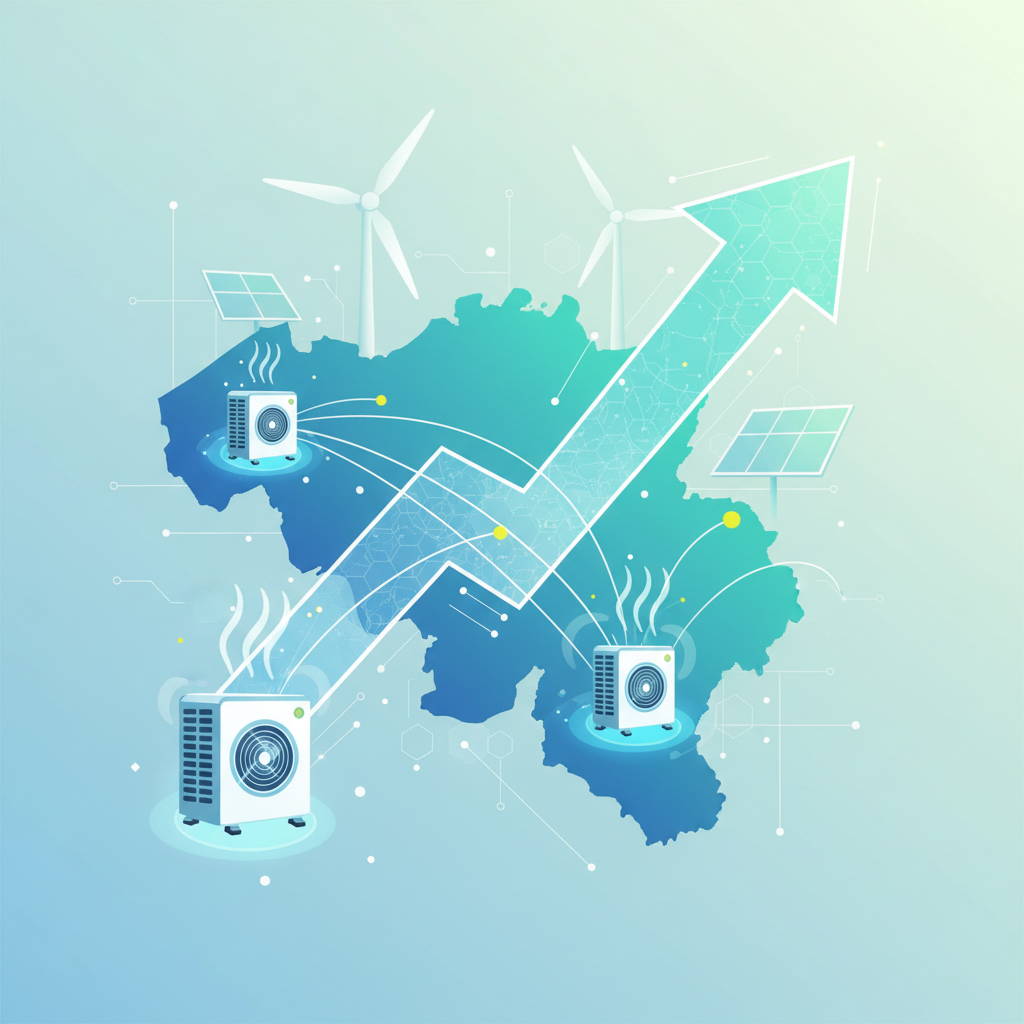
Belgian authorities anticipate an average growth of 8% in heat pump installations each year until 2050. This objective, although ambitious, is based on rigorous planning and reinforced support mechanisms.
The obligation for carbon neutrality of tertiary buildings by 2050 creates a binding framework that pushes owners to anticipate their investments. This long-term visibility favors the emergence of a mature and structured market.
This dynamic is part of a broader logic of transforming the Belgian energy system, as illustrated by reflections on circular economy strategies or innovations in the nuclear sector with SMRs.
Key points to accelerate deployment:
- Removal of financial obstacles through grants and subsidies.
- Strengthening technical skills and vocational training.
- Long-term planning with ambitious goals.
- Development of electrical infrastructure and heating networks.
- Favorable regulatory framework via energy performance obligations.
Future prospects: a changing ecosystem
The Belgian decarbonization industry is gradually taking shape. According to recent analyses on industrial decarbonization, the electrification of industrial heat, including heat pumps, is becoming a real economic "game-changer."
This technological evolution is accompanied by a transformation of economic models. Specialized companies are developing new services: energy performance contracts, predictive maintenance, or innovative financing solutions that reduce the barrier to entry.
Standardization of installations and the emergence of economies of scale also contribute to reducing costs. This virtuous dynamic should accelerate with increasing volumes and the maturation of the sector.
The increasing integration of heat pumps into overall energy renovation strategies also helps optimize the initial investment. This systemic approach, encouraged by new regulations, facilitates the economic acceptability of these technologies.