
Beyond Silicon: Perovskites and Tandem Cells

For decades, crystalline silicon solar panels have dominated the global market. They currently account for over 600 GW of installed capacity, enough to power a country like Brazil. However, this mature technology is approaching its physical limits: a theoretical efficiency ceiling around 25%, high production costs due to high-temperature processes, and rigidity that restricts possible applications.
Faced with these constraints, a new generation of photovoltaic materials is emerging in laboratories worldwide. Perovskites and tandem cells that combine them with silicon promise to radically transform the solar industry: efficiencies exceeding 33%, low-temperature manufacturing, and flexible, lightweight modules. These advancements pave the way for more efficient, flexible, and economically accessible solar panels.
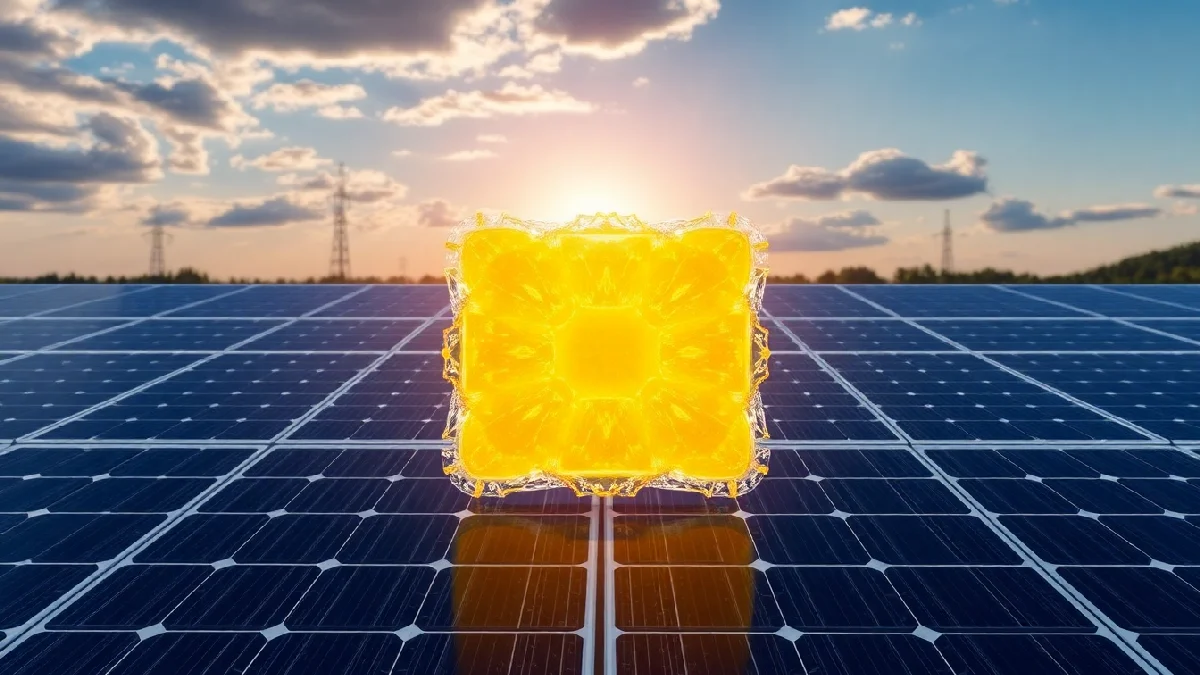
Perovskites: A Crystalline Architecture with Exceptional Properties
The term perovskite does not refer to a single material, but a specific ABX₃ crystalline structure. This architecture combines an organic cation (A), a metal such as lead or tin (B), and a halogen (X). This "cubic lattice" arrangement gives perovskites remarkable optical and electronic properties.
Unlike silicon, perovskites are characterized by an adjustable bandgap, allowing them to absorb a much broader portion of the solar spectrum. This structural flexibility explains their rapid progress: perovskite cells now achieve over 25% efficiency in the laboratory, a level that took several decades of development for silicon.
The manufacturing of perovskites represents another major advantage. These materials are deposited in solution at low temperatures, using printing or thin-film evaporation processes. This simplicity contrasts sharply with the energy-intensive silicon processes, which require furnaces at over 1000°C and expensive crystalline ingots to produce. According to Polytechnique Insights, this simplified manufacturing approach significantly reduces the required industrial investments.
Tandem Cells: Union Makes Performance
The combination of perovskites with silicon in tandem cells is currently the most promising path to overcome the limitations of each technology taken in isolation. The principle: superimposing two photovoltaic cells that capture different portions of the light spectrum.
The upper perovskite cell absorbs high-energy photons (blue and green light), while the lower silicon cell captures lower-energy photons (red and infrared light). This spectral complementarity allows for the exploitation of a much larger portion of incident solar energy.
The results are spectacular. Successive records have been set in recent years:
- 33.1% efficiency for a fully textured cell developed by Fraunhofer ISE and KAUST
- 34.6% for Longi's recently announced record
- A theoretical potential estimated between 43% and 45% for these tandem architectures
These performances far exceed the Shockley-Queisser limit, which caps silicon at approximately 29% in single-junction configurations. For the industry, this means increased electricity production for the same surface area, or conversely, a reduction in the surface area required to achieve a given power.

Flexibility and New Uses: Beyond Traditional Roofs
The possibility of manufacturing flexible photovoltaic modules is one of the most disruptive promises of new materials. Perovskites, deposited as thin films on flexible substrates, open up applications impossible with rigid silicon panels.
Imagine solar panels integrated into curved building facades, applied to textile surfaces, or installed on electric vehicles. This lightness and morphological adaptability significantly expand the range of usable surfaces for solar energy production.
Other thin-film technologies already exist commercially, notably based on cadmium telluride (CdTe) or copper-indium-gallium-selenide (CIGS). These materials do offer some flexibility, but their dependence on rare elements like tellurium and indium limits their economic competitiveness on a large scale. Perovskites, composed of more abundant elements, could overcome this obstacle.
The Challenge of Durability: Perovskites' Achilles' Heel
Despite their impressive performance, perovskite cells face a major obstacle that delays their mass commercialization: their long-term stability. Crystalline silicon modules offer performance guarantees of 25 to 30 years. To date, perovskites typically achieve lifetimes of only 2 to 5 years. According to France Renouvelables, significant efforts are underway to improve this stability.
| Technology | Typical Lifespan |
|---|---|
| Silicon | 25-30 years |
| Perovskites | 2-5 years |
Several factors explain this fragility. Perovskite structures degrade under the effect of humidity, heat, and UV rays. Ions present in their crystalline structure can migrate under the effect of the electric field, gradually altering the material's properties. This environmental sensitivity is the main barrier to large-scale industrial adoption, as detailed by Les Énergies Renouvelables.
Research is nevertheless progressing on several fronts. Surface passivation techniques improve the chemical resistance of perovskite layers. Advanced encapsulation strategies better protect cells from external aggressions. Some laboratories are exploring intrinsically more stable perovskite compositions, partially substituting organic ions with inorganic cations like cesium. The LOCAL-HEAT project, funded by the European Union, also contributes to these advances, as mentioned by CORDIS.
These advancements suggest medium-term commercialization, likely in applications with less demanding lifespan requirements initially, before gradually reaching the standards of the residential and utility markets.
A Global Industrial Race Already Underway
Photovoltaic giants have fully grasped the disruptive potential of perovskite-silicon tandem technologies. Oxford PV, Qcells, GCL, and Longi are multiplying announcements and investments in this emerging sector, as highlighted by Connaissances des énergies.
This industrial dynamic is accompanied by an unprecedented fundamental research effort. Projects like LOCAL-HEAT, funded by the European Union, aim to better understand the microscopic mechanisms of perovskite layer formation and crystallization. The objective: to precisely control these processes to simultaneously improve cell efficiency and stability.
China, already the world leader in silicon solar panel production, is investing heavily in perovskites to consolidate its dominant position. Europe and the United States are trying to catch up industrially by focusing on innovation and cutting-edge research. This international competition accelerates the pace of discoveries and brings closer the market arrival of the first high-performance commercial modules.
In the sodium-ion battery sector, a similar dynamic of disruptive technological innovation is observed in the face of the limitations of established solutions. New-generation photovoltaics follows the same logic of transitioning to more efficient and sustainable technologies.
Towards a Diversified Technological Mix
The future of solar energy is not simply a matter of replacing silicon with perovskites. The most probable scenario combines several complementary technologies, each optimized for specific use cases.
Perovskite-silicon tandem cells are expected to gradually gain ground in installations where surface efficiency is paramount: residential rooftops with limited space, solar farms with expensive land, and space applications. Their initial higher cost will be offset by increased electricity production.
Flexible perovskite modules will find their place in high-value niche applications: architectural integration, electric mobility, and autonomous portable devices. These markets are more tolerant of higher costs and shorter lifespans.
Crystalline silicon will likely maintain a dominant position for several more years in large utility-scale installations, where proven technologies and long-term reliability remain priorities.
This technological diversification resembles what is observed in other areas of the energy transition, such as holistic water management in the face of microplastics, where several complementary approaches coexist to address complex challenges.