SMR: Heavy Water vs. Light Water Reactors – 2026 Duel

The nuclear energy sector is entering a new era with small modular reactors (SMRs). As international decarbonization commitments multiply, two technological families are vying for market dominance: heavy water reactors (HWRs) and light water reactors (LWRs). This technological confrontation is shaping the future of nuclear energy and reshuffling the cards in a sector long dominated by large conventional installations.
A Market Undergoing Strategic Realignment
The global SMR market is experiencing sustained growth. Heavy water reactors, primarily represented by CANDU-type concepts, hold approximately 43% of total SMR deployments in 2025, while light water reactors – including pressurized water and boiling water variants – account for the remaining 57%.
This distribution reflects not just coexistence, but a true race for performance. Forecasts show that HWRs are projected to achieve a compound annual growth rate (CAGR) of approximately 7.1% over the 2026-2033 period, slightly higher than the overall SMR market CAGR of 6.8%. This progression is expected to increase HWR's share to nearly 45% of the SMR portfolio by 2026, mechanically reducing LWR's share to around 55%.
| Technology | 2025 Market Share | 2026-2033 CAGR | Projected 2026 Share |
|---|---|---|---|
| HWR | 43% | 7.1% | ~45% |
| LWR | 57% | < 6.8% | ~55% |
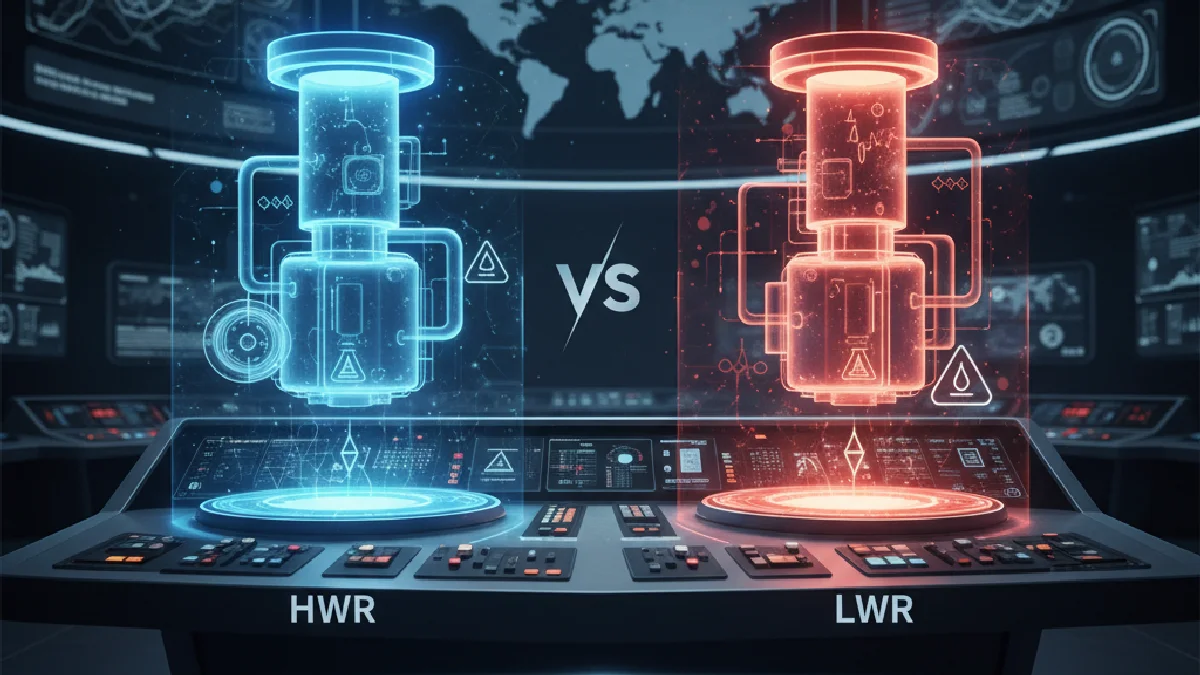
"Heavy water reactors are experiencing renewed interest thanks to their proliferation-resistant fuel cycle and their ability to extend operational life."
According to data from the global SMR market, the sector was valued at $5.96 billion in 2025 and is expected to reach $8.77 billion by 2034, with an annual growth rate of 4.59%.
Differentiating Strengths of Heavy Water Reactors
The competitive advantage of HWRs rests on several technological and strategic pillars.- The modernization of existing heavy water facilities is a major lever: many countries already have CANDU infrastructure that they seek to extend and optimize, creating a favorable ecosystem for modular deployments.
- The HWR fuel cycle inherently possesses nuclear proliferation-resistant characteristics, a decisive argument in a tense geopolitical context. This property facilitates international acceptance and simplifies regulatory negotiations for new deployments.
- Extending reactor life is another notable economic advantage. Heavy water technologies allow for more flexible maintenance and component replacement operations than their light water counterparts, reducing long-term operating costs.
The Absolute Dominance of Light Water Reactors
Despite the breakthrough of HWRs, light water reactors maintain a dominant position in absolute terms. This supremacy is explained by the exceptional maturity of their supply chain: decades of commercial operation have forged a dense and efficient industrial network.
LWRs benefit from broad acceptance among utility operators, who are accustomed to these proven technologies. Component standardization, established certifications, and accumulated operational experience constitute entry barriers that alternative technologies must overcome.
The industrial ecosystem of light water reactors extends across the entire value chain: component manufacturing, personnel training, spent fuel management, decommissioning. This comprehensive infrastructure facilitates the rapid deployment of new units and reduces perceived risks for investors.
The global nuclear power market as a whole is expected to grow from $41.68 billion in 2026 to $52.62 billion by 2034, supported by the need for stable, low-carbon baseload supply.
Industrial Applications and Strategic Positioning
Both technological families target complementary application segments. Heavy water SMRs are particularly suited for:
- Gradual modernization of existing facilities without complete shutdown
- Markets sensitive to non-proliferation issues
- Applications requiring high operational flexibility
Light water SMRs, on the other hand, dominate in:
- Replacing fossil fuel plants in established electricity grids
- Large-scale deployments with maximum standardization
- Regulatory environments favoring already certified technologies
This complementarity explains why the market is unlikely to experience a radical shift, but rather a sustainable coexistence with gradual adjustments. As with charging networks for electric vehicles, infrastructure and standardization play a decisive role in technological adoption.
Geopolitical and Industrial Stakes
The choice between HWR and LWR extends far beyond technical considerations. Industrial alliances and technology transfers structure the competitive landscape. Countries with CANDU expertise, notably Canada and India, are actively promoting HWR solutions internationally.
Conversely, major Western and Asian nuclear powers – the United States, France, Russia, South Korea, China – are pursuing the development of their LWR sectors with massive investments in modularization and cost reduction.
The fuel issue constitutes another strategic challenge. HWRs use natural or low-enriched uranium, reducing dependence on enrichment chains controlled by a few global players. LWRs require higher enrichment, creating different industrial and geopolitical interdependencies.
Advanced nuclear technologies could also benefit from innovations developed for other energy sectors, similar to perovskite photovoltaic cells transforming solar power.
Outlook 2026-2033: Shared Growth
Projections for the 2026-2033 period confirm sustained expansion for both technologies, with a slight advantage for HWRs in terms of growth rate. This dynamic is part of a broader global nuclear renaissance, driven by climate commitments and the need to secure energy supply.
Advanced nuclear technologies are experiencing a marked resurgence of interest, particularly after announcements at COP28 where several countries pledged to triple their nuclear capacity by 2050. The IAEA's optimistic scenario (see Advances in SMR Developments 2024) predicts that SMRs will account for a quarter of new nuclear capacity installed by that horizon.
This rise will nevertheless depend on several critical factors: international regulatory harmonization, reduction of construction times, demonstration of economic competitiveness against renewables and storage. The first commercial units currently being deployed will play a decisive role in validating the theoretical promises of SMRs.
Diversification of applications constitutes an additional lever: decarbonized hydrogen production (see Global Advanced Nuclear Technologies Market 2026-2045), industrial heat, desalination, power supply for isolated sites. These uses expand the potential market far beyond centralized electricity production alone. Just like the expansion of sodium-ion batteries in the maritime sector, application diversification stimulates innovation and accelerates cost reduction.
Conclusion
The technological duel between heavy water and light water reactors in the SMR sector is unlikely to result in a unilateral victory. Each technological family brings distinct advantages that meet specific needs and varied national contexts. The slight progression in HWR market share reflects more a maturation of the sector and a diversification of strategies than a fundamental challenge to the historical dominance of LWRs.
The central challenge for both technologies remains demonstrating their economic and operational viability on a large scale. The years 2026-2033 will be decisive in transforming projections into industrial reality and confirming the role of SMRs in the global energy transition.