
Tech Recycling: The Impact of 2026 Carbon Taxes

Electronic waste is one of the fastest-growing categories in global waste streams. Faced with this urgency, the European Union and Ontario have, between 2024 and 2026, deployed ambitious regulatory frameworks that are profoundly reshaping the technological recycling sector. The objective: to drastically reduce the carbon footprint while increasing material recovery rates.
These new carbon taxes and environmental regulations are not mere technical adjustments. They impose a complete overhaul of value chains on manufacturers, recyclers, and distributors of electronic equipment, from device design to end-of-life. Between economic incentives and strict prohibitions, two models are emerging on either side of the Atlantic.
European Plastic Tax: Direct Economic Pressure
Since 2024, the European Union has applied a tax of €0.80 per kilogram on plastic packaging that does not contain at least 30% recycled material. This measure, initially designed for generic packaging, is progressively extending to the plastic casings and components of electronic devices.
In 2025, the revision of the Extended Producer Responsibility (EPR) framework took an additional step: electronic equipment manufacturers must now achieve a minimum recycling rate of 70% for their plastic components. This requirement stimulates the adoption of innovative processes such as chemical recycling and pyrolysis, which allow for the revalorization of plastics once considered unrecyclable.

The economic impact is immediate. Companies that persist in using virgin plastic see their production costs increase significantly. Conversely, those that invest in high-efficiency recycling channels benefit from a growing competitive advantage. This dynamic creates a structural demand for recycled plastic materials, fueling a virtuous cycle of investment in advanced sorting technologies and low-carbon processing.
The report from the National Productivity Council also emphasizes that the ecological transition cannot occur without a rethinking of industrial competitiveness models, particularly in sectors exposed to international competition.
Ontario: Stringent Regulations and Enhanced Traceability
On the other side of the Atlantic, Ontario is taking a different but equally ambitious path. The updated Waste Diversion Act (2025-2026) imposes a fee on electronic equipment producers based on the carbon emitted during waste processing. Each kilogram of CO₂ generated by recycling processes incurs an additional cost for manufacturers.
This approach has a dual objective: on the one hand, to encourage producers to design more easily recyclable devices; on the other hand, to push recycling plants to migrate towards less emitting technologies. Hydrometallurgical and mechanical processes powered by renewable electricity are thus becoming the norm in the province.
But Ontario doesn't stop there. The legislation also introduces a progressive ban on plastics containing bisphenol-A (BPA) and chlorinated flame retardants in electronic devices. These substances, ubiquitous in consumer electronics, significantly complicate recycling and generate toxic emissions during their treatment.
Recycling plants must now report their carbon footprints with unprecedented precision. This enhanced traceability allows authorities to distinguish virtuous actors from poor performers, while offering consumers and businesses transparent information on the real environmental impact of their equipment.
Recycling Technologies: Accelerated Transformation
New regulations are catalyzing the emergence of innovative recycling technologies. Three main families of processes stand out:
- Optimized mechanical recycling: automated sorting by artificial intelligence, multi-material separation, and fine recovery of technical plastics
- Chemical recycling: depolymerization of complex plastics to recover monomers of quality equivalent to virgin material
- Advanced pyrolysis: thermal conversion of plastic waste into reusable raw materials, with capture and valorization of emissions
These technologies share a common point: they require a stable and decarbonized electricity supply to remain competitive against new carbon taxes. Hence, a notable acceleration of investments in renewable energy infrastructure within recycling centers themselves.
The HAL study on battery recycling shows that these technological transitions, already underway in the battery sector, are now applying to the entire electronics industry.
Economic Impacts: Between Immediate Costs and Medium-Term Gains
The transition imposes immediate operational costs on recycling stakeholders. Companies must invest in new equipment, train their staff in new traceability standards, and, in some cases, relocate their activities to areas with decarbonized electricity.
However, economic analyses converge: these investments generate productivity and competitiveness gains in the medium term. Industries that master advanced recycling technologies capture increasing value, while those dependent on fossil fuels see their margins erode.
A particularly visible phenomenon concerns the valorization of rare metals contained in electronic equipment. Hydrometallurgical processes, although more expensive to implement, allow for the recovery of significantly higher quantities of palladium, gold, and rare earths, transforming e-waste into true urban mines.
This dynamic resonates with the challenges of carbon storage and energy transition that are transforming the entire industrial sector.
Consequences for Electronics Manufacturers
Electronics manufacturers must rethink their product strategy from the design phase. Eco-design becomes an economic imperative, not just a voluntary approach. Several trends are emerging:
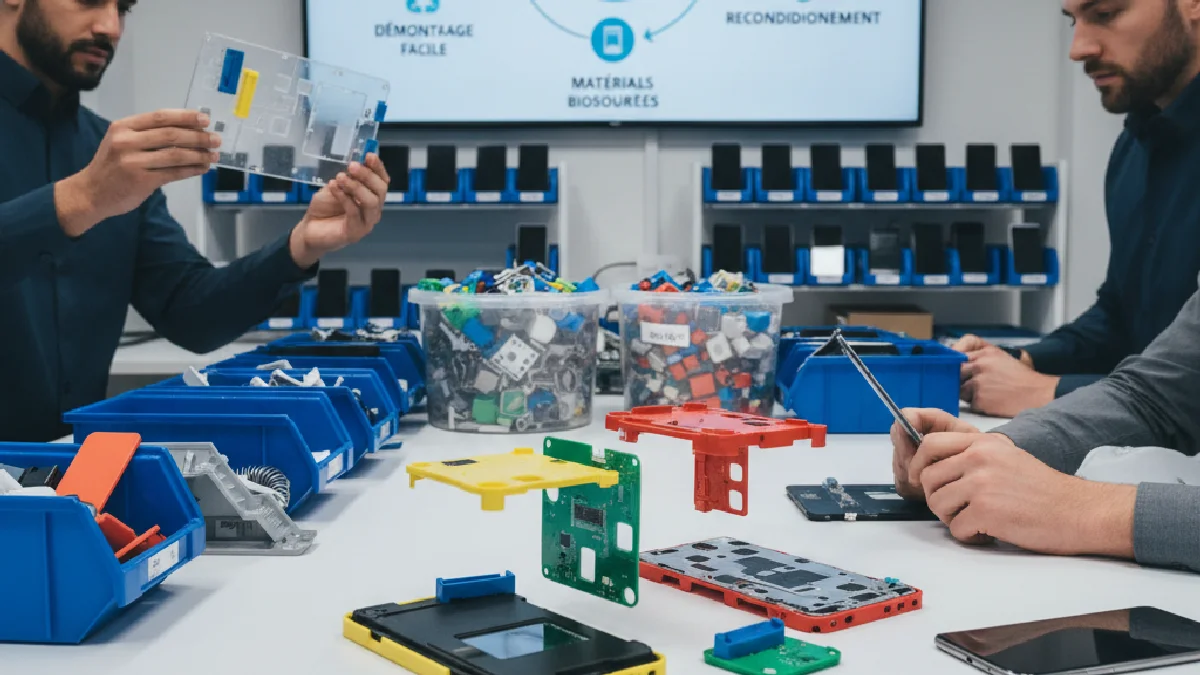
Modular and mono-material plastics are gradually replacing complex and multi-component assemblies. Devices incorporate quick disassembly systems, facilitating material separation at end-of-life. Flame retardants and other problematic additives are giving way to bio-based or mineral alternatives.
Some manufacturers go further by offering take-back and reconditioning programs, thereby reducing the volume of e-waste while creating new circular economic models. A strategy that aligns with the logic of sodium-ion batteries and other innovations aimed at reducing dependence on critical materials.
European and Ontarian regulations impose a complete overhaul of the electronic value chain, from design to end-of-life, with recycling targets now exceeding 70% for plastic components.
Towards International Harmonization?
The coexistence of two distinct regulatory models – the European economic tax and the Ontarian carbon fee – raises the question of potential international harmonization. Large multinational companies advocate for common standards that would simplify their regulatory compliance.
Some observers believe that an ISO standard on the carbon traceability of e-waste could emerge by 2027-2028, inspired by best European and North American practices. Others are banking on bilateral trade agreements that include binding environmental clauses.
In any case, the trend is clear: environmental regulations are becoming a structuring factor for industrial competitiveness. Actors who anticipate these developments gain a decisive advantage, while those who resist experience a progressive erosion of their market share.
This dynamic is part of a broader energy transition movement, particularly visible in the deployment of electric vehicle charging stations and other low-carbon infrastructures.
Measurable Results: Recovery Rates and Emissions
Initial available data show encouraging results. In countries that have adopted strict carbon taxes, e-waste recovery rates have notably increased. The share of recycled plastics in the manufacturing of new devices is steadily rising, mechanically reducing the demand for virgin resin.
Regarding emissions, recycling centers powered by renewable energies show significantly lower carbon footprints than those using conventional thermal processes. This improvement impacts the entire life cycle of electronic devices, contributing to national and international climate goals.
Enhanced traceability, particularly mandated in Ontario, now allows for precise quantification of the impact of each process step: collection, sorting, dismantling, material recovery. This data feeds scientific knowledge bases and facilitates continuous optimization of the sectors.
The IGAS report on the social challenges of climate change also highlights the importance of an integrated approach, combining environmental regulation and social justice, to ensure a transition acceptable to all stakeholders.
Persistent Challenges and Future Prospects
Despite these advances, several challenges persist. The first concerns e-waste collection: a significant portion of end-of-life equipment still escapes official channels, feeding informal circuits that often disregard environmental standards.
The second challenge is technological. Some composite materials or ultra-miniaturized assemblies remain difficult to recycle, even with the most advanced processes. Research and development must intensify efforts to find economically viable solutions. An overview of challenges and opportunities can be found in Bpifrance's visions on progress.
Finally, the social dimension must not be overlooked. The transformation of recycling sectors leads to professional retraining, with massive needs for training in new technologies. Public authorities, industrialists, and social partners must collaborate to support this transition and avoid abrupt disruptions.
Comparison of Regulatory Models
| Model | Key Specifics | Main Objective |
|---|---|---|
| European Union | Plastic tax (€0.80/kg) and EPR revision (70% plastic recycling rate) | Economic pressure via material costs & compliance |
| Ontario | Carbon fee on waste treatment, BPA/flame retardant ban | Incentive for sustainable design & low-carbon recycling technologies |