
CVC vs. Traditional VC: Which Strategy Dominates in 2026?

The venture capital landscape is undergoing a major transformation. While traditional venture capital funds have long monopolized the financing of startups, corporate venture capital (CVC) is now establishing itself as a key player. In 2026, this duality shapes the innovation ecosystem: two investment philosophies, two visions of value creation, and a central question for entrepreneurs and investors alike: which strategy generates the best results?
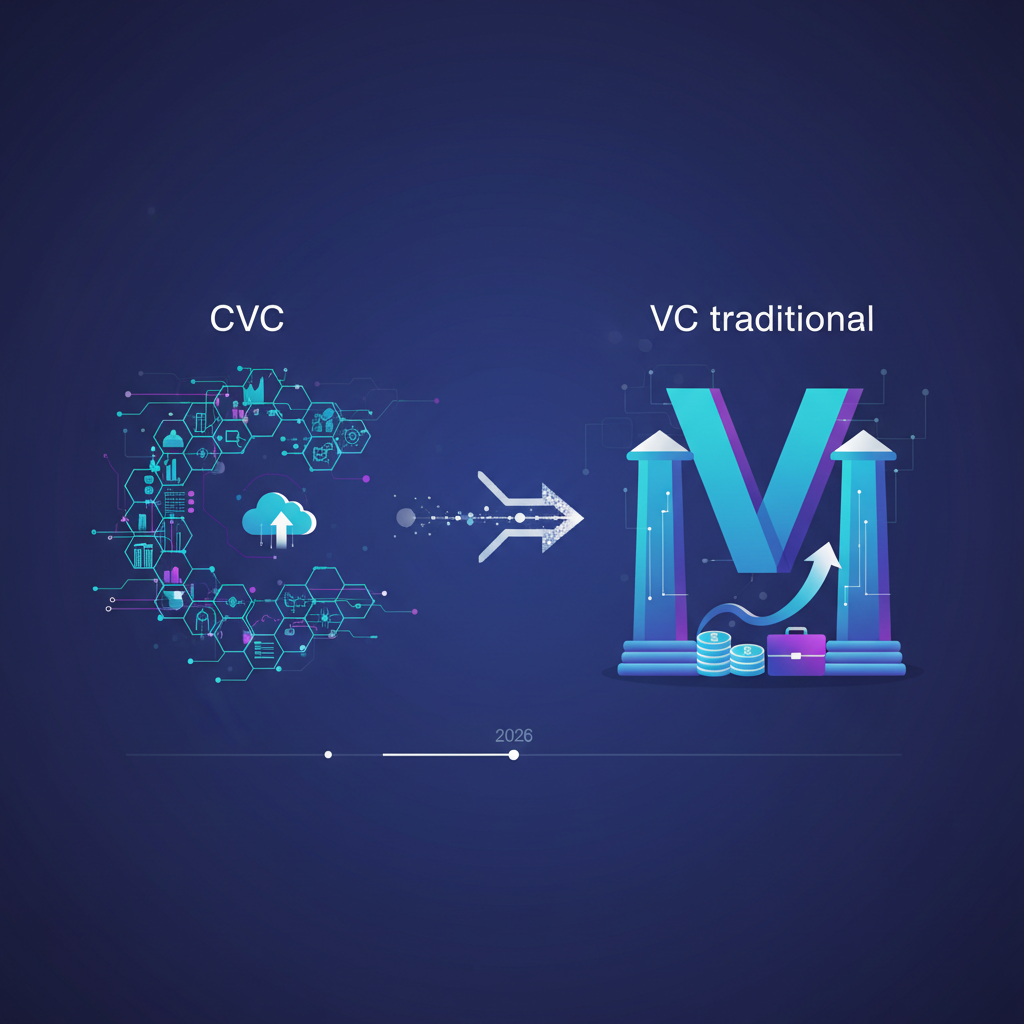
CVC and Traditional VC: Two Investment Philosophies
Traditional venture capital is based on pure financial logic. Independent funds raise capital from institutional investors—pension funds, family offices, foundations—with an explicit goal: to maximize return on investment within a 7- to 10-year horizon. Startup selection follows criteria of profitability, product-market fit, and exit potential via acquisition or IPO.
Corporate venture capital adopts a hybrid approach. Large corporations invest directly in startups, certainly to generate financial returns, but primarily for strategic reasons: access to emerging technologies, testing new business models, early detection of sectoral disruptions. As an academic study highlights, CVC allows corporations to “secure access to emerging technologies and strengthen the value chain.”
This fundamental difference in motivation influences the entire investor-startup relationship. Where traditional VC seeks hypergrowth and rapid exit, CVC prioritizes strategic alignment and operational patience.
Financial Performance: Who Delivers the Best Returns?
In absolute volume, traditional VC retains the top spot. Independent funds still represent the majority of transactions and capital raised globally. The best-performing funds show internal rates of return (IRR) exceeding 20%, a result of rigorous selection and sharp financial expertise.
CVC, however, is not far behind. In sectors where strategic alignment is crucial—artificial intelligence, quantum technologies, green energy, insurtech—corporate investments outperform. Giants like Meta, Nvidia, or AXA deploy envelopes sometimes exceeding 10 billion dollars, offering startups much more than capital: direct access to millions of customers, proprietary databases, distribution and execution capabilities beyond the reach of independent funds.
“CVC is emerging as the dominant strategy in sectors where strategic alignment is crucial, particularly AI, quantum, and green energy.”
This complementarity between financial return and strategic value creates multi-speed competition. Startups now seek a balance between the independence guaranteed by traditional VC and the synergies offered by CVC.
| Characteristic | Traditional VC | Corporate VC |
|---|---|---|
| Primary Objective | Pure financial return | Strategy & Financial return |
| Time Horizon | 7-10 years (quick exit) | Long term (operational patience) |
| Operational Support | Limited | Access to resources, clients, databases |
| Sectors of Excellence | SaaS, marketplaces, apps | AI, quantum, green energy, insurtech |

Advantages and Limitations of CVC: The Power of Synergies
Corporate venture capital offers undeniable structural advantages:
- Immediate operational synergies: A startup funded by a major insurer gains privileged access to millions of contracts; an AI startup supported by Nvidia accesses the latest chip generations and cloud infrastructure. These resources accelerate time-to-market far beyond what a check alone can accomplish.
- Patient capital: Unlike funds subject to pressure from limited partners (LPs), corporations can adopt a long-term vision. This reduction of liquidity risk allows startups to structure their growth without rushing a premature exit.
- Market validation: Being backed by a sector leader provides a mark of quality. This credibility facilitates recruitment, commercial partnerships, and subsequent fundraising rounds.
But these advantages come with significant trade-offs. Decision-making processes in large organizations are often slower, burdened by committees, multiple validations, and internal arbitrations. The risk of conflicts of interest is real: a startup funded by an established player may see its freedom of maneuver restricted, particularly in the choice of its partners or its exit strategy. Finally, the imposed strategic orientation can limit pivots or the exploration of adjacent markets not aligned with the corporate investor's interests.
Traditional VC: Speed, Expertise, and Independence
Facing these dynamics, classic venture capital retains distinct advantages. Its agile structure allows for rapid decision-making, a crucial asset in markets where the window of opportunity is measured in quarters. Independent fund teams cultivate purely financial expertise: valuation modeling, round structuring, term negotiation, optimized exit strategies.
Traditional VC also offers a diversified investor network. By investing in multiple funds, startups multiply entry points to other funding sources, complementary board members, and strategic introductions. This diversification reduces dependence on a single player.
However, the limitations are symmetrical to CVC's strengths. Traditional VC rarely provides concrete operational support: no captive clients, no access to proprietary infrastructure, no immediate synergies. The pressure for quick exits remains intense, imposing a growth pace sometimes incompatible with the maturation of complex or regulated innovations.
To understand how to balance performance and strategic objectives in a diversified investment portfolio, consult our analysis on balancing performance and personal goals in 2026.
2026 Trends Redefining Competition
Several structural developments are increasing CVC's competitiveness this year. Market fragmentation is intensifying: on one hand, corporate mega-deals in generative AI or green energy; on the other, a multitude of early-stage rounds led by traditional VCs. This polarization creates two parallel ecosystems with distinct logics.
The emergence of the CVC-as-a-Service model is transforming practices. Specialized platforms like Mandalore Partners offer corporations the ability to outsource the management of their investment arms, combining the agility of independent funds with corporate strategic alignment. This hybrid model addresses traditional criticisms of CVC—cumbersomeness, slowness—while preserving its advantages. For more information on the subject, see the article by Mandalore Partners.
Venture studios, structures that incubate startups internally before funding them, are also gaining popularity. They allow corporations to test disruptive concepts in a protected environment, reducing the risk of public failure and accelerating future integration.
Finally, regulatory easing via sectoral sandboxes—particularly in fintech, insurtech, and health—facilitates experimentation. These mechanisms, encouraged by European and North American regulators, allow corporate-backed startups to test innovations in controlled environments, accelerating regulatory and commercial validation.
These trends position CVC as a preferred strategy in sectors where strategic innovation takes precedence over exit speed: deeptech, critical infrastructure, regulated technologies.
Sectors of Excellence: Where Each Model Excels
Traditional VC still dominates sectors with short cycles and rapid scalability potential: B2B SaaS, marketplaces, consumer applications. The ability to multiply valuation by 10 or 100 in a few years remains the prerogative of independent funds, accustomed to betting on lightning-fast execution and proven business models.
CVC gains the upper hand in areas where access to resources, data, and customers changes the game. In artificial intelligence, partnerships with tech giants offer computing power and massive datasets. In insurtech, backing from a major insurer allows products to be tested on millions of real contracts. In green energy, industrial corporations provide engineering capabilities, supply chains, and distribution networks.
Integrating ESG criteria into investment strategies amplifies this trend. To delve deeper into ESG methodologies in investment, discover our dossier on ESG investment strategies in the stock market.
Which Strategy to Prioritize in 2026?
The answer depends on the startup's profile and objectives. Early-stage companies, seeking rapid validation and maximum flexibility, will favor traditional VC. Its ability to take high risks, fund pivots, and structure complex rounds remains unmatched.
Mature startups, operating in regulated or highly operational sectors, will find a strategic partner in CVC. Access to customers, infrastructure, and sectoral expertise largely compensates for governance constraints.
A hybrid approach is becoming widespread: raising a Series A from independent funds to structure growth and governance, then integrating a corporate investor in Series B or C to accelerate scaling and secure commercial partnerships. This sequence combines initial independence with subsequent synergies.
For individual investors looking to gain exposure to these dynamics, private equity solutions accessible via specialized platforms offer an entry point into this market historically reserved for institutional investors.
Outlook: Towards Strategic Coexistence
Far from being mutually exclusive, CVC and traditional VC are shaping a complementary ecosystem. Independent funds retain their role of exploration and early-stage risk-taking. Corporations, meanwhile, structure scaling and industrial integration.
This division of roles is observed in investment syndicates: a typical round in 2026 combines a traditional VC lead investor, providing financial rigor and an investor network, and one or two CVC co-investors, providing sectoral synergies and market access.
The coming years will likely see the emergence of hybrid funds: independent structures backed by corporations, benefiting from patient capital and operational resources while preserving decision-making autonomy and agility. These vehicles could reconcile the best assets of both models.
FAQ (JSON format - translate question and answer fields only):