Private Equity 2026: Strategies for Interest Rates and Inflation

Private equity funds are currently navigating an environment vastly different from the era of easy money. In 2026, the stabilization of interest rates around 3.75-4% in the United States and persistent inflation at 2-3% are profoundly redefining the rules of the game. How are private equity players adapting to this new landscape to continue generating attractive returns?
The current environment necessitates a transformation of operational models. Where financial leverage once served as the primary driver of profitability, funds are now prioritizing an approach centered on operational improvement and sectoral selectivity. This shift is accompanied by a complete redefinition of financing, exit, and value creation strategies.
The Rebalanced Interest Rate Environment
After two years of successive increases, key interest rates have plateaued. This stabilization marks a turning point for private equity, historically very sensitive to the cost of credit. The economic outlook for 2026 confirms that the current macroeconomic complexity demands more active and sophisticated portfolio management.
The cost of debt, which surged between 2022 and 2024, now remains high but predictable. This predictability allows funds to recalibrate their financing structures and more calmly anticipate the refinancing needs of portfolio companies. Leveraged Buy-Out (LBO) transactions now incorporate more prudent debt ratios, typically lower than those practiced during the 2010s.
| Key Factor | Before 2022 | After 2024 (2026 Forecasts) |
|---|---|---|
| Cost of Debt | Low | High but predictable |
| Debt Ratios | High (LBO) | More prudent (LBO) |
| Inflation | Temporary | Structural |
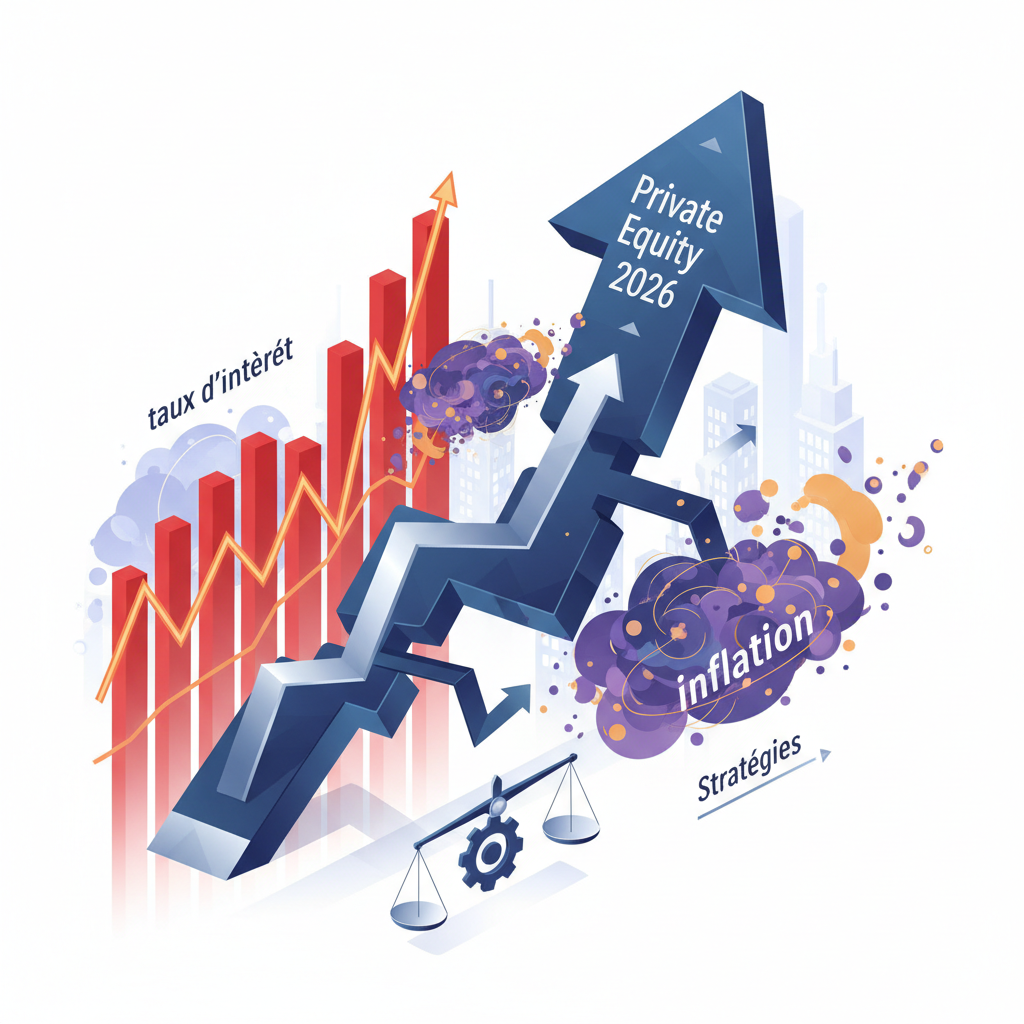
Persistent inflation, meanwhile, is no longer perceived as a temporary phenomenon. Funds are adapting their valuation models by incorporating structural inflation projections, which directly impacts anticipated exit multiples and revenue growth trajectories.
Private Debt and Alternative Financing: The New Allies
Facing more restrictive traditional banking conditions, the private debt market is experiencing unprecedented expansion. Private equity funds are increasingly turning to alternative financing solutions to structure their operations.
Preferred instruments include floating-rate loans indexed to inflation, which help preserve real returns, and mezzanine solutions offering increased flexibility. This evolution creates a more diversified financial ecosystem where private lenders play a growing role in financing acquisitions and refinancings.
According to private markets outlook, this trend is part of a profound reorganization of portfolios, where investment discipline and liquidity management become priorities. Funds are also negotiating inflation protection clauses in their financing agreements, anticipating a sustained normalization of inflation around 2-2.5% in the Eurozone.
Sectoral Selectivity: Betting on Price Transmission
In an inflationary environment, not all sectors are equal. Private equity funds are now focusing their efforts on segments that offer a strong ability to pass on cost increases to their end customers.
Preferred sectors in 2026 share common characteristics:
- Technology and software: Recurring models (SaaS) offering long-term visibility and resilient margins.
- Healthcare and biotechnology: Inelastic demand and continuous innovation justifying premium valuations.
- Energy infrastructure: Energy transition and growing needs for production and distribution capacities.
- Data centers: Exploding demand linked to artificial intelligence and cloud computing.
This sectoral orientation is accompanied by a more granular approach. Rather than investing in established leaders with high multiples, some funds target niche players benefiting from strong barriers to entry and potential for sectoral consolidation.

Operational Value Creation: The New Mantra
The era when simple financial leverage was enough to generate attractive returns is over. Funds are now deploying dedicated operational teams working hand-in-hand with the management of portfolio companies.
Operational improvement levers include process optimization, accelerated digitalization, commercial excellence, and gross margin improvement. This transformation requires significant investments in information systems, automation, and skills development.
"The ability to improve margins and productivity now determines the performance of private equity funds much more than acquisition multiples." — Goldman Sachs Asset Management 2026 Analysis
The integration of ESG (Environmental, Social, and Governance) criteria is no longer just a matter of responsibility: it has become a genuine factor of value creation. Companies with strong ESG performance benefit from more advantageous financing conditions and greater attractiveness to strategic acquirers during exits.
Liquidity and Rethought Exit Strategies
Liquidity is a major challenge for private equity in 2026. After several years of slowing exits, funds are exploring alternative avenues to generate returns for their investors.
The secondary market is experiencing notable dynamism. Portfolio transactions between funds (secondary buyouts) are multiplying, allowing capital to be recycled and offering opportunities for partial exits. Some funds are also developing early dividend distribution programs financed by strategic refinancings.
Initial Public Offerings (IPOs) are gradually regaining attractiveness, although the context remains selective. Opportunity windows are opening primarily for companies demonstrating profitable growth and strong fundamentals, particularly in the technology and healthcare sectors. Strategic sales to industrial acquirers remain preferred for quality assets, often offering higher exit multiples than market valuations.
Continuation fund strategies are emerging as an innovative alternative, allowing funds to retain their best assets beyond the initial life of the vehicle, while offering liquidity to investors wishing to exit.
Diversification and Niche Strategies
The excessive concentration on mega-deals is gradually giving way to a more diversified and granular approach. Funds are exploring segments previously neglected: European mid-market, venture growth, digital infrastructure, and energy transition assets.
This diversification addresses several imperatives. It reduces sensitivity to economic cycles, allows access to more reasonable entry valuations, and offers greater potential for value creation. Buy-and-build strategies, consisting of acquiring a platform and then strengthening it through complementary acquisitions, are gaining popularity in fragmented segments.
The internationalization of portfolios is also accelerating. While developed markets (United States, Western Europe) remain dominant, some funds are increasing their exposure to emerging Asian markets and Latin America, where growth prospects remain higher despite increased geopolitical risks.
Technology and Artificial Intelligence: Catalysts for Transformation
The integration of artificial intelligence and advanced technologies is radically transforming private equity processes. Funds are deploying predictive analytics tools to identify promising acquisition targets, assess operational risks, and optimize portfolio management.
Due diligence is partially automated thanks to AI solutions capable of rapidly analyzing massive volumes of financial, commercial, and regulatory data. This acceleration reduces execution times while improving analytical depth.
In portfolio companies, funds are investing heavily in digitalization: adoption of cloud platforms, deployment of business intelligence tools, automation of administrative processes, and development of e-commerce capabilities. These digital transformations generate measurable efficiency gains and strengthen the competitiveness of assets.
The rise of generative AI also opens new optimization perspectives: automated marketing content generation, customer relationship assistance, accelerated product development. Funds that master these technologies have a significant competitive advantage in value creation.
Outlook: A New Balance Between Prudence and Opportunism
Private equity in 2026 is part of a logic of constructive resilience. Funds have assimilated the lessons of recent turbulences and are now adopting a more balanced approach, combining financial discipline and growth ambition.
Anticipated returns are adjusting to the new macroeconomic reality. While double-digit IRRs (Internal Rates of Return) remain the objective, funds are now prioritizing the quality and sustainability of performance rather than one-off spectacular gains. This maturation of the sector benefits institutional investors, particularly insurers who are restructuring their allocations towards unlisted assets.
2026 thus marks a phase of strategic consolidation. The most agile funds, capable of identifying pockets of structural growth and deploying differentiated operational expertise, should continue to generate attractive outperformance. In this context, complementarity with other asset classes becomes essential for building balanced portfolios, as illustrated by diversification strategies via thematic ETFs or dividend optimization.