Kessler Syndrome and Starlink: The Race Against Orbital Runaway
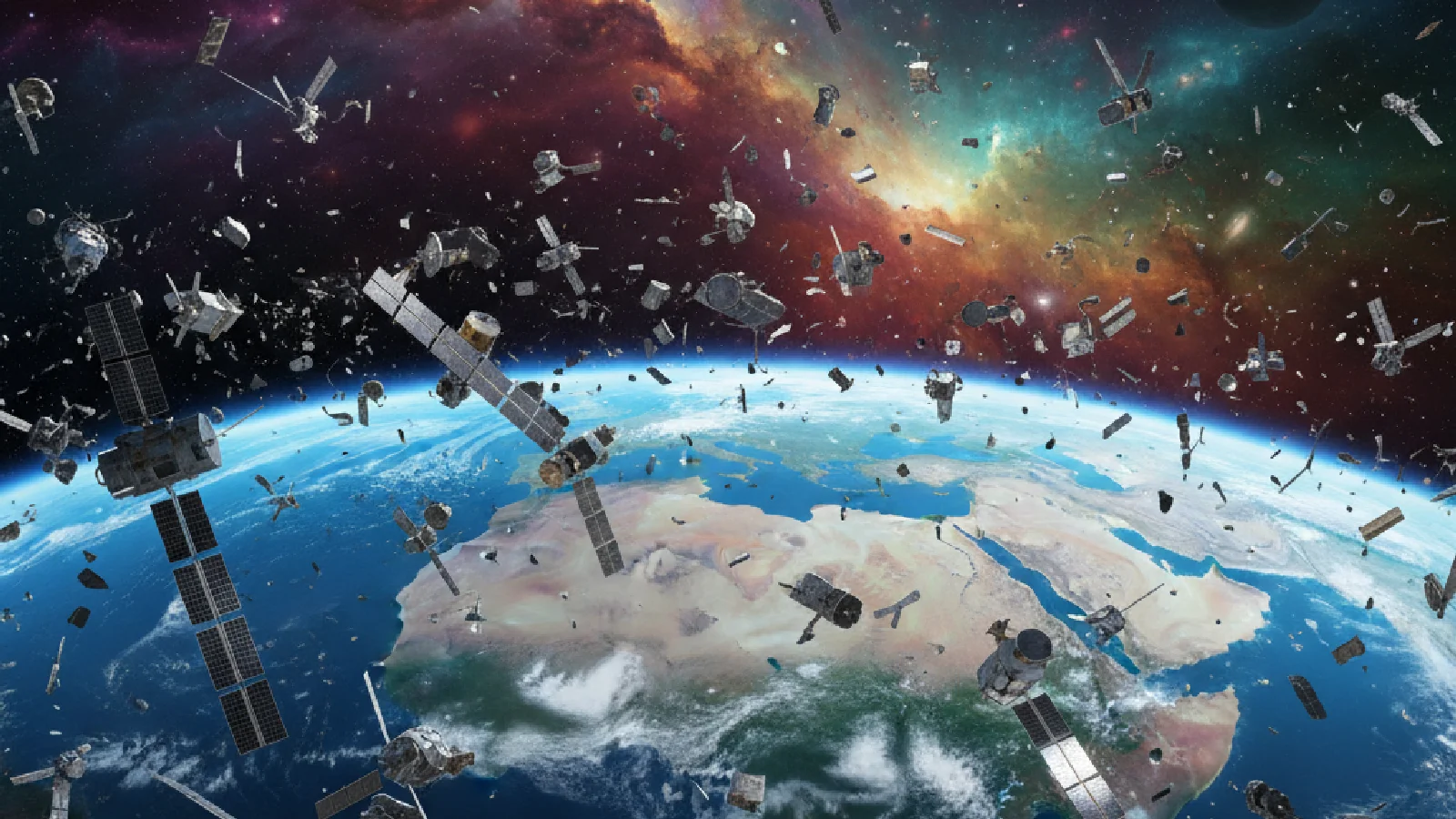
In February 2024, Starlink satellite 35956 experienced an “anomaly” followed by an explosion in orbit. The incident generated fragments that added to the tens of thousands of debris already present around Earth. This type of event, though isolated, illustrates the major dilemma of the mega-constellation era: how to reconcile global connectivity with the safety of the orbital environment? Since 1978, the Kessler Syndrome scenario has haunted the space community. Today, with over 4,000 Starlink satellites in service and tens of thousands planned by 2030, the question is no longer theoretical.

The Kessler Syndrome: A Cascade Scenario Threatening Low Earth Orbit
First described by NASA consultant Donald Kessler in 1978, the Kessler Syndrome refers to a chain reaction of space collisions. The principle is simple but formidable: when the density of objects in orbit reaches a critical threshold, each impact generates fragments that exponentially increase the probability of new collisions. This cascade could render certain low Earth orbits unusable for several decades, or even centuries.
Specifically, low Earth orbit (LEO, between 200 and 2,000 km altitude) currently concentrates most space traffic: communication satellites, space stations, observation craft. It is also in this zone that the majority of debris is located: abandoned rocket stages, defunct satellites, fragments from past collisions. According to the French Academy of Sciences, managing this debris is a major challenge for space sovereignty and sustainability.
The risk of runaway is not uniform: it depends on altitude, orbital inclination, and the critical mass of objects present. The more satellites there are, the more the probability of impact increases non-linearly.
Starlink and the Proliferation of Mega-Constellations
SpaceX, Elon Musk's company, has disrupted the space landscape with Starlink. Launched in 2019, this constellation aims to provide global high-speed internet access via a dense network of satellites in low Earth orbit. By 2026, over 4,000 Starlink satellites are operational, and authorizations obtained cover tens of thousands of additional units.
This proliferation radically changes the game. Traditionally, space was the domain of states. Now, private actors are deploying thousands of satellites at an unprecedented rate, often standardized and mass-produced. Other similar projects – Amazon Kuiper, OneWeb – amplify the phenomenon. Orbital traffic is intensifying, and with it, the risks of collisions.
In 2025, the Starlink constellation performed over 300,000 avoidance maneuvers to prevent collisions with other orbital objects.
This impressive figure testifies to both the effectiveness of automated avoidance systems and the increasing density of the space environment. Starlink uses artificial intelligence to anticipate dangerous trajectories and adjust the position of its satellites in real-time. These maneuvers, fueled by orbital surveillance data, have prevented numerous potentially catastrophic impacts, as highlighted by Trust My Science.
| Characteristic | Impact on the orbital environment |
|---|---|
| Proliferation | Increased traffic and risks |
| Standardization | Rapid deployment of thousands of satellites |
| Automated avoidance | Prevention of many collisions |
| Increasing density | Increased complexity of traffic management |
Recent Incidents: When Technology Isn't Enough
Despite these precautions, technical failures remain inevitable. The explosion of Starlink satellite 35956 in 2024 illustrates the vulnerability of space systems, even recent ones. Other isolated failures have also been reported over the years. Each incident potentially generates debris that adds to the critical mass already present in orbit.
These events raise a fundamental question: at what threshold does the multiplication of satellites become uncontrollable? Simulation models vary, but all agree on one point: without strict regulation measures and space debris removal technologies, the Kessler Syndrome could be triggered in certain orbital zones within a few decades.
Mega-constellations amplify this risk in several ways:
- Volume of satellites: the more objects there are, the more the probability of impact mechanically increases.
- Limited lifespan: Starlink satellites are designed to deorbit at the end of their life, but failures can prevent this maneuver.
- Involuntary fragmentation: an accidental explosion or collision creates hundreds, even thousands, of fragments impossible to track individually.
International Coordination and Space Governance: An Urgent Imperative
Faced with this threat, the international community struggles to organize itself. Outer space remains governed by the 1967 Outer Space Treaty, which stipulates that space is the “common heritage of mankind,” but which does not provide for binding mechanisms for debris management or limiting the number of satellites.
Nevertheless, several initiatives are emerging. The European Space Agency (ESA) conducts debris surveillance and tracking programs. “End-of-life” standards recommend passive or active deorbiting of satellites at the end of their mission. France and Europe are exploring space debris removal projects: robotic arms, nets, or capture systems to remove defunct objects.
The IRIS2 project, led by the European Union, aims to develop a sovereign constellation of communication satellites while integrating strict orbital sustainability standards from the design phase. This type of initiative shows that another path is possible, combining connectivity and environmental responsibility.
But coordination remains fragile. Private operators are not subject to the same constraints as public agencies. Geopolitical rivalries – particularly between the United States, China, and Russia – complicate the adoption of common standards. Without strengthened global governance, the risk of runaway remains high.
Avoidance Technologies and Debris Removal Programs: The Technological Race
To avoid the Kessler Syndrome, two technological levers are under development: automated avoidance and orbital clean-up.
Automated Avoidance and AI
Current avoidance systems, such as those used by Starlink, rely on artificial intelligence and real-time updated trajectory databases. Each satellite is equipped with sensors and thrusters capable of reacting within minutes to a collision alert. This approach has prevented many impacts, but it has limitations: it requires fine coordination between operators and full visibility of objects in orbit, including the smallest debris.
As the number of satellites increases, the complexity of calculations and the frequency of maneuvers grow exponentially. Researchers are working on more powerful predictive algorithms and on sharing data between public and private actors.
Space Debris Removal Programs
Several “removal” projects aim to actively remove debris and defunct satellites. Among the technologies being considered:
- Robotic arms to capture and deorbit large objects
- Nets and harpoons to catch inactive satellites
- Ground-based lasers to slow down small debris and accelerate their atmospheric re-entry
These solutions, still experimental, raise technical, legal, and economic challenges. Who finances the clean-up? Who decides which objects to remove? How can these technologies be prevented from being diverted for military purposes?
What Future for Near-Earth Space?
The future of low Earth orbit will be decided in the coming years. If current trends continue – increasing launches, lack of binding regulation, isolated incidents – certain orbital zones could become impassable before the end of the century. The consequences would be major: loss of GPS access, interruption of satellite communications, end of certain scientific missions, or even the impossibility of exploring deeper space, as launchers would have to cross a dangerous zone.
But another scenario is possible. It rests on three pillars:
1. Strengthened international regulation: adoption of mandatory design, end-of-life, and deorbiting standards. 2. Coordination between operators: sharing trajectory data, pooling avoidance systems. 3. Investment in debris removal: development of collectively funded removal technologies.
Mega-constellations like Starlink are not inherently a threat. They can coexist with a sustainable orbital environment, provided their growth is controlled and operators fully assume responsibility for their satellites. Artificial intelligence, new-generation plasma thrusters, and innovations in ion propulsion open promising perspectives for more refined space traffic management.
The question is no longer whether the Kessler Syndrome can occur, but how to prevent it. The answer will depend on political, industrial, and scientific choices made now. Near-Earth space, a strategic resource for humanity, deserves better than an uncontrollable minefield.
FAQ (JSON format - translate question and answer fields only): [ { "answer": "The Kessler Syndrome is a theoretical scenario from 1978 where the density of objects in orbit reaches a critical threshold, triggering a chain reaction of collisions. Each impact generates fragments that exponentially increase the probability of new collisions, rendering certain orbits unusable for decades, or even centuries.", "question": "What exactly is the Kessler Syndrome?" }, { "answer": "By 2026, over 4,000 Starlink satellites are operational in low Earth orbit. SpaceX has obtained authorizations to deploy tens of thousands more by 2030, making it the largest satellite constellation ever built.", "question": "How many Starlink satellites are currently in orbit?" }, { "answer": "Starlink uses automated avoidance systems powered by artificial intelligence. In 2025, the constellation performed over 300,000 avoidance maneuvers to prevent potential collisions. Each satellite is equipped with thrusters capable of adjusting its trajectory within minutes based on real-time orbital surveillance data.", "question": "How does Starlink avoid collisions with other space objects?" }, { "answer": "The challenges are both technical (capturing rapidly rotating objects, safely deorbiting), legal (who decides which objects to remove, who is responsible for debris), economic (who funds these costly operations), and geopolitical (preventing debris removal technologies from being diverted for military purposes).", "question": "What are the main challenges of space debris removal?" }, { "answer": "No, the Kessler Syndrome is not inevitable, but it is becoming increasingly probable without strict measures. Strengthened international regulation, mandatory end-of-life standards, coordination between operators, and investments in space debris removal can prevent the catastrophic scenario, provided action is taken quickly and collectively.", "question": "Is the Kessler Syndrome inevitable with current mega-constellations?" } ]