Hall Ion Propulsion: The Future of Space Refueling
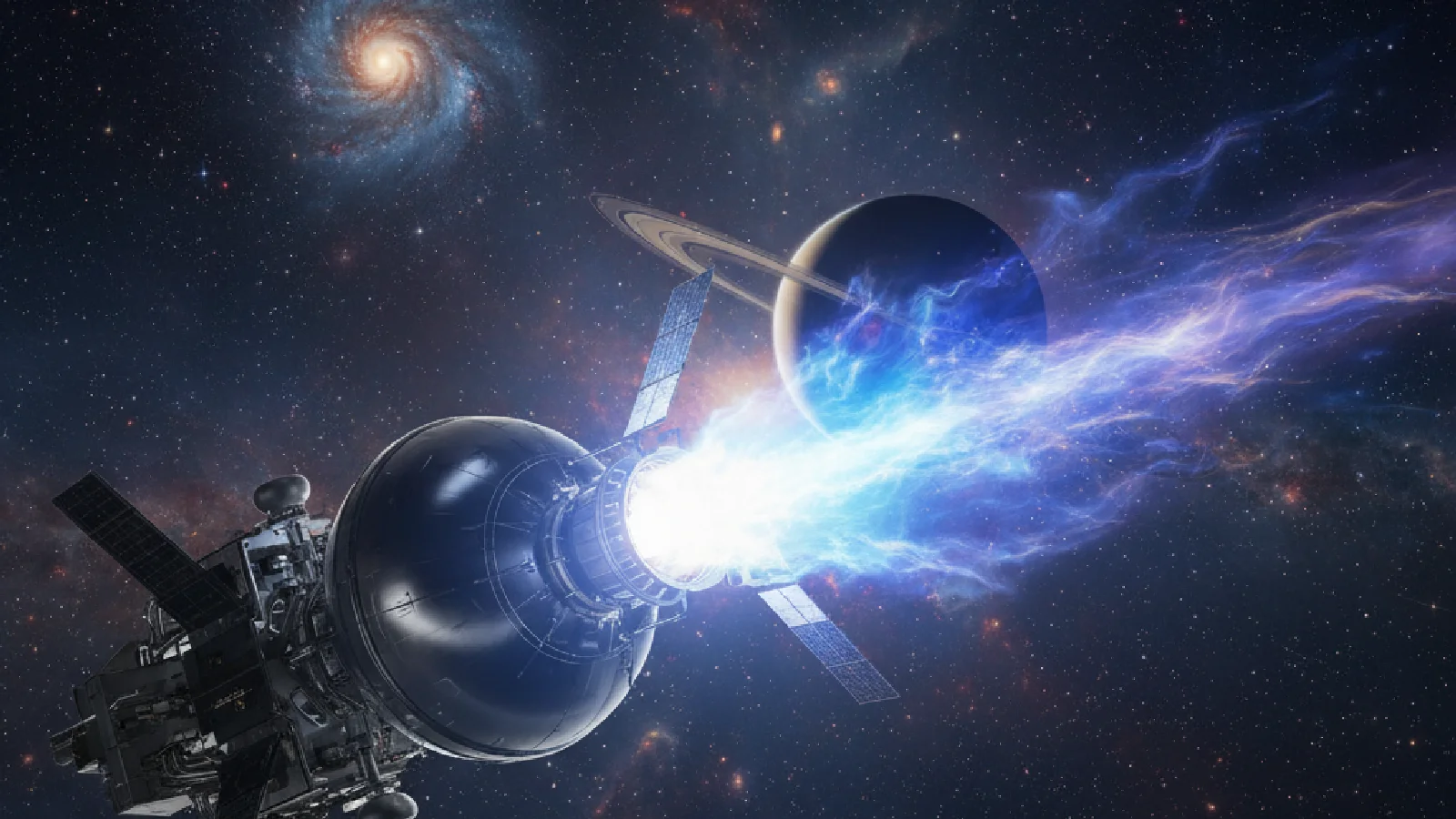
Imagine a space probe traveling millions of kilometers, capable of stopping to "refuel" before continuing its journey to the far reaches of the solar system. This scenario, long relegated to science fiction, is becoming a concrete prospect thanks to Hall effect thrusters. These electric engines, already proven on several iconic missions, are transforming how we conceive interplanetary travel and orbital refueling.
Unlike conventional chemical propulsion, which burns its fuel in minutes, Hall thrusters operate for months, even years, consuming a few grams of xenon per hour. This unprecedented endurance paves the way for space architectures where strategically positioned fuel depots allow spacecraft to replenish their tanks and significantly extend their range.
The Principle of Hall Effect Propulsion: Efficiency and Endurance
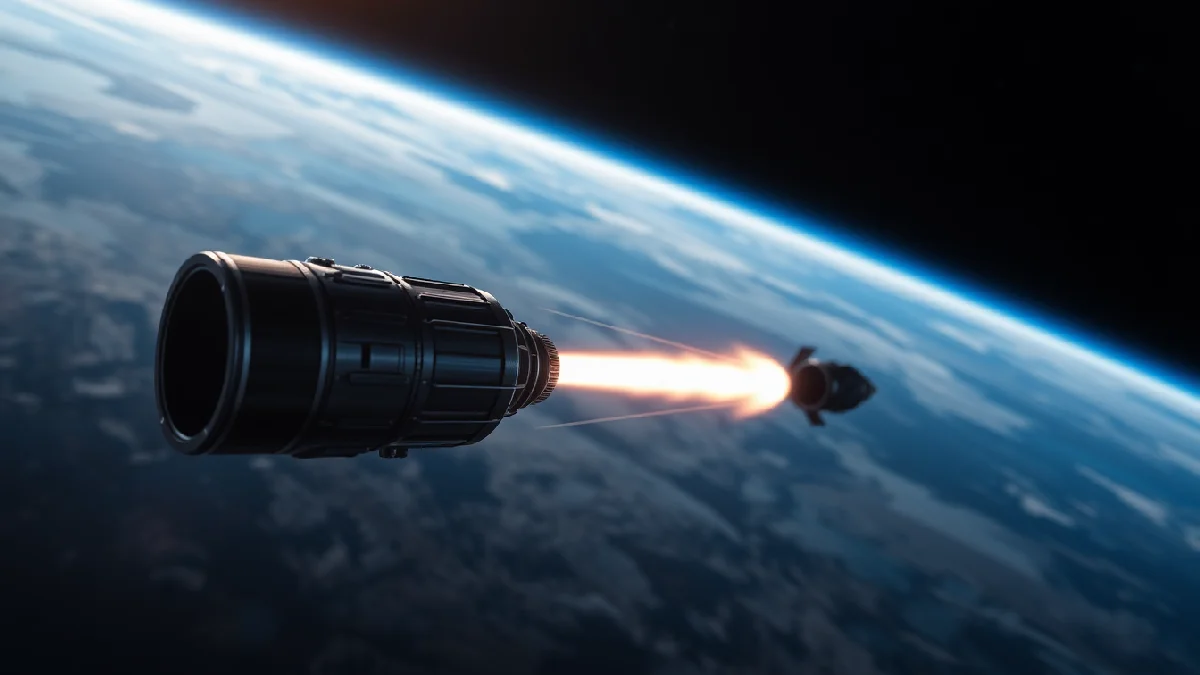
Hall effect propulsion relies on an elegant physical principle: xenon atoms are ionized in a magnetic chamber, then accelerated by an electric field to produce thrust. Although modest in intensity – on the order of milli-newtons to a few newtons depending on available power – this force accumulates over long periods to generate a high delta-v (change in velocity).
This technology stands out for three major advantages:
- Minimal consumption: a few grams of xenon per kilosecond, compared to several tons of chemical propellant for an equivalent mission
- High specific impulse: up to 10 times higher than chemical engines, allowing for higher speeds with less mass
- Proven reliability: missions like SMART-1, Dawn, and Hayabusa have validated the system's robustness over several years of operation
Raphaël Vilamot's thesis on the optimization of Hall thruster magnetic configurations details recent advances in the design of these systems, particularly the improvement of energy efficiency and the durability of magnetic components. For a broader understanding of space propulsion, you can consult resources on Space Propulsion on Wikipedia or the Québec Science article on ion propulsion.
| Characteristic | Hall Propulsion | Classic Chemical Propulsion |
|---|---|---|
| Operating Duration | Months, even years | Minutes |
| Consumption (xenon/propellant) | A few grams/hour | Several tons/mission |
| Specific Impulse | Up to 10 times higher | Lower |
| Thrust | Milli-newtons to a few Newtons | High (several thousand Newtons) |
| Delta-v | High (accumulated over long duration) | High (achieved quickly) |
In-Flight Refueling: A Strategic Lever for Deep Space Exploration
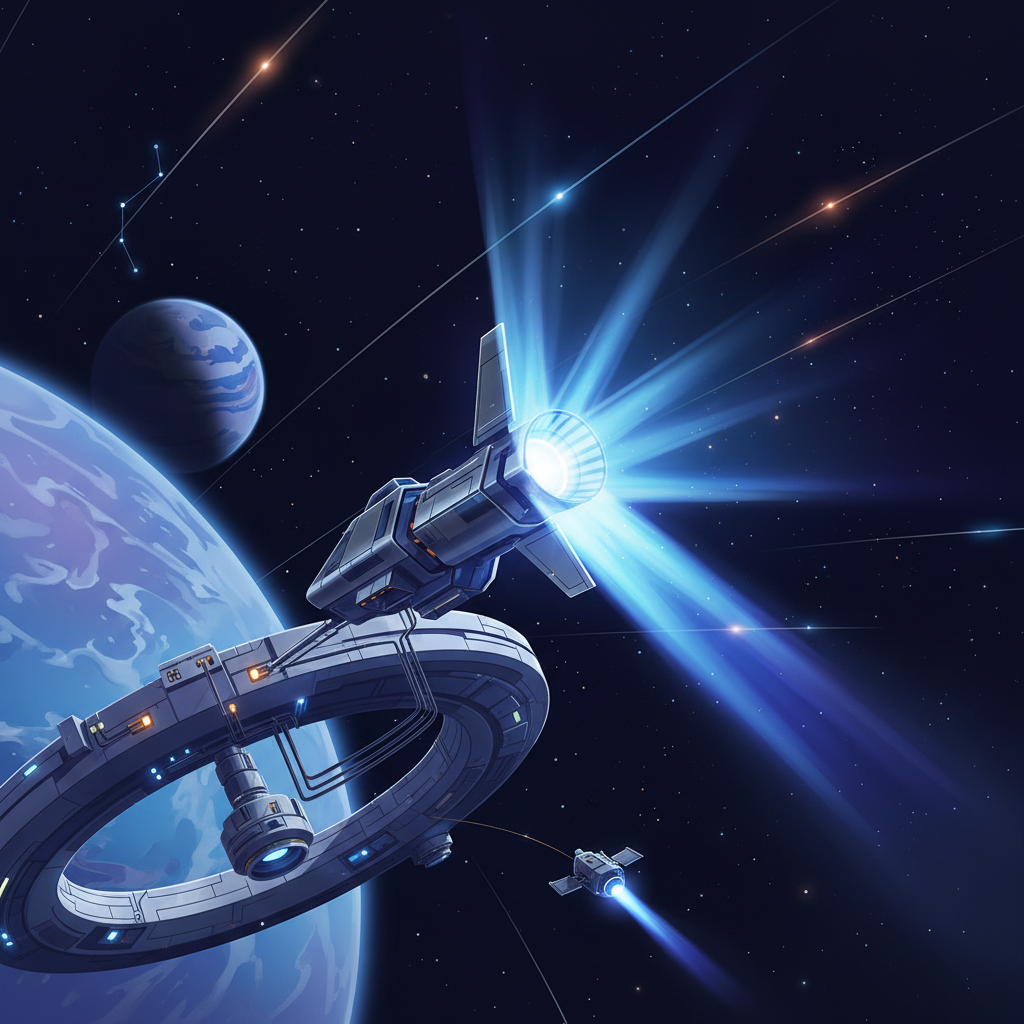
The concept of space refueling is based on a simple yet revolutionary logic: instead of carrying all the necessary fuel from Earth, spacecraft stop at orbital depots placed along interplanetary trajectories. These refueling stations, supplied with xenon from Earth or produced in situ on the Moon or Mars, allow probes equipped with Hall thrusters to replenish their tanks.
This approach reduces the necessary fuel mass at launch by approximately 40%, compared to a purely chemical mission. The savings translate into two major benefits:
- An increased scientific payload: instruments and experiments can occupy the space formerly dedicated to fuel tanks
- More ambitious destinations: additional maneuvering margins allow detours to asteroids, moons, or hard-to-reach regions
“With ion-propelled spacecraft, we can design increasingly complex missions: to lunar orbit, then to asteroids, and finally, towards Mars.”
— Pour la Science, En route vers Mars
Emblematic Missions and Ongoing Developments
Several space missions have already validated the potential of Hall thrusters. SMART-1, the European Space Agency (ESA) lunar probe, used a Hall engine to reach the Moon in 2004, demonstrating that electric propulsion could replace a chemical system for a complete scientific mission. The Dawn probe, launched by NASA, explored the asteroids Vesta and Ceres between 2007 and 2018, performing multiple orbital insertion maneuvers thanks to its ion propulsion.
More recently, all-electric platforms like the Boeing 702SP have introduced Hall thrusters into the commercial telecommunications satellite sector. These spacecraft, lacking chemical engines for station-keeping, save several tons of fuel and extend their operational lifespan.
Current developments aim for powers of 3 to 5 kW, or even beyond, to accelerate interplanetary transfer times. Hall propulsion modules powered by large solar panels, or by compact nuclear reactors, are under study for missions to Jupiter, Saturn, and their icy moons like Europa or Enceladus, where drilling robots could explore subglacial oceans. For more information on the introduction of these technologies, Chapter 1 of Aleph-Zero provides an overview.
Modular Architectures and Xenon Depots: Towards a Space Logistics Network
The rise of in-flight refueling relies on the establishment of a space logistics infrastructure. Several architectures are being considered:
- Autonomous cylindrical depots: modules containing several tons of xenon, equipped with their own Hall thrusters, positioned in strategic orbits (Earth-Moon Lagrange point, Martian orbit). Spacecraft dock, refuel, and depart without delay.
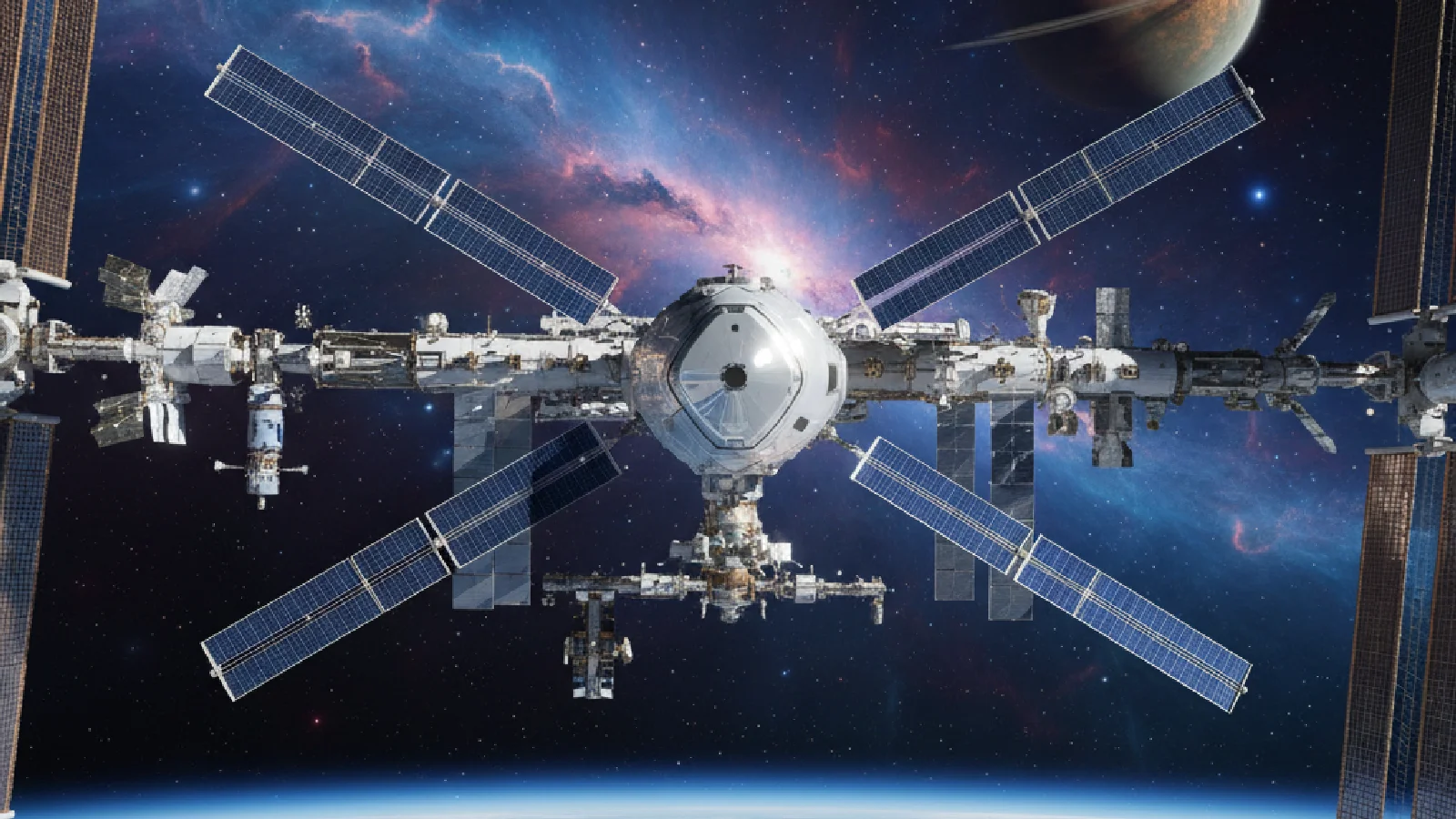
- All-electric relay stations: multi-functional platforms providing fuel storage, robotic maintenance, and communication relay. These stations, deployed progressively, would form an interplanetary network comparable to terrestrial gas stations.
- In-situ propellant production: on the Moon or Mars, the extraction and purification of xenon (or other rare gases) from regolith would reduce dependence on launches from Earth, drastically lowering costs and paving the way for a sustainable space economy.
This vision is part of a broader strategy of orbital industrialization, where private space stations and governmental infrastructures coexist to support scientific and commercial exploration.
Technical Challenges and Prospects for Improvement
Despite their advantages, Hall thrusters must overcome several challenges before becoming the standard for long-duration missions. The erosion of electrodes and magnetic walls currently limits their lifespan to a few thousand hours of operation. Ongoing research explores advanced ceramic materials and optimized magnetic configurations to extend this endurance.
Thermal management is another challenge: efficiently dissipating the heat generated by electronic components and plasma requires bulky radiators, adding weight to spacecraft. Future architectures integrate passive cooling systems and high-emissivity surfaces to limit onboard mass.
Finally, electrical power remains a limiting factor. Solar panels lose efficiency beyond Mars' orbit, necessitating the use of nuclear sources for missions to outer planets. Radioisotope thermoelectric generators (RTGs) and compact fission reactors are being experimented with to provide the kilowatts needed for high-power Hall thrusters.
Beyond Current Frontiers: Hall Propulsion and Deep Exploration
Hall effect thrusters do not merely push technical boundaries: they redefine the very strategy of space exploration. By enabling modular missions, where each stage can be refueled and adjusted, they introduce unprecedented operational flexibility. A probe can thus modify its trajectory mid-flight to seize an unexpected scientific opportunity, without compromising its return or the rest of the mission.
This agility opens up fascinating prospects: close flybys of comets, orbital insertion around small bodies (asteroids, irregular moons), or multi-target missions successively visiting several destinations. Walking robots deployed on Mars could, tomorrow, be transported by cargo ships propelled by Hall engines, refueled en route from lunar depots.
In the longer term, spacecraft with Hall propulsion combined with solar or magnetic sails could reach speeds allowing them to reach the heliosphere's boundaries in a few decades, expanding our knowledge of the interstellar medium and perhaps preparing the first probes to nearby stars.
Conclusion
Hall effect propulsion embodies a profound transformation in astronautics. By combining exceptional endurance, fuel economy, and in-flight refueling capabilities, it overcomes the constraints that have long hindered interplanetary exploration. The emblematic missions already accomplished – from SMART-1 to Dawn – have validated the reliability of this technology, while ongoing developments promise even greater performance. As space infrastructure densifies, with orbital xenon depots and relay stations, Hall thrusters will become the preferred engine for scientific probes, commercial cargo, and, perhaps one day, crewed spacecraft to Mars and beyond. From this perspective, electric propulsion is not just a technical advance: it is the key that unlocks the doors to the deep solar system.