Massive Black Hole Mergers: A New Era for Astronomy
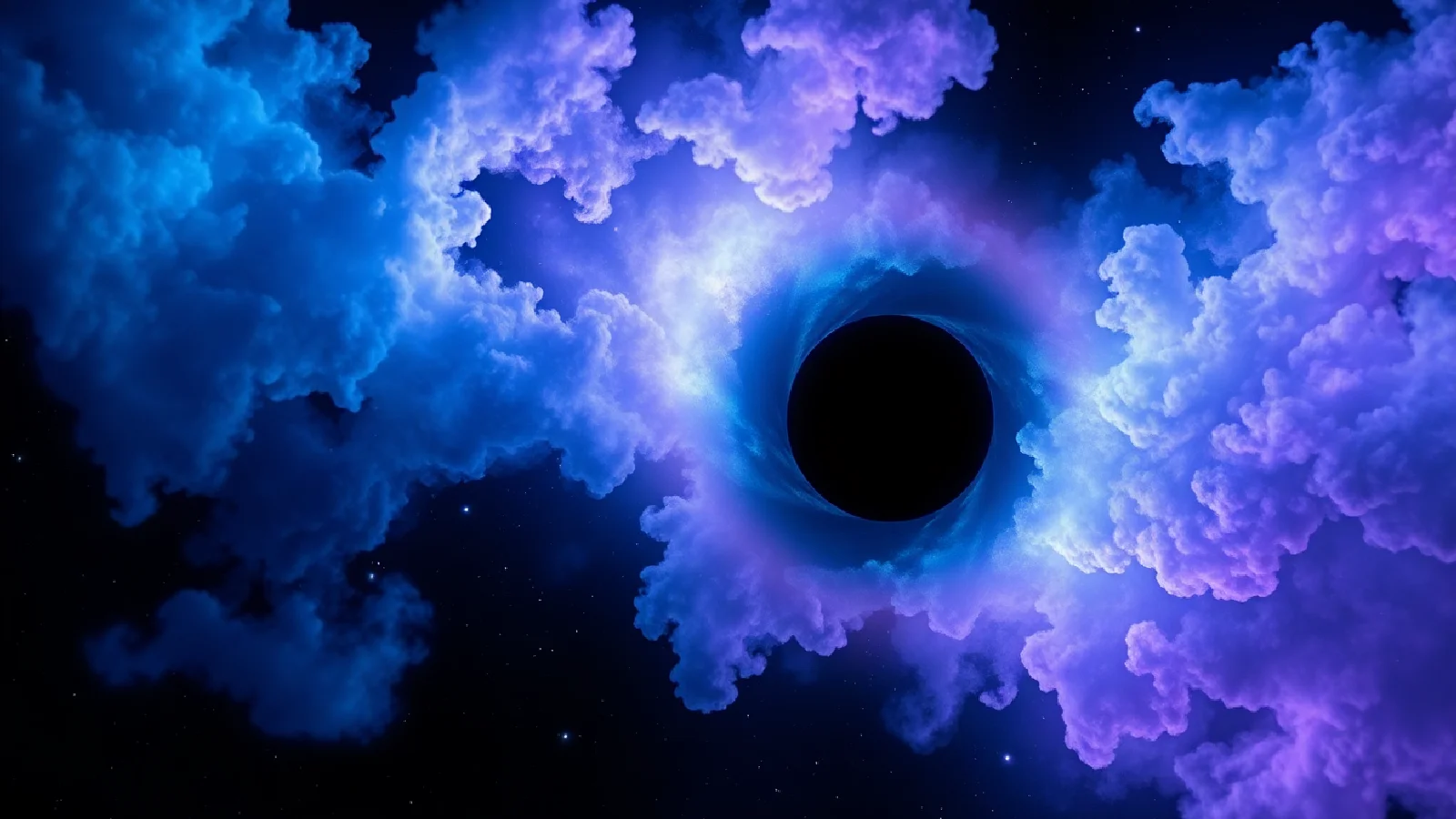
The GW231123 signal marked a historic turning point in gravitational astronomy. This colossal merger, which gave birth to a black hole of approximately 225 solar masses, surpasses all previous records and challenges our most fundamental theoretical models. How can such cosmic monsters exist, and what do they reveal about the mysteries of our universe?
Since the first detection of gravitational waves in 2015 with GW150914, terrestrial observatories have revolutionized the way we explore space. But recent discoveries of ultra-massive mergers now open an unprecedented window into the formation and evolution of the most extreme objects in the cosmos.
Records that defy theory
The detection of the GW231123 signal by the LIGO-Virgo-KAGRA collaboration represents a major challenge for contemporary stellar physics. This merger between two black holes, each of 103 and 137 solar masses, produced a final object of astonishing mass.
“This is the most massive binary black hole system we have observed through gravitational waves,” emphasize researchers from the international collaboration.
This discovery far surpasses the previous record held by GW190521, which had already created a black hole of approximately 140 solar masses. The scale of these new events shakes up our traditional models of stellar evolution.
Current theories struggle to explain the direct formation of such massive black holes. Indeed, the heaviest stars are supposed to lose a considerable amount of mass during supernova explosions, which theoretically limits the mass of the resulting stellar black holes.
The spectacular enrichment of catalogs
The GWTC-2 catalog perfectly illustrates this observational revolution. With more than fifty confirmed detections, compared to only eleven in the first version, data is accumulating at an impressive rate. This explosion in the number of detections allows astrophysicists to significantly refine their models.
The third observation campaign (O3a) notably produced about three times more confirmed events than the first two campaigns combined. This exceptional productivity testifies to the constant improvement of detection instruments and their increased sensitivity.
The new cataloged events reveal a remarkable diversity in astrophysical parameters:- Mergers of binary black hole systems
- Coalescences of neutron stars
- Mixed systems combining black holes and neutron stars
| Observation Campaign | Number of Detections |
|---|---|
| First (O1+O2) | ~11 |
| Third (O3a) | ~33 |
| Total (GWTC-2) | >50 |
Revolutionary formation scenarios
Faced with these observations that defy classical models, astrophysicists are exploring alternative formation mechanisms. Hierarchical mergers emerge as the most plausible explanation for these cosmic giants.
In this scenario, “normal” mass black holes merge once, creating an intermediate object that can then merge with another black hole. These cascade processes likely occur in particularly dense environments, such as the cores of active galaxies or globular clusters.
These extreme environments favor the complex gravitational interactions necessary for such successive mergers. The high density of compact objects significantly increases the probability of encounters and gravitational captures.
A laboratory for general relativity
These ultra-energetic events constitute exceptional natural laboratories for testing Einstein's theory of general relativity in its most extreme regimes. The energy released in the form of gravitational waves is equivalent to several tens of solar masses converted into pure energy.
These conditions allow for the exploration of gravitational field regimes of unparalleled intensity in the laboratory. Scientists can thus verify whether Einstein's predictions stand up to these ultimate tests, or if deviations would reveal physics beyond the standard model.
The analysis of detected waveforms reveals subtle details about the dynamics of the merger, the rotation of the initial objects, and the properties of spacetime strongly curved around coalescing black holes.
The future of gravitational astronomy
The next generation of observatories promises even more spectacular revolutions. Planned improvements for LIGO, Virgo, and KAGRA will significantly increase their range and sensitivity, multiplying the volume of observable space.
The LISA space project represents a major technological leap. This space observatory will be able to detect very low-frequency gravitational waves, emitted by the merger of supermassive black holes at the heart of galaxies. These detections will open a unique window into the evolution of galaxies and the formation of large-scale structures.
Synergies between gravitational and electromagnetic observations also promise revolutionary discoveries. Multi-messenger astronomy now combines different types of signals for a global understanding of cosmic phenomena.
Towards a revolutionized cosmology
These observations also revolutionize our understanding of cosmic evolution. The observed merger rates constrain stellar formation models in the primordial universe and shed light on the history of heavy element nucleosynthesis.
The mass distribution of detected black holes reveals unexpected populations of compact objects. These discoveries challenge our understanding of stellar evolution and suggest alternative formation pathways in the early universe.
Modern gravitational astronomy thus brings us closer to the great cosmological mysteries. It could notably provide decisive elements on the nature of dark matter and dark energy, these mysterious components that dominate our universe.
This observational revolution is part of a broader dynamic of space exploration, where technological advances and international collaborations constantly push the boundaries of our knowledge. Gravitational astronomy perfectly illustrates how technological innovation can revolutionize our vision of the cosmos.