Singularity-Free Black Holes: A Cosmic Revolution Underway
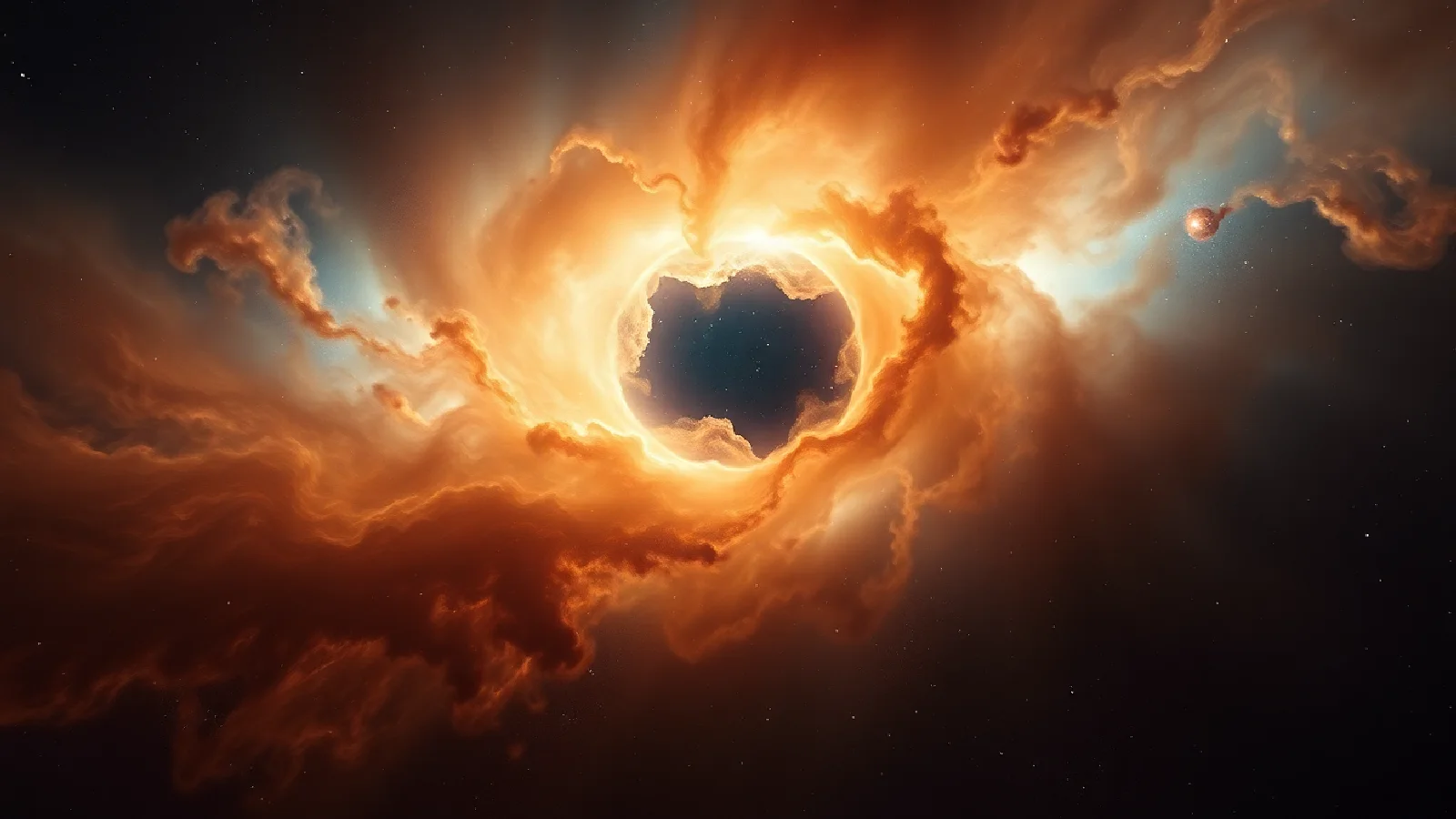
For over a century, black holes have both fascinated and challenged our understanding of the universe. These cosmic objects, described by Einstein as regions where spacetime curves infinitely, pose a fundamental paradox: their theoretical center, the singularity, where density becomes infinite and physical laws break down. But what if this singularity didn't exist?
Revolutionary theories are now emerging, proposing singularity-free models that could transform our view of these cosmic giants. These alternatives promise to resolve mathematical paradoxes while retaining the observed properties of black holes.

The Classical Model and Its Fundamental Limitations
Einstein's general relativity predicts that when a massive star collapses, its matter concentrates into a point of infinite density: the singularity. This region is surrounded by the event horizon, an invisible boundary beyond which nothing can escape, not even light.
The Schwarzschild metric, developed in 1916, mathematically describes these objects. For a non-rotating black hole, this solution predicts gravitational effects perfectly consistent with our observations. However, it generates a mathematical divergence at the center, where the curvature of spacetime becomes infinite.
"The singularity represents the point where our physical theory breaks down. It's a signal that we are missing something fundamental." - Contemporary theoretical physicist
This conceptual limitation has pushed researchers to explore alternatives that eliminate this problematic singularity. Recent research suggests that these new models could revolutionize our cosmological understanding.
Regular Black Holes: A Finite Density Core
Regular black holes represent the first family of singularity-free alternatives. In these models, the central point of infinite density is replaced by a region of finite maximum density. This approach resolves mathematical paradoxes while preserving the external event horizon.
The key mechanism relies on the inclusion of quantum gravitational effects. As the center is approached, classical attractive gravity gradually gives way to repulsive forces of quantum origin. This transition creates a de Sitter-type core, a region where spacetime exhibits constant positive curvature.
These models retain essential observable properties:- An event horizon identical to the classical case
- Similar gravitational lensing effects
- Unchanged external gravitational attraction
The main advantage lies in the elimination of mathematical divergence, allowing for a coherent physical description of the entire object. This approach relies on quantum gravity considerations to resolve the inconsistencies of the classical model.
| Characteristic | Classical Black Hole (Singularity) | Regular Black Hole (Singularity-Free) |
|---|---|---|
| Density at the center | Infinite | Finite maximum |
| Paradox Resolution | No | Yes |
| Event Horizon | Present | Present (identical to classical) |
| External Gravitational Eff. | Identical to observations | Identical to observations |
Mimicker Objects: Beyond the Event Horizon
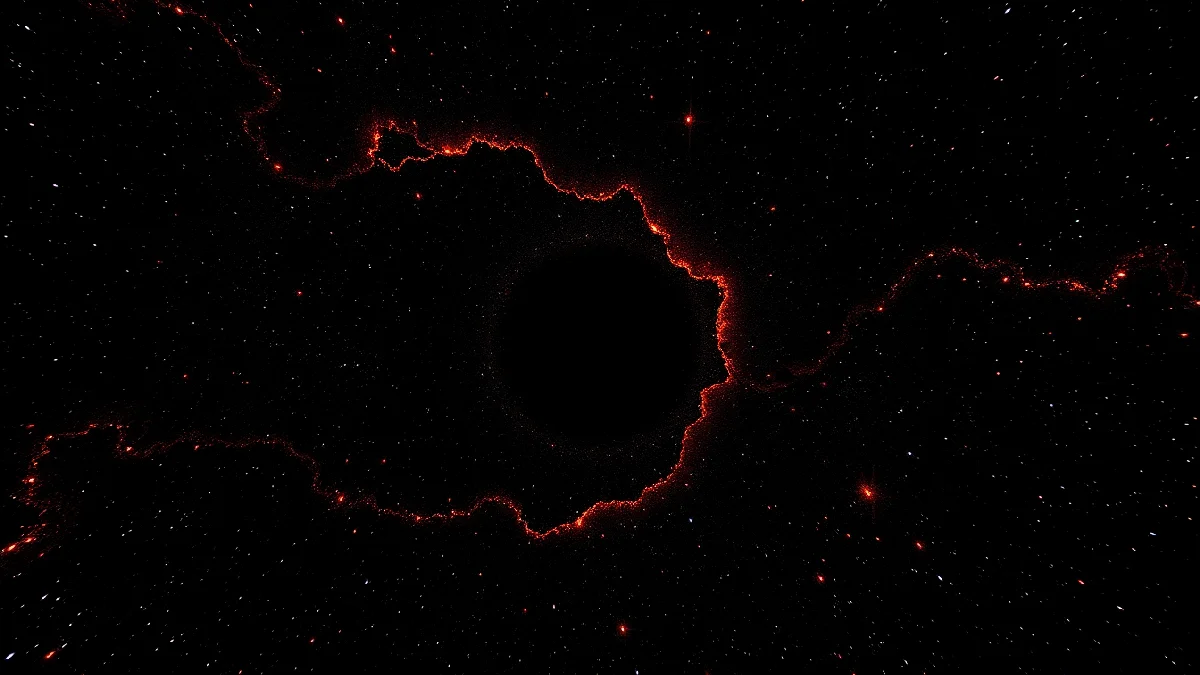
Even more radical, the concept of mimicker objects completely removes the event horizon. These ultra-compact structures possess a physical surface located just above the Schwarzschild radius, theoretically allowing light and signals to escape.
Mimickers exhibit distinctive characteristics:- Absence of a permanent event horizon
- Possibility of radiation emission from the surface
- Slightly different gravitational wave profiles
This family includes gravastars (gravitational vacuum stars), where an ultra-dense shell surrounds a quantum vacuum, and plugstars (learn more about plugstars), which replace the singularity with a finite-density surface. Theoretical research explores these promising alternatives.
These objects could explain certain puzzling observations, particularly variations in high-energy emissions around supposed black holes. Their study requires advanced numerical simulations to predict their observational signatures.
Observational Signatures and Experimental Tests
The distinction between classical black holes and singularity-free alternatives relies on identifying specific observational signatures. Current and future telescopes offer ways to test these revolutionary theories.
The Event Horizon Telescope (EHT) network is a key tool for these investigations. Images of M87 and Sagittarius A reveal details about the structure near the horizon, potentially sensitive to differences between models. Luminosity variations and emission profiles could betray the presence of a physical surface rather than a classical horizon.
Gravitational interferometers like LIGO and Virgo analyze waves emitted during the coalescence of compact objects. Singularity-free black holes would produce slightly different signals, particularly in the final merger phases. These subtle deviations require extreme instrumental precision to be detected.
Analyzing gravitational echoes represents a promising avenue. If objects possess a physical surface, gravitational waves could bounce off it and create characteristic echoes, absent in the case of classical black holes with a horizon.
Impact on Fundamental Physics
These new theories transcend the mere description of black holes to question our physical foundations. The elimination of singularities resolves several conceptual paradoxes of general relativity, including the information paradox and difficulties in gravitational quantization.
Black hole thermodynamics is also transformed. Hawking radiation, a quantum process near the horizon, could exhibit variations depending on the underlying model. Would singularity-free objects retain the relationship between entropy and surface area? These fundamental questions require in-depth theoretical developments.
The unification of general relativity and quantum mechanics benefits from these alternative approaches. By avoiding mathematical divergences, singularity-free theories offer a more favorable ground for developing coherent quantum gravity. This perspective opens avenues towards a unified understanding of fundamental forces.
These developments are part of a broader effort to revise our cosmological models, similar to recent advances in Martian exploration that are transforming our view of the solar system.
Technological Challenges and Future Prospects
Experimental validation of these theories requires extremely precise instruments. Future generations of space telescopes and gravitational interferometers will need to achieve unprecedented sensitivities to distinguish the subtle signatures of different models.
Artificial intelligence plays an increasing role in the analysis of astrophysical data. Machine learning algorithms can identify complex patterns in observations, potentially revealing singularity-free structures. This computational approach complements traditional theoretical methods.
Relativistic numerical simulations represent a major technical challenge. Precisely modeling the dynamics of these exotic objects requires supercomputers and sophisticated algorithms. These tools allow for the prediction of expected observational signals for each class of models.
International collaboration is intensifying around this research. Scientific consortia coordinate multi-wavelength observations and theoretical analyses, maximizing the chances of detecting characteristic signatures. This mobilization is reminiscent of efforts made for space observation that are revolutionizing our perception of the universe.
Conclusion
Singularity-free theories potentially mark a major conceptual revolution in astrophysics. By replacing points of infinite density with finite-density structures, these models resolve mathematical paradoxes while preserving the observed properties of black holes.
The emergence of regular black holes and mimicker objects opens fascinating prospects for fundamental physics. These alternatives promise to reconcile general relativity and quantum mechanics, while offering new observational tests for current and future telescopes.
The next decade will be crucial for distinguishing between these competing models. Technological advancements in high-resolution imaging and gravitational wave detection will provide the necessary data to decide between singularity and alternatives. This scientific quest could transform our understanding of the universe and reveal new cosmic horizons.