Mars Future Plan: NASA Revolutionizes Martian Exploration

Mars exploration is entering a new era with NASA's Mars Future Plan. This revolutionary strategy proposes a modular and commercialized approach that could radically transform how we explore the Red Planet. By leveraging local resources and private partnerships, this plan aims to drastically reduce costs while multiplying mission opportunities.
NASA is developing an innovative architecture that combines technological reuse, commercialization of space transport, and exploitation of Martian resources. This approach promises to make Martian exploration more regular and economically viable, paving the way for a permanent scientific presence on Mars. To learn more about the future directions of space exploration, one can consult NASA's document "Futures of Deep Space Exploration, Commercialization..." (NTRS NASA).

A Revolutionary Modular Architecture
The Mars Future Plan is based on a philosophy of modularity and reusability that transforms the traditional approach to Martian missions. Unlike previous missions designed as isolated projects, this new paradigm favors interconnected and scalable systems.
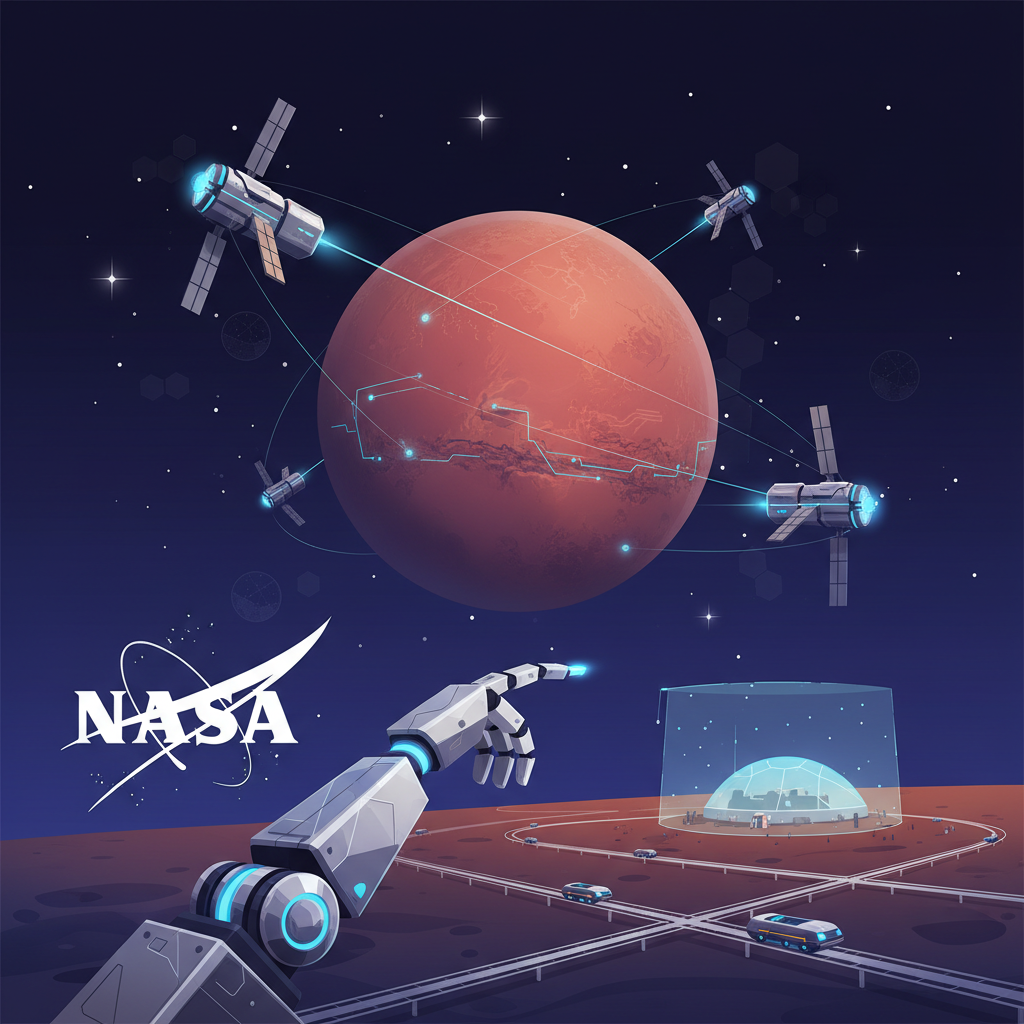
This modular architecture allows for the development of standardized platforms capable of accommodating different types of scientific equipment. Light landers, constellation rovers, and autonomous laboratories can thus be deployed in a coordinated manner, creating a permanent exploration network on the Martian surface.
The modular approach also offers unprecedented operational flexibility. Missions can be adapted in real-time according to scientific discoveries, allowing for more reactive and targeted exploration of priority areas of interest.
| Key Feature | Description | Primary Benefit |
|---|---|---|
| Modularity | Interconnected and scalable systems | Operational flexibility |
| Reusability | Standardized platforms | Coordinated deployment |
| Adaptability | Responds in real-time to discoveries | Targeted and reactive exploration |
Commercialization of Space Transport
The integration of commercial providers is a central pillar of the Mars Future Plan. Building on the experience gained with over 40 payloads delivered to the Moon by private partners, NASA is applying this approach to Mars with significant economic benefits.
This commercialization strategy significantly reduces launch costs while stimulating technological innovation. Private companies bring their agility and innovation capacity, accelerating the development of more efficient and less expensive technical solutions.
"The commercialization of space transport to Mars could reduce mission costs by more than 60% compared to traditional approaches, enabling a more sustained mission cadence."
Public-private partnerships also create a sustainable economic ecosystem around Martian exploration, encouraging private investment in advanced space technologies. The challenges and evolution of space policy are also addressed in documents such as "Mars Wars: The Rise and Fall of the Space Exploration..." by NASA (NASA).
Exploitation of Martian Resources (ISRU)
The use of in-situ resources (ISRU - In-Situ Resource Utilization) represents the technological core of the Mars Future Plan. This approach involves exploiting resources available on Mars to produce fuel, oxygen, and other essential materials directly on site.
ISRU technologies enable the transformation of Martian carbon dioxide into oxygen and methane, thus creating the elements necessary for propulsion and life support. This local production capability drastically reduces the mass to be transported from Earth, thereby lowering mission costs.
NASA is currently testing these technologies on the Moon through several preparatory missions. These tests include:
- Oxygen production systems from lunar regolith
- Fuel generators using atmospheric resources
- NTAC nuclear batteries for autonomous power supply
These validated technologies will then be deployed on Mars, creating an autonomous energy and logistics infrastructure on the Red Planet.
Key Technologies and Innovations
The program integrates disruptive technologies that revolutionize Martian exploration capabilities. High-specific-impulse propulsion systems enable faster and more efficient journeys, reducing critical launch windows.
Autonomous laboratories are a major innovation of the plan. These scientific platforms can conduct experiments continuously without ground intervention, multiplying the scientific productivity of missions. They integrate advanced chemical, biological, and geological analysis capabilities.
Artificial intelligence and advanced automation allow systems to explore autonomously, make real-time decisions, and optimize their scientific paths. This autonomy compensates for communication delays with Earth and maximizes operational efficiency.
Economic Impact and Mission Frequency
The Mars Future Plan transforms the economics of Martian exploration by making missions more frequent and affordable. The reduction in costs makes it possible to envision sustained exploration campaigns rather than infrequent, one-off missions separated by several years.
This new space economy fosters the emergence of a Martian commercial market where private companies can develop their own scientific or technological missions. Easier access to Mars stimulates innovation and attracts new players to the space sector.
"Fast-and-frequent" missions allow for faster accumulation of scientific data and maintenance of a continuous presence on Mars. This approach significantly accelerates the pace of discoveries and improves our understanding of the Red Planet.
According to NASA's forecasts, this strategy could enable the launch of a mission to Mars every 18 months instead of the traditional biennial windows.
Challenges and Future Prospects
Despite its revolutionary potential, the Mars Future Plan faces several technological and logistical challenges. The reliability of ISRU systems in the Martian environment remains to be demonstrated on a large scale, requiring extensive testing and robust redundancy systems.
International governance aspects also pose complex questions. The exploitation of Martian resources raises legal issues concerning the ownership and use of space resources, requiring strengthened international coordination. The OECD has also published analyses on the future of space, such as "Space 2030" (OECD). Additional information on space exploration can be found via Planète Mars (Planète Mars).
The formation of a commercial ecosystem around Mars requires massive investments and a long-term vision. Private companies must be incentivized to invest in technologies whose profitability will only be visible in the medium term.
Integration with existing exploration programs, such as Perseverance continuing its research on Mars, helps maintain scientific continuity while preparing the transition to this new approach.
Conclusion
NASA's Mars Future Plan represents a fundamental paradigm shift in space exploration. By combining commercialization, modularity, and local resource utilization, this strategy paves the way for more accessible and sustainable Martian exploration.
This revolutionary approach could transform Mars from a distant and costly destination into a permanent, regularly accessible scientific laboratory. The implications extend far beyond the scientific realm, laying the groundwork for an expanded space economy that could eventually include crewed missions.
The future of Martian exploration is thus taking shape around a collaborative vision combining technological innovation, commercial partnerships, and scientific ambition. This plan could well be the catalyst that definitively transforms our relationship with the Red Planet, moving it from the status of a scientific curiosity to that of an accessible destination for humanity.