Perseverance: The Future Martian Record-Breaker and its Role in the Search for Life

Since its landing in the Jezero Crater in February 2021, the Perseverance rover has been redefining space exploration through its autonomous prowess and promising discoveries. With over 40 kilometers traveled and an autonomous navigation capability exceeding 90%, this NASA robotic explorer tirelessly continues its quest for signs of ancient life on Mars. Its recent analyses of rock samples, particularly from the famous "Cheyava Falls" rock, bring humanity closer to a historic discovery that could revolutionize our understanding of life in the universe.
Revolutionary Autonomy Redefining Martian Exploration
Perseverance's navigation autonomy represents a major technological advance compared to previous Martian missions. The AEGIS (Autonomous Exploration for Gathering Increased Science) system combines several cutting-edge technologies: high-resolution navigation cameras, real-time obstacle detectors, and image processing algorithms that allow the rover to make independent decisions.
This exceptional autonomy enables Perseverance to effectively avoid the dangers of the Martian terrain: sharp rocks, deep ravines, and quicksand areas that could jeopardize the mission. The rover can thus plan its routes optimally, maximizing the time dedicated to scientific analyses rather than avoidance maneuvers.
"Over 90% of Perseverance's journey is now conducted autonomously, freeing up ground teams to focus on interpreting scientific data rather than daily navigation."
This operational independence is crucial given the communication delay with Earth, which varies between 4 and 24 minutes depending on the planets' positions. NASA confirms that Perseverance can continue its mission with even more ambitious objectives, planning an additional 60 kilometers of exploration.
A Scientific Arsenal Dedicated to Astrobiology
The rover carries a suite of scientific instruments specifically designed to detect potential biosignatures in Martian rocks. This technological array includes:
- PIXL: X-ray spectrometer for precise chemical analysis
- SHERLOC: UV laser spectrometer to identify organic minerals
- SuperCam: plasma laser and microphone for remote analysis
- MOXIE: oxygen generator from the Martian atmosphere
These instruments allow for the analysis of the chemical and mineralogical composition of rocks with unparalleled precision. They specifically search for chemical signatures consistent with the preservation of ancient microbial organisms, such as complex organic compounds or mineral structures formed by biological activity.
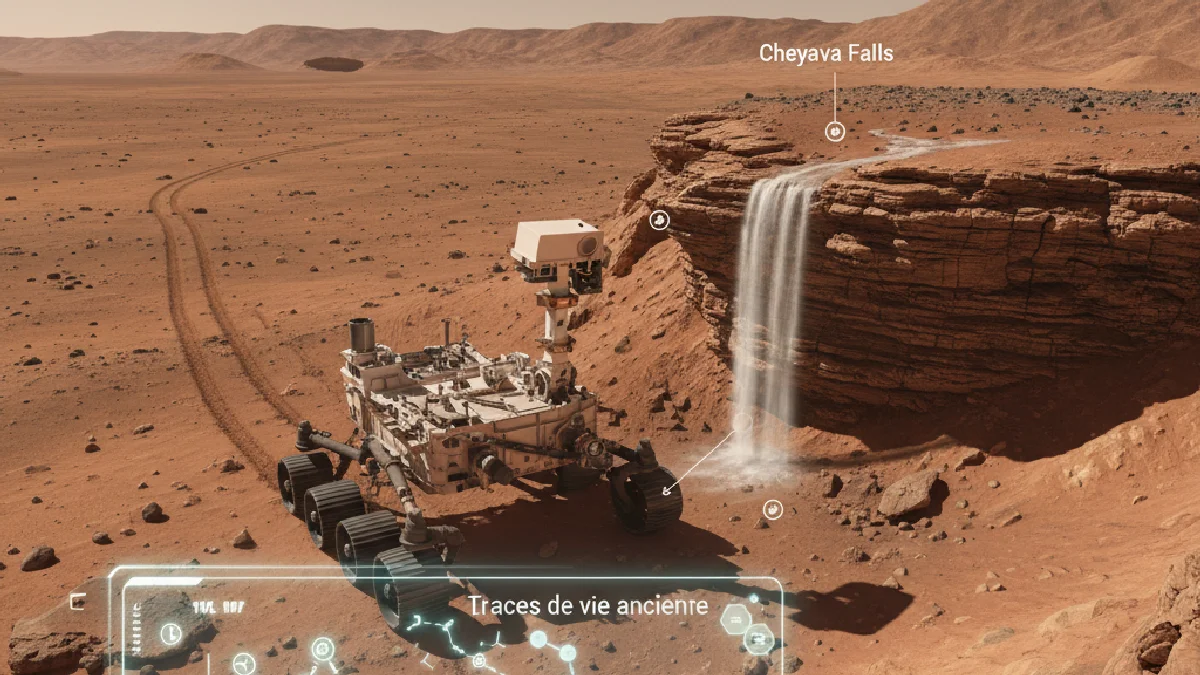
The effectiveness of this multi-instrument approach is perfectly illustrated in the analysis of the "Cheyava Falls" rock, where the different spectrometers revealed intriguing geochemical characteristics suggesting ancient habitable environments.
Comparative Table of Perseverance Instruments
| Instrument | Main Function | Analysis Type |
|---|---|---|
| PIXL | Elemental analysis | X-ray Spectrometry |
| SHERLOC | Organic detection | UV Spectrometry |
| SuperCam | Remote analysis | Laser, spectroscopy |
| MOXIE | Oxygen production | In-situ experiment |
The Sampling Strategy: Preparing for a Historic Return
Perseverance does not merely analyze rocks on site; it methodically prepares for the return of Martian samples to Earth. This sampling mission follows a rigorous protocol developed in collaboration with the European Space Agency (ESA).
The rover has already collected about thirty rock cores stored in hermetically sealed tubes specially designed to preserve the integrity of the samples. These samples target different geological formations within Jezero Crater:
- Mudstones from the bottom of the ancient lake
- Sedimentary conglomerates from the deltas
- Igneous rocks from the crater rim
This geological diversity maximizes the chances of discovering fossilized traces of microorganisms that lived in Mars' aquatic environments 3.6 billion years ago. The Mars Sample Return mission, planned for the 2040s, will retrieve these precious samples for analysis in the most advanced terrestrial laboratories.
Terrestrial analysis will allow the use of techniques impossible to deploy on Mars, such as high-precision isotopic dating or transmission electron microscopy, significantly increasing the chances of detecting potential organic biosignatures.
Promising Discoveries in Jezero Crater
Jezero Crater proves to be an exceptional investigation site for astrobiology. This 45-kilometer-diameter geological formation preserves remarkably well-preserved traces of an ancient lake and river system, offering a unique insight into the environmental conditions of early Mars.
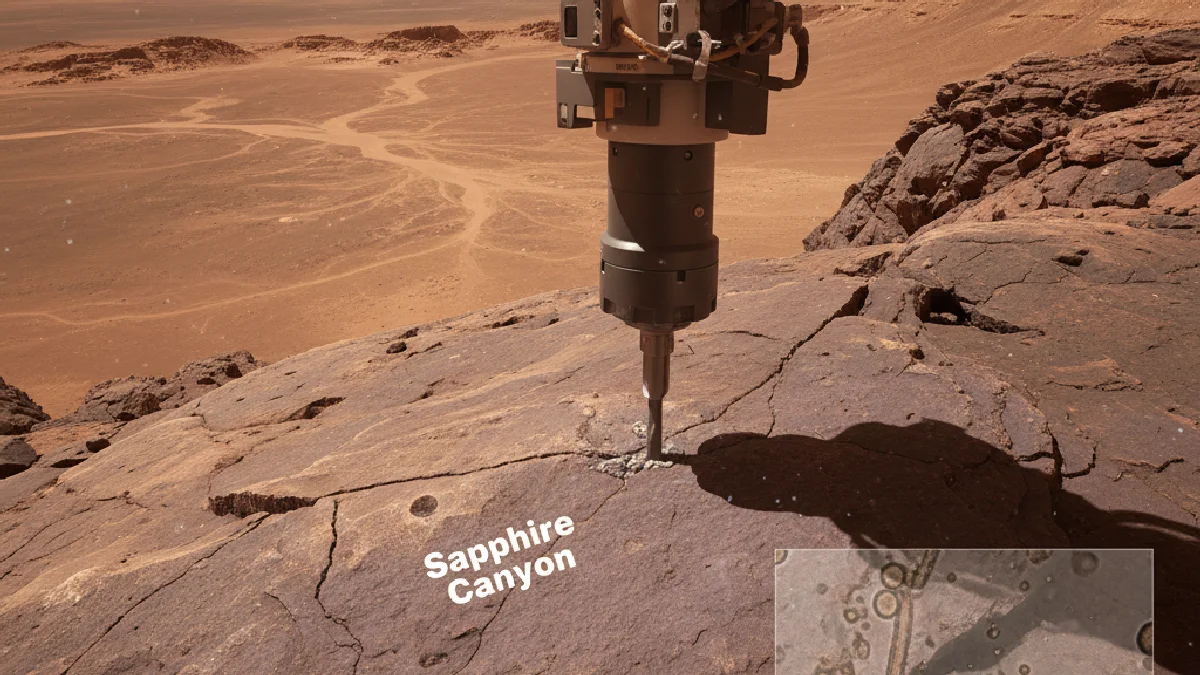
Recent analyses have revealed particularly encouraging discoveries. Rocks in the crater reveal clues of ancient microbial life, particularly in the "Sapphire Canyon" sample taken from the "Cheyava Falls" formation.
This fine-grained mudstone, formed from ancient lake sediments, exhibits intriguing morphological characteristics: annular structures resembling "leopard spots" and dark inclusions that could correspond to ancient fossilized microbial colonies.
Spectroscopic analysis has also identified clay minerals and chemical compounds compatible with the preservation of organic matter, reinforcing the hypothesis of an ancient environment favorable to the development and conservation of primitive life forms.
The Perseverance-Ingenuity Synergy: Exploring from Ground and Air
The Ingenuity helicopter accompanies Perseverance in this scientific quest, bringing a revolutionary aerial dimension to Martian exploration. This collaboration between ground and aerial exploration multiplies investigation capabilities and optimizes the selection of sites of interest.
Ingenuity conducts reconnaissance flights over promising geological formations, identifying areas with the best chances of preserving ancient biosignatures. These overflights also help assess the feasibility of access for Perseverance and optimize routes to priority scientific objectives.
This robotic synergy proves particularly effective for mapping ancient sedimentary deposits and identifying the most interesting rock outcrops from an astrobiological perspective. High-resolution aerial images complement ground analyses, offering a global geological perspective impossible from the surface.
The experience gained with this robotic tandem is already influencing the design of future exploration missions, particularly projects to explore the moons of Jupiter and Saturn where similar environments could harbor life forms.
Future Prospects: Towards an Astrobiological Revolution
Perseverance's exceptional performance opens new perspectives for astrobiological exploration of the solar system. The autonomy technologies developed for this mission serve as a basis for future robotic explorers destined for the most promising extraterrestrial environments. To learn more about NASA's advancements, consult this detailed article.
Upcoming Martian missions will benefit from Perseverance's lessons, particularly in autonomous navigation and in-situ analysis. These technological advancements will enable exploration of more difficult-to-access regions, such as deep canyons or complex geological formations.
The Mars Sample Return mission, currently in preparation, represents the logical culmination of this exploratory approach. The return of samples collected by Perseverance could provide the first definitive proof of the past existence of life on Mars, revolutionizing our understanding of the distribution of life in the universe.
This methodological approach is already influencing projects to explore icy moons like Europa and Enceladus, where subsurface oceans could harbor current ecosystems. Perseverance's technological and scientific legacy will guide these future quests for extraterrestrial life, from Blue Origin's ambitious projects to next-generation interplanetary missions.
Conclusion
Perseverance embodies a new era of autonomous space exploration, combining technological prowess and scientific excellence in the service of the search for extraterrestrial life. Its 40 kilometers of autonomous exploration and its promising discoveries in Jezero Crater bring humanity closer to a historic revelation about our cosmic origins.
The rover's autonomy performance, coupled with its sophisticated analysis capabilities and its collaboration with Ingenuity, sets a new standard for robotic exploration of distant worlds. This revolutionary approach is already influencing the design of future missions to the most promising environments in the solar system.
Perseverance's scientific and technological legacy transcends mere Martian exploration to pave the way for a global understanding of life in the universe, fundamentally transforming our perspective on our place in the cosmos.
FAQ (JSON format - translate question and answer fields only):