Roman Telescope: The Hunt for 100,000 Exoplanets
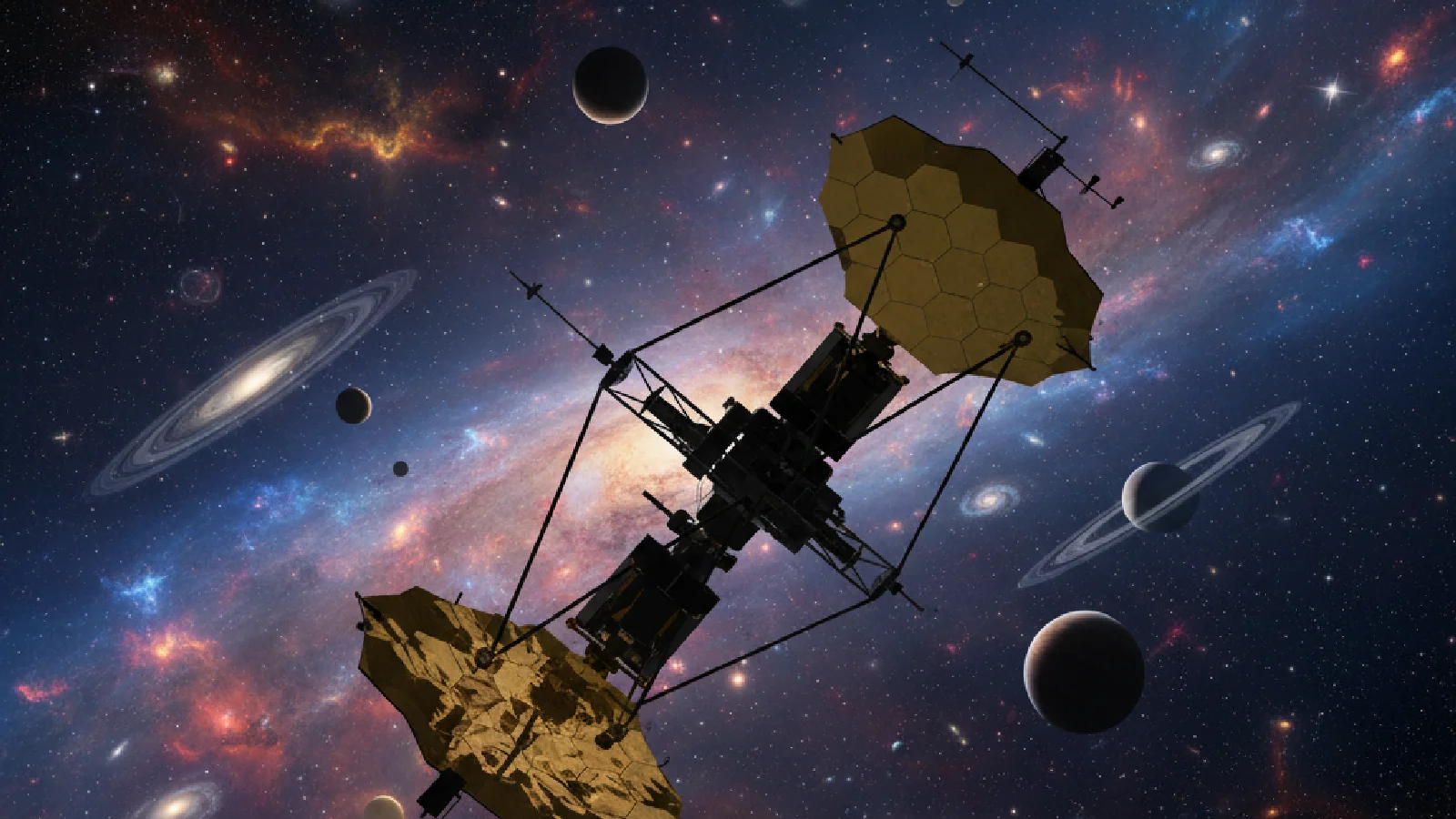
A silent revolution is brewing in space. On November 25, the NASA reached a historic milestone by completing the assembly of the Nancy Grace Roman Space Telescope, also known as Roman. This technological giant, equipped with a 2.4-meter mirror and a field of view 100 times wider than that of the Hubble Telescope, is poised to transform our understanding of the Universe. With a launch planned for autumn 2026, Roman promises to detect approximately 100,000 exoplanets while unraveling the mysteries of dark energy.
An Exceptional Exoplanet Hunter
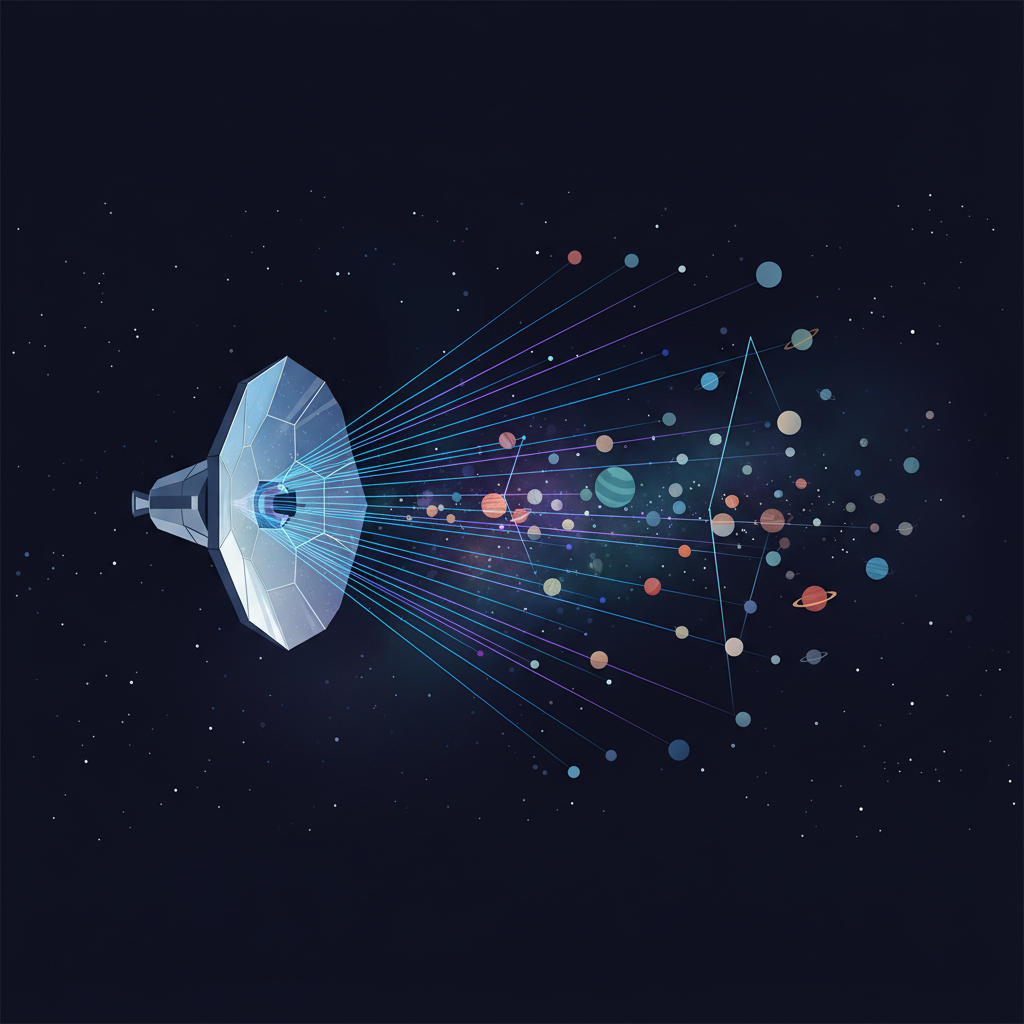
The Roman Telescope revolutionizes exoplanet detection through two complementary approaches. Its ultra-sensitive wide-field camera utilizes the technique of gravitational microlensing to reveal planets invisible by other methods. When a planet passes in front of its host star, it creates a gravitational lensing effect that temporarily amplifies the starlight.
This method allows for the detection of planets located far beyond the habitable zone, including free-floating planets that do not orbit any star. Roman will thus be able to compile an unprecedented statistical census of our galaxy's planetary population.
The telescope also features a state-of-the-art coronagraph capable of directly observing Jovian-type planets around nearby stars. This revolutionary instrument blocks the dazzling light of stars to reveal the faint glow of their planetary companions, paving the way for spectroscopic analysis of their atmospheres.
Unprecedented Capabilities for Characterization
Roman will mark a first in the history of astronomy: the spectroscopic characterization of the atmospheres of sub-Neptunes and super-Earths. These planets, more massive than Earth but less massive than Neptune, represent the most common planetary type in our galaxy according to current NASA data.
The instrument will be able to analyze the chemical composition of planetary atmospheres, detecting the presence of water vapor, methane, or other key molecules. This crucial information will inform us about planetary formation and the conditions conducive to the emergence of life.
Roman: Comparison of Exoplanet Detection Techniques
| Technique | Primary Target | Key Capabilities |
|---|---|---|
| Gravitational Microlensing | Free-floating and distant planets | Detection via gravitational light amplification |
| State-of-the-art Coronagraphy | Nearby Jovian planets | Direct observation by blocking starlight |
The Enigma of Dark Energy Finally Solved?
Beyond the hunt for exoplanets, Roman will dedicate a major part of its observation time to dark cosmology. Dark energy, this mysterious force accelerating the expansion of the Universe, accounts for approximately 68% of the total energy content of the cosmos. Yet, its nature remains one of the greatest enigmas of modern physics.
Roman's high-latitude survey will measure the shape and distribution of several billion galaxies. These observations will allow the use of four complementary techniques to constrain the properties of dark energy:
- Weak gravitational lensing which reveals the distribution of dark matter
- Distance measurements via Type Ia supernovae
- Baryon acoustic oscillations in the distribution of galaxies
- Direct analysis of the large-scale structure of the Universe
"Roman will allow us to trace the history of the Universe's expansion with sufficient precision to test whether it is a cosmological constant or an evolving dynamic," explains the scientific team in the mission's official documents.
A Technological Giant Serving Science
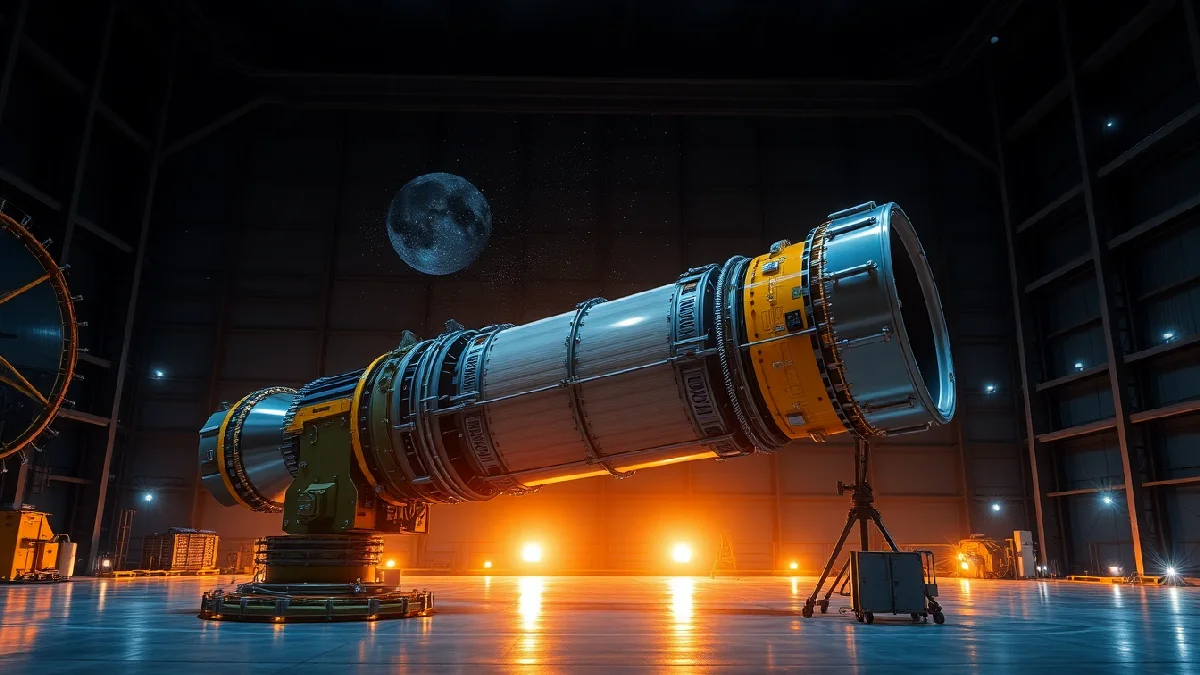
The recent assembly of the telescope in the clean rooms of the Goddard Space Flight Center in Greenbelt marks the culmination of several decades of technological development. Roman combines a 2.4-meter mirror – identical in size to Hubble's – with instruments of unparalleled sophistication.
Its Wide Field Instrument (WFI) offers a field of view of 0.28 square degrees, approximately 200 times larger than Hubble's current infrared camera. This observation capability allows for survey speeds up to 1000 times faster than its predecessor.
The mission also benefits from a strategic orbital position at the L2 Lagrange point, 1.5 million kilometers from Earth. This position offers exceptional thermal stability and an environment free from terrestrial interference, ideal conditions for high-precision observations.
A Revolution for Modern Astronomy
Roman is part of a new generation of space telescopes that will transform our understanding of the Universe. Its unprecedented observation capabilities will allow the study of billions of stars in the Milky Way and neighboring galaxies, providing sufficient statistical samples to answer fundamental questions of modern astrophysics.
The mission will also contribute to the study of stellar populations, galactic evolution, and even small bodies in our solar system. This "big data" approach to astronomy represents a paradigm shift in how cosmological questions are addressed.
The recent integration of the instruments and the telescope paves the way for summer 2025 tests, before the final assembly of the observatory. If all goes according to plan, Roman will soon join the network of space missions exploring the mysteries of the cosmos, alongside future space probes searching for life in the oceans of Europa and Enceladus.
Towards a New Era of Cosmic Exploration
The Roman Telescope represents much more than a simple scientific instrument: it embodies the human ambition to understand our place in the Universe. By combining the search for exoplanets and the study of dark energy, this mission could answer two of the most fundamental questions of our time: are we alone in the Universe, and what is the cosmic destiny of our cosmos?
The coming years will see Roman transform our understanding of astrophysics, opening new chapters in the history of space exploration. With its anticipated 100,000 exoplanets and its revelations about dark energy, this telescope could well mark the beginning of a new era for modern astronomy, comparable to the revolutionary discoveries of massive black hole mergers that are already transforming our view of the Universe.